
A restaurant meal with friends can create more anxiety than the workout itself. You may have trained consistently all week, followed your meals closely, then wonder whether one burger, dessert, or shared Omani dinner erased the entire deficit.
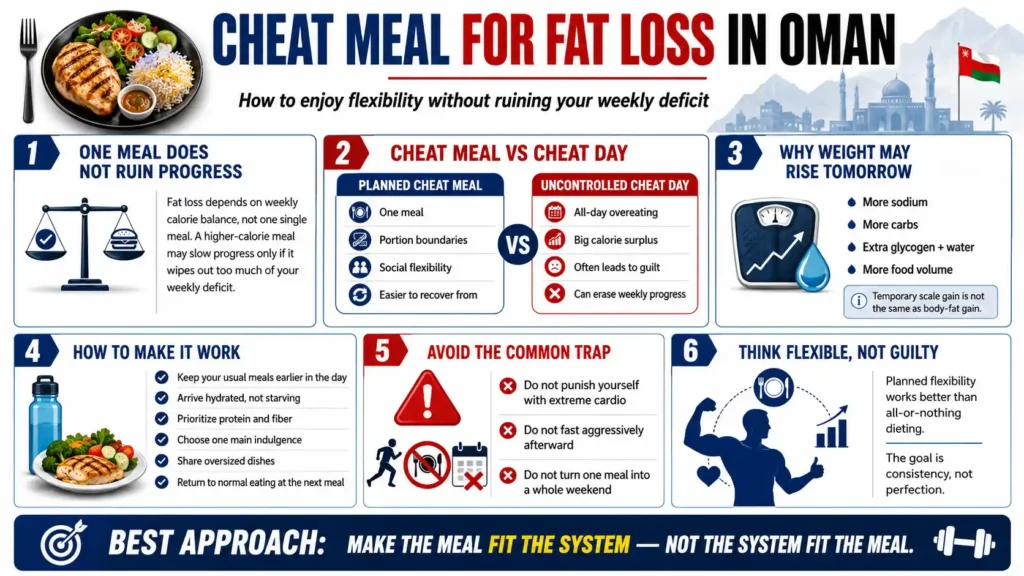
A Cheat Meal for Fat Loss in Oman can fit a successful plan, but it is not a metabolic reset and it is not automatically harmless. Its effect depends on the meal’s energy content, frequency, and what happens afterward. One flexible meal rarely defines progress. A repeated cycle of restriction, overeating, guilt, and compensatory exercise can.
Listen
Does a Cheat Meal for Fat Loss in Oman Stop Progress?
Not necessarily. Fat loss is driven by energy balance across time, not by whether every meal looks “clean.” If average intake still creates a manageable deficit, one higher-calorie meal may only reduce that week’s deficit. If it exceeds several days of planned deficit, progress can slow or stop.
This is why the wider fat-loss system matters more than the label. A person who understands sustainable fat loss in Oman evaluates weekly eating, strength training, movement, sleep, and adherence together instead of judging one dinner in isolation.
Scale weight may rise the next morning because restaurant meals often contain more carbohydrate, sodium, and food volume. That can increase glycogen, water retention, and digestive contents rather than representing equivalent overnight fat gain.
Cheat Meal, Refeed, Diet Break, or Loss of Control?
A planned flexible meal has boundaries. A refeed or diet break is more structured, while an uncontrolled cheat day may continue for hours.
| Approach | Structure | Potential value | Main risk |
|---|---|---|---|
| Planned flexible meal | One selected meal | Social flexibility | Portion creep |
| Refeed | Planned calorie increase with targets | Training fuel or dietary relief | Becoming unrestricted |
| Diet break | Several days or longer near maintenance | Break from prolonged restriction | Losing structure |
| Cheat day | Unrestricted eating for most of a day | Perceived mental break | Erasing the weekly deficit |
| Binge-like episode | Loss of control and distress | No reliable fat-loss benefit | Harmful pattern requiring support |
The key distinction is control. A planned meal is a decision inside the program. A binge-like episode feels difficult to stop and may involve distress. It should not be normalized as a fitness tactic.
What Research Says About the Diet Cheat Impact
Evidence does not support promising that a cheat meal will “boost metabolism,” preserve muscle, or improve performance. A 2025 scoping review found only eight eligible articles and reported mixed physiological findings.
“the evidence on the retention of lean mass, the attenuation of metabolic adaptation, or the improvement in exercise performance during weight reduction was mixed.”
Jaclyn Hei Tsang et al., nutrition and sports science researchers — Nutrition Reviews
The practical interpretation is conservative: a Cheat Meal for Fat Loss in Oman should provide flexibility, not act as a biological shortcut. The fundamentals in a realistic metabolism strategy—adequate protein, resistance training, daily movement, recovery, and an appropriate deficit—matter more.
Flexibility can therefore be compatible with progress, but it is not automatically superior. Structure still decides the outcome.
The Weekly Deficit Shows the Meal’s Real Effect
Consider a simplified example. Someone creates an estimated 400-calorie daily deficit for six days, producing 2,400 calories of planned weekly deficit. If one restaurant meal adds 1,500 calories above usual intake, the remaining deficit becomes much smaller. Progress may still occur, but more slowly.
This illustrates direction, not exact fat gain; weight change adapts over time and calorie estimates are imperfect.
The diet cheat impact becomes larger when the meal expands into a day, liquid calories and sauces go unnoticed, or earlier meals are skipped to “save calories.” The aftermath matters too. Guilt may trigger fasting or punishing cardio, followed by another overeating episode.

Planned Flexibility Beats Food Guilt
Calling food “cheating” can create an all-or-nothing mindset: the diet is either perfect or broken. A more useful approach is flexible restraint—maintaining boundaries while allowing selected foods and social meals.
“Explicitly encouraging flexible restraint may be important in preventing and treating obesity.”
Joachim Westenhoefer et al., health-science researchers — Eating Behaviors
Flexible does not mean vague. Decide the meal, approximate portion, frequency, and return point. This connects with fitness psychology and consistency: after a higher-calorie meal, do not wait for a new week or slash food intake. Resume normal hydration, protein, vegetables, regular meals, and the next scheduled workout.
People who experience recurrent loss of control, distress around food, purging, compulsive compensation, or binge-eating symptoms should seek an appropriately qualified healthcare professional. A cheat-meal strategy is not treatment for an eating disorder.
How to Plan a Higher-Calorie Meal in Muscat

Muscat’s restaurant culture and family meals can fit fat loss when the meal is planned rather than treated as a free-for-all. Make a few high-impact decisions before hunger and social momentum take over:
- Keep your usual meal pattern earlier in the day; do not starve to save calories.
- Include protein and fiber so you do not arrive excessively hungry.
- Choose the main indulgence instead of automatically having starters, a large main, sweet drinks, and dessert.
- Share dishes when portions are large.
- Drink water, especially after heat exposure or training.
- Resume normal eating at the next meal.
In Oman, thirst and heat fatigue can be confused with hunger. The local hydration guide explains changing fluid needs; water does not neutralize calories, but dehydration can complicate appetite and training.
Do Not Use Training to Repay the Meal
Exercise supports fat loss and health. It should not become punishment for eating. Adding random hours of cardio after a large meal can increase fatigue without fixing the behavior that created the problem.
Keep the program stable with progressive resistance training, planned conditioning, and daily movement. The guides to effective fat-burning exercises and a structured morning routine show how to increase weekly activity without turning every session into a calorie emergency.
Avoid reducing food aggressively while also increasing training volume. Review common gym mistakes before changing several variables at once. A higher-carbohydrate meal may make the next workout feel stronger, but that does not prove it accelerated fat loss. Judge the system through multiweek trends in weight, waist, performance, hunger, and consistency.
Decide Whether Cheat Meals Belong in Your Plan
A Cheat Meal for Fat Loss in Oman may be workable when it is occasional, planned, satisfying, and followed by an immediate return to normal habits. It is less useful when the word “cheat” creates guilt, secrecy, loss of control, or repeated overrestriction.
Ask whether you can choose the meal in advance, stop when comfortably satisfied, resume normal eating afterward, and maintain appropriate weight, waist, performance, and adherence trends. If not, remove the cheat-meal format. Small enjoyable foods included regularly or a defined maintenance-calorie meal may work better.
A broader healthy lifestyle approach in Oman can help connect food decisions with movement, sleep, stress, and long-term behavior.

Make the Meal Fit the System
The correct question is not, “Am I allowed a cheat meal?” Ask whether the meal supports a plan you can maintain and whether its size fits the weekly target.
A Cheat Meal for Fat Loss in Oman works best as planned flexibility—not a metabolism hack, a reward for suffering, or permission to lose control. Keep the boundary clear, return to normal at the next meal, and assess progress over several weeks.
If restaurant meals, appetite, training, and calorie targets keep conflicting, contact 5D Fitness to discuss structured coaching built around your schedule, current fitness, and realistic fat-loss goal in Muscat.
FAQ
Not automatically. Its effect depends on the meal’s calorie surplus and whether your weekly intake still maintains a deficit.
There is no universal frequency. Use it only when progress, appetite, training, and eating control remain stable.
Usually no. Resume your normal meal pattern, hydration, and training instead of using extreme restriction to compensate.
Evidence is insufficient. Any short-term metabolic change does not guarantee greater body-fat loss over time.
Extra sodium, carbohydrate, water, and food volume can raise scale weight temporarily without representing equivalent fat gain.
Usually. A full unrestricted day can create a much larger surplus and erase more of the weekly deficit.
No specific food is required. Choose a satisfying meal with clear portions and return to normal eating afterward.
It may improve glycogen availability and perceived energy, but stronger performance does not prove faster fat loss.
Avoid arriving starved, prioritize protein, choose one main indulgence, drink water, and stop when comfortably satisfied.
Avoid it when it triggers loss of control, distress, binge eating, purging, or compulsive exercise; seek qualified support.