
A 6:00 AM alarm, an empty stomach, and forty minutes of sweating can feel like the perfect fat-loss formula. Then the scale barely moves. Is the routine wrong, or does morning exercise simply not burn fat the way social media promises?
A Fat Burning Morning Routine in Oman can be highly effective, but not because sunrise unlocks a secret metabolic window. It works when the routine helps you train consistently, increase weekly energy expenditure, use resistance training, and organize the day around sensible nutrition and recovery. For people in Muscat, it can also remove late-day excuses created by work and hotter outdoor conditions.
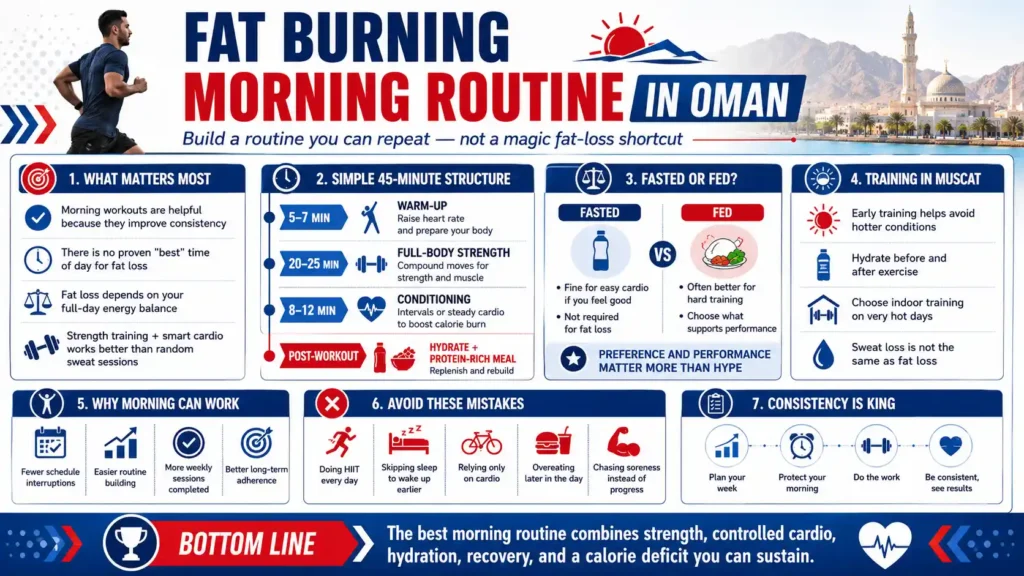
Stop treating “fat burning” as a sensation. Sweat, breathlessness, and training before breakfast can feel intense without guaranteeing body-fat reduction. Sustainable transformation comes from a repeatable system. This explains many common fat-loss mistakes that stall progress even when someone believes they are working hard.
Listen
Why Morning Workouts Can Help Fat Loss—Without Being Magic
Morning exercise is not automatically superior to afternoon or evening exercise for fat loss. Its strongest advantage is often behavioral: the workout happens before the day becomes crowded. If that timing helps you complete more planned sessions over months, it can become a powerful transformation tool.
A 2023 randomized controlled trial assigned inactive adults with overweight or obesity to morning exercise, evening exercise, or a control group. Both exercise groups lost a modest amount of weight and improved cardiorespiratory fitness. The researchers did not find a clear time-of-day winner.
“there does not appear to be an optimal time to exercise.”
Paige G. Brooker et al., human movement and nutrition researchers — Obesity
That changes the question. Instead of asking, “What time burns the most fat?” ask, “What training window can I protect every week?”
Coaches often see the same pattern: a member plans to train after work, a meeting runs late, and the session disappears. An early morning workout in Oman can reduce those competing decisions.

Research on successful weight-loss maintainers has found that greater consistency in exercise timing was associated with higher moderate-to-vigorous physical activity. That is an association, not proof that a fixed clock time causes fat loss. Still, routines can be easier to repeat when fewer decisions are required. This connects with building workout discipline instead of relying on motivation.
The Fat-Burning Part Happens Across Your Whole Day
A hard morning session can increase energy expenditure, but body-fat change is driven by the larger energy balance created across days and weeks. If training burns calories and the rest of the day repeatedly replaces them through oversized portions, liquid calories, or uncontrolled snacking, the morning routine cannot compensate forever.
Energy deficit still does the heavy lifting
For fat loss, the routine should support a manageable energy deficit rather than become punishment for eating. The deficit should suit the individual, training load, body size, and recovery capacity. An aggressive approach may increase hunger, fatigue, and poor training quality.
This is why a sensible calorie deficit for fat loss in Oman should work with the training plan. Your gym session creates a stimulus. Your daily intake determines whether the body is consistently placed in an environment that supports weight reduction.
Use trends rather than one morning weigh-in. If performance is improving, hunger is manageable, and body-weight or waist trends move gradually over several weeks, the system may be productive. Constant exhaustion, falling strength, and uncontrolled evening eating are not automatic reasons to add more cardio.
Fasted does not automatically mean faster fat loss
Training before breakfast can increase fat use during a particular exercise bout, but burning more fat during the session is not the same as losing more body fat over time.
In a randomized study of young women following hypocaloric diets, both fasted and fed aerobic groups lost weight and fat mass. There were no significant between-group differences in the measured body-composition outcomes.
“Hence, those seeking to lose body fat conceivably can choose to train either before or after eating based on preference.”
Brad Jon Schoenfeld et al., exercise science researchers — Journal of the International Society of Sports Nutrition
If a fasted walk feels comfortable, there is no need to force breakfast first. If strength work feels weak without food, a small pre-workout meal may improve training quality. Preference, tolerance, workout intensity, and the total diet matter more than turning fasting into a rule.
A 45-Minute Fat Burning Morning Routine in Oman
The most useful Fat Burning Morning Routine in Oman combines movement preparation, resistance training, and a controlled conditioning block. It should increase energy expenditure while preserving enough quality to progress. For many people, 45 minutes of structured work is more useful than 90 minutes of random exercises.

1. Prime the body for 5–7 minutes
Morning stiffness is common. Start by increasing temperature and rehearsing the movement patterns you will use.
A practical warm-up may include:
- 2 minutes of brisk treadmill walking, cycling, or rowing
- 8–10 bodyweight squats
- 6–8 reverse lunges per side
- 8 controlled hip hinges
- 10 band rows or light cable rows
- 20–30 seconds of faster cardio before the first working set
The warm-up is for readiness, so the productive work can be performed with better control.
2. Use full-body strength for 20–25 minutes
Choose four or five exercises that train large muscle groups and can be progressed. A beginner does not need a new circuit every morning. Repetition improves technique and load tracking.
A simple session could use:
- Goblet squat or leg press — 3 sets of 8–12 reps
- Dumbbell bench press or chest press — 3 sets of 8–12 reps
- Lat pulldown or supported row — 3 sets of 8–12 reps
- Romanian deadlift or hip hinge variation — 3 sets of 8–10 reps
- Plank, carry, or cable anti-rotation exercise — 2–3 controlled sets
Rest long enough to keep repetition quality high, often around 60–90 seconds. A well-structured full-body workout is practical for busy people because each session covers major movement patterns without requiring a six-day split.
3. Finish with 8–12 minutes of conditioning
The conditioning block should complement strength training. Choose one machine or simple movement pattern and use a repeatable format.
For example, on a bike or rower:
- 40 seconds at a challenging but controlled pace
- 80 seconds easy
- Repeat for 5 rounds
A fitter trainee might use harder intervals; a beginner may use brisk incline walking. Review how HIIT training can fit a weight-loss plan rather than assuming every morning must become an all-out interval session.
| Morning approach | Main value | Best suited to | Common mistake |
|---|---|---|---|
| Strength + short conditioning | Muscle stimulus plus energy expenditure | Most general fat-loss clients | Turning the finisher into punishment |
| Steady brisk cardio | Simple, repeatable aerobic work | Beginners and recovery days | Assuming sweat equals faster fat loss |
| HIIT | Time-efficient high-intensity conditioning | Trained people with adequate recovery | Using it daily |
| Fasted low-intensity cardio | Convenient for people comfortable without food | Walking, cycling, easy aerobic work | Believing fasting creates automatic extra fat loss |
| Random exercise circuit | Variety and high perceived effort | Occasional novelty | No progression or load tracking |
The best choice is the one you can recover from, measure, and progressively improve.
Strength Before Sweat: A Better Transformation Strategy
Many people chasing fat loss still treat resistance training as optional because the treadmill calorie display feels directly connected to the goal. Yet transformation is not only about making body weight smaller; body composition and training capacity matter too.
A four-month randomized trial in premenopausal women compared diet, resistance training, resistance training plus diet, and control conditions. All three intervention groups reduced fat mass, with the steepest reduction in the resistance-training-plus-diet group. The resistance-training-only group also showed a significant increase in lean mass.
Strength training does not “turn fat into muscle”; the tissues are different. It provides a training stimulus while the broader nutrition plan supports fat reduction.
For a person using a Fat Burning Morning Routine in Oman, strength work also creates objective markers. You can track reps, loads, exercise control, and work capacity. This is easier to coach than a vague instruction to “burn 500 calories before breakfast.”
Squats, presses, rows, hinges, split squats, loaded carries, and machine-based compound movements can all be useful. Exercise selection should match training history, movement skill, equipment, and relevant limitations. The principles in structured strength training in Oman matter here: stable technique first, then gradual progression.
A coach may reduce exercise variety when someone is not progressing. It feels less exciting, but makes the program measurable. If movement quality improves and loads rise gradually, you have a training process. Random “fat burner” workouts rarely give that clarity.
Breakfast or Fasted Training? Decide by Performance, Not Hype
The best pre-workout nutrition strategy is the one that lets you complete the planned session without unnecessary digestive discomfort or excessive hunger later. There is no requirement to train fasted simply because the workout happens in the morning.

Many people handle an easy walk or low-intensity ride with water and breakfast afterward. Heavier resistance training or hard conditioning may feel better after a small, familiar meal.
Practical options include:
- Banana with yogurt
- Toast with eggs
- Oats with a moderate protein source
- A small smoothie with fruit and protein
You do not need a special “fat-burning” drink. Do not introduce a new supplement, large meal, or extreme fasting rule before a demanding workout and expect stable performance.
After training, return to the priorities: adequate protein, sensible total energy intake, fiber-rich foods, and meals that fit your day. If you prefer longer fasting windows, the pattern still needs to support training quality and dietary control. The guide to intermittent fasting and fat loss can help you compare that structure with your actual routine rather than treating fasting as a shortcut.
Muscat Changes the Routine: Heat, Hydration, and Timing
A morning routine in Muscat has a practical advantage during hotter periods: it can place outdoor activity earlier in the day, before the most demanding heat. This is a safety and comfort issue, not a metabolic fat-burning hack.

The CDC advises people exercising in hot conditions to schedule activity earlier or later when temperatures are cooler, start slowly, and drink more water than usual. It also advises stopping activity and moving to a cool place if you feel faint or weak.
For outdoor walking, easy running, or beach-based conditioning, planning matters. The guide to training outside in Muscat covers local options and environment-aware programming in more detail. On very hot mornings, a climate-controlled gym may be the smarter choice for intervals, heavy strength work, or longer sessions.
A practical sequence is simple: wake, drink water, assess how you feel, decide whether food is needed, choose indoor or outdoor training, then rehydrate and eat according to the wider plan. Heavy sweaters may need a different hydration approach from someone completing a short air-conditioned session.
Do not use a soaked T-shirt as proof that the workout “melted fat.” Heat and sweat can cause short-term fluid loss, which may move the scale temporarily. That is not the same as losing body fat.
The Routine Only Works If You Can Repeat It
The first week is rarely the problem. The real test arrives in week three, when sleep is inconsistent, work is busy, and the novelty disappears.
This is where a Fat Burning Morning Routine in Oman should become simpler, not more extreme. For many beginners, three structured morning sessions plus additional walking is more sustainable than seven hard workouts.
One earlier analysis of a 10-month supervised exercise program found greater weight loss among people classified as early exercisers than late exercisers. The researchers were careful about the interpretation.
“Although the mechanisms are unclear, the timing of exercise may be important for body weight regulation.”
Erik A. Willis et al., exercise and obesity researchers — International Journal of Obesity
The evidence should not be turned into “morning burns more fat.” The later randomized trial found no optimal exercise time. Timing may interact with behavior and energy balance, while consistency remains central.

Sleep belongs here too. A controlled weight-loss study found that recurrent sleep restriction changed the composition of weight loss, with a smaller proportion coming from fat. If waking early means cutting sleep night after night, recovery and training quality may suffer. Improving your sleep schedule for training may be more useful than forcing a 5:00 AM alarm you cannot sustain.
Watch for signs that the routine needs adjustment:
- Strength is declining for several sessions
- Resting fatigue is rising
- You are skipping more workouts than you complete
- Morning training triggers uncontrolled evening eating
- Soreness is persistent rather than resolving
- You feel faint, unusually weak, or unwell during heat exposure
Persistent pain, concerning symptoms, or repeated dizziness should be assessed by a healthcare professional. For normal fatigue, reduce volume, adjust intensity, and strengthen your post-workout recovery habits before adding more work.
Make the Morning Routine Serve the Transformation
The strongest fat-loss routine is not the one with the most burpees, longest fast, or earliest alarm. It creates enough training stimulus and weekly activity while still allowing sensible eating and recovery.
Start with three or four planned mornings. Build each session around a short warm-up, progressive full-body resistance training, and a controlled conditioning block. Use fasted training only when it suits your preference and performance. In Muscat’s hotter periods, make timing, hydration, and indoor-versus-outdoor choice part of the plan.
A Fat Burning Morning Routine in Oman becomes effective when it is connected to the rest of the transformation system: an appropriate calorie deficit, sufficient protein, regular movement, recovery, and progressive training. If your current routine feels random or you keep restarting every few weeks, discuss your goal and training history with a qualified coach. A structured plan at 5D Fitness can help turn “morning exercise” into a measurable program built around your schedule, recovery, and fat-loss target.
FAQ
Not automatically. Morning training can support fat loss when it improves consistency, weekly activity, and adherence to a suitable calorie deficit.
A mix of full-body resistance training and short controlled conditioning is practical because it supports training quality and energy expenditure.
No. Fasted and fed training can both work. Choose the option that supports comfort, performance, and your overall nutrition plan.
A structured 30–60 minute session can be effective. Quality, progression, and weekly frequency matter more than simply exercising longer.
Usually no. Daily HIIT can create excessive fatigue. Mix hard conditioning with strength training, walking, easier cardio, and recovery.
Use familiar, easy-to-digest food if needed, such as fruit, yogurt, oats, eggs, or toast, depending on session intensity.
Early training can be more practical for outdoor exercise because cooler times reduce heat exposure. Very hot conditions may favor indoor training.
Many beginners can start with three structured sessions, then adjust frequency according to recovery, schedule, and progress.
Common reasons include an inconsistent calorie deficit, low daily activity, poor sleep, weak recovery, or a routine with no measurable progression.
Yes. Resistance training can support body-composition goals and provides measurable progression. Pair it with suitable nutrition and overall activity.