
You promised yourself you would train four times this week. Sunday went well. Monday became busy. By Wednesday, the gym bag was still in the car and one thought appeared: I have lost my motivation again.
That conclusion is often too harsh. Fitness Psychology helps explain why consistency is not simply a test of how badly you want results. Motivation changes with mood, stress, sleep, workload and immediate reward. The more useful question is not, “How can I feel motivated every day?” It is, “How can I keep training when motivation feels ordinary?”
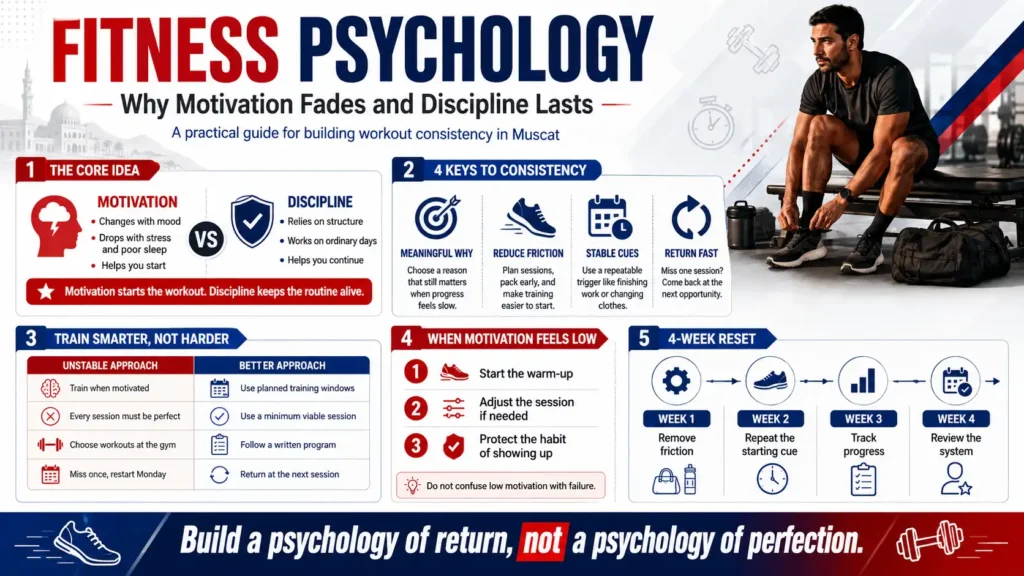
For people training in Muscat, work schedules, family commitments, traffic, hot months and Ramadan can all affect routine. A serious fitness system must survive real life. Understanding fitness motivation and workout discipline can help prevent one difficult day from becoming a lost month.
Listen
Motivation Is a Spark, Not a Training System
Motivation can help you start exercising, but it is unreliable as the only engine of long-term training. You can genuinely want fat loss, greater strength or more energy and still skip the gym when going home feels immediately easier.
This is one reason Fitness Psychology matters. Exercise asks for effort now, while many desirable results arrive later. A productive workout may improve your training process today, but visible body-composition changes or major strength gains require repeated sessions.
“We’re built to want instant gratification over delayed reward”
Katy Milkman, PhD, Wharton professor — Penn CHIBE
On a high-energy day, the future reward feels worth the effort. After poor sleep or a demanding workday, the sofa may win. That does not automatically mean your goal has disappeared.
Why chasing more motivation can fail
A common response to inconsistency is emotional pressure: set a harder target, watch more transformation content and promise never to miss another session. Attendance may improve briefly, but the surge often fades.
Exercise research distinguishes between controlled reasons, such as guilt or external pressure, and more autonomous reasons that feel personally chosen or genuinely valuable. Research based on self-determination theory has generally linked more autonomous motivation with stronger exercise participation and persistence.
There is nothing wrong with wanting to lose weight, look sharper for an event or improve sports performance. The problem begins when your entire relationship with training depends on one distant result.

The Reason You Return Matters More Than a Motivational Slogan
A useful “why” is not a dramatic quote on a gym wall. It is a reason for training that still matters when progress feels slow. Fitness psychology becomes practical when exercise connects with something you genuinely value.
For one person, the reason may be feeling physically capable. Another may want more stamina for squash or padel. A busy professional may value the mental separation between work and home that a focused training session creates.
Enjoyment also matters. Someone who strongly dislikes long treadmill workouts does not need to build an entire fitness identity around a treadmill. Resistance training, swimming, squash or a structured full-body workout routine may create a better match between the goal and the person.
Ask three practical questions: What benefit of training can I notice this week? Which style of exercise makes me feel more capable? Which part of my goal is genuinely mine rather than pressure from someone else?
Answers such as “I think more clearly after training” or “I want to feel stronger in daily life” may sound less dramatic than a transformation promise. Psychologically, they can be more useful because the reward feels closer.
Make Training Easier to Start
Discipline becomes more reliable when fewer decisions are required at the moment of action. The objective is not to make the workout physically easy. It is to make starting psychologically simple.

Habit research is useful here. Repeating a behavior around stable cues can increase automaticity and reduce the amount of conscious negotiation required every time you plan to train.
“But if you can make physical activity habitual, being active becomes a lot easier.”
David Conroy, kinesiology researcher — Penn State
Use a cue, a minimum action and a return rule
Suppose you train after work in Muscat. Your cue may be closing the laptop. Your minimum action is arriving at the gym and completing the warm-up. Your return rule is simple: if you miss a session, you train at the next planned opportunity rather than waiting for Monday.
This system is stronger than “I will exercise when I feel focused.” It is especially useful for beginners who need a clear gym routine with realistic progression instead of deciding on exercises, sets and intensity every day.
| Unstable approach | More repeatable approach | Psychological advantage |
|---|---|---|
| Train when motivated | Use planned training windows | Less mood-based negotiation |
| Every workout must be perfect | Use a minimum viable session | Protects continuity |
| Choose exercises at the gym | Follow a written program | Reduces decision friction |
| Miss once and restart Monday | Return at the next opportunity | Stops a longer break |
| Track only body weight | Track attendance and performance | Creates more evidence of progress |
A large Nature megastudy involving 61,293 gym members tested different behavior-change interventions. Many approaches improved gym attendance during the intervention period, but sustained behavior change was harder to produce. One especially useful lesson was the value of getting people to return after a missed workout.
Do not build a psychology of perfection. Build a psychology of return.
Discipline Should Not Become Self-Punishment
Workout discipline means following useful training decisions when mood is not ideal. It does not mean ignoring pain, exhaustion or every competing responsibility. Good discipline still requires judgment.
Coaches often see members respond to guilt with extreme behavior. Someone misses two workouts and tries to train seven days consecutively. Another notices weaker performance for several sessions and adds more intensity because they believe suffering proves commitment.
Those reactions can make the problem worse. Persistent fatigue, declining performance and reduced enthusiasm may require a closer look at overtraining symptoms and gym burnout. Understanding why rest days matter for training quality also helps separate intelligent recovery from simple avoidance.
- Full session: follow the program when readiness feels normal.
- Adjusted session: reduce load, volume or conditioning when temporary fatigue is high.
- Recovery decision: rest or seek appropriate professional advice when pain, illness or concerning symptoms make training unsuitable.
This removes the false choice between “crush the workout” and “do nothing.” One imperfect week also stops becoming an identity statement such as “I am lazy” or “I always quit.”
Muscat Lifestyle Changes the Consistency Equation
A training program can be scientifically sensible and psychologically unrealistic. In Muscat, consistency may depend on work hours, driving, family responsibilities, summer heat, sleep timing and Ramadan schedule changes.
These factors do not remove personal responsibility. They change the environment in which your plan must work. The smarter approach is to design around predictable friction.
A member may schedule five evening workouts despite knowing two evenings are regularly consumed by work or family commitments. Calling those interruptions “unexpected” every week is a planning problem. Three protected sessions and one flexible backup workout may produce more training across three months.
The same principle applies to workout timing. A structured morning training routine can work when morning is the time you can protect. It is not automatically superior because early workouts look more disciplined.
Sleep also affects how training feels. A normal workout may feel unusually difficult when recovery is poor. Before assuming you have lost motivation, review sleep habits that support muscle growth and recovery.
Ramadan, travel and intense work periods may require a temporary version of your normal routine. Reducing training frequency or volume can be more productive than disappearing until life becomes easy. Plan the adjustment and decide when you will review the normal program.
Coaching and Feedback Can Strengthen Exercise Adherence

People do not train in a psychological vacuum. Coaches, training partners and feedback systems influence whether exercise feels confusing or purposeful. Clear programming can support confidence because the member understands what they are trying to improve.
Random workouts may weaken motivation when progress is difficult to measure. A structured plan can turn vague effort into specific evidence: one extra repetition with the same load, better squat control or improved consistency across working sets.
Technology may also support the process. The discussion around AI fitness coaching and human guidance is relevant because data can help reveal patterns. However, numbers still need context and sensible interpretation.
Your social environment can change training behavior
Training around other people may provide accountability, social support and a sense that exercise is a normal part of the week. Competition can also increase effort for some personalities.
“However, when done right, we found that social media can increase people’s fitness dramatically.”
Damon Centola, PhD, study author — Penn CHIBE
The phrase “when done right” matters. Not every challenge, leaderboard or group environment helps everyone. Some members enjoy competition. Others respond better to private performance measures, calm coaching and more autonomy.
At 5D Fitness, professional coaching can go beyond counting repetitions. A clearer program, visible progression and feedback on movement quality may reduce uncertainty and help members make better decisions when difficult weeks appear.
Try a Four-Week Fitness Psychology Reset
If your motivation has become inconsistent, do not automatically choose a more extreme goal. Use four weeks to test the system surrounding your training.

Week 1: Remove friction
Choose realistic training windows, place them in your calendar and prepare your gym clothes before the first session. Follow a written workout. The goal is to reduce last-minute decisions.
Week 2: Repeat the starting cue
Create a recognizable pre-training sequence. Finish work, change clothes, arrive and start the warm-up. The schedule can remain flexible enough for real life while still creating contextual consistency.
Week 3: Collect evidence of progress
Track completed sessions, one performance measure and one subjective marker such as energy or confidence. Do not rely only on scale weight. An extra repetition or better movement control is still evidence of competence.
Week 4: Review the system
Look at the sessions you repeatedly missed. Was the main barrier timing, poor recovery, workout length, boredom or a confusing program? Change the largest source of friction instead of judging your personality.
- Attendance is low: simplify the schedule before searching for more motivation.
- Attendance is good but performance is falling: review sleep, load and post-workout recovery habits.
- Boredom is high: keep the objective but review exercise or sport selection.
- The program feels confusing: get coaching input instead of adding random workouts.
You Do Not Need to Feel Motivated Every Day
The strongest training mindset is not permanent excitement. It is the ability to continue through normal changes in mood while still respecting recovery and real-life constraints.
Fitness Psychology offers a practical framework: choose meaningful reasons, reduce friction, create stable cues, measure progress and return quickly after missed sessions. Motivation can open the door. Discipline helps you act. Habits make the route more familiar.
If your training in Muscat repeatedly cycles between intense starts and long breaks, stop demanding more willpower before reviewing the structure. A coach at 5D Fitness can help assess your training habits, progression and consistency barriers, then build a clearer plan around your actual schedule. The next step does not need to be a dramatic promise. It needs to be a system you can return to.
FAQ
Fitness Psychology examines how motivation, habits, emotions, beliefs and environment influence exercise behavior and long-term training consistency.
Motivation changes with stress, sleep, mood and workload. A structured routine reduces dependence on feeling motivated every day.
Discipline is usually more reliable for consistency, but meaningful goals, habits and sensible planning help make disciplined action easier.
Use stable cues, planned sessions and a clear workout. After missing training, return at the next realistic opportunity.
Start with the warm-up or a shorter planned session. Adjust for fatigue, but do not ignore pain, illness or concerning symptoms.
A qualified coach can clarify goals, structure progression, provide feedback and reduce decision fatigue around training.
It can. Training partners may increase accountability, enjoyment and social support, although individual preferences still matter.
Protect realistic training windows, plan a flexible backup session and build workouts around actual work and family commitments.
No. Discipline includes following planned recovery. Training frequency should match your goals, program, experience and recovery capacity.
There is no universal deadline. Focus on repetition, recognizable cues and returning quickly after disruptions rather than chasing a specific date.