
You arrive with a plan to work hard, but halfway through the session you are copying someone else’s exercise, rushing your rest periods, and adding weight because the previous set “felt easy.” The workout feels intense. The next day you are sore. Yet after several weeks, your strength, technique, and confidence have barely moved.
That pattern explains many Gym Mistakes in Oman. The problem is rarely a lack of effort. More often, effort is being spent without a repeatable program, reliable technique, or enough recovery to turn training stress into adaptation. Beginners are especially vulnerable because almost every exercise, machine, and social-media routine looks plausible.
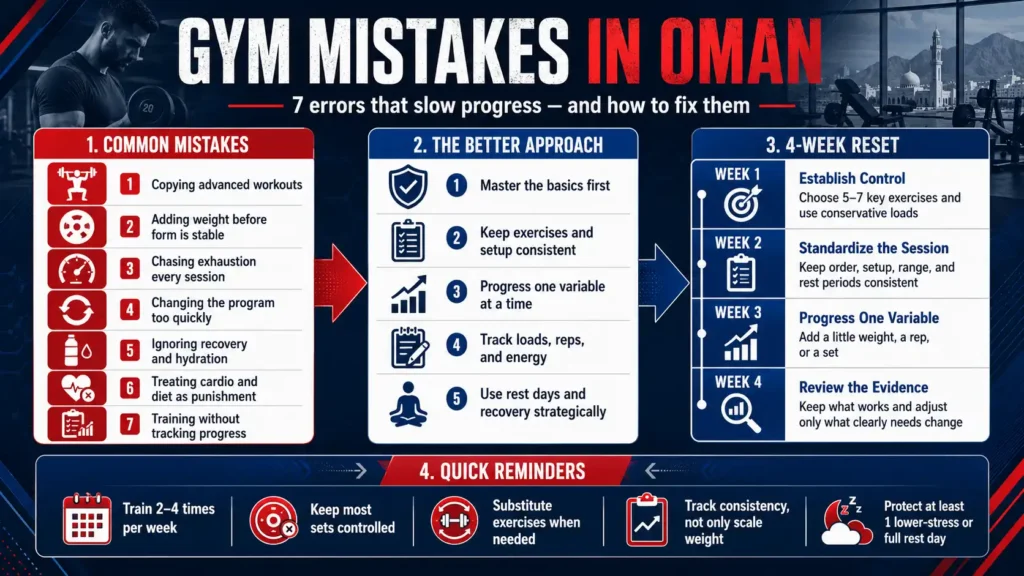
The most productive correction is not to train harder immediately. It is to make each session easier to evaluate: know the purpose of the exercise, use a load you can control, record performance, and recover well enough to repeat quality work. This guide breaks down the beginner gym errors that most often waste time or create avoidable setbacks in Muscat.
Listen
Being New Is Not the Problem; Training Without Feedback Is
A beginner does not need perfect biomechanics, advanced periodization, or a complicated supplement stack. A beginner needs a small number of movements, clear performance targets, and feedback that shows whether the plan is working.
Without feedback, the gym becomes a collection of sensations. Sweating feels like fat loss. Soreness feels like muscle growth. A heavier dumbbell feels like progress even when range of motion shortens. None of those signals is useless, but none is reliable enough to guide the entire program.
A useful training log records a few practical variables:
- Exercises, sets, repetitions, and load
- Repetition quality and usable range of motion
- Effort at the end of each working set
- Pain, unusual discomfort, or recurring technique breakdown
- Sleep, energy, and performance trends across several sessions
A short training log gives you evidence to add weight, repeat the session, change an exercise, or reduce fatigue. It also prevents one disappointing workout from causing an unnecessary program change.
For a broader foundation, a structured beginner gym workout in Oman can help organize exercise selection, frequency, and early progression before random habits become permanent.
Mistake 1: Copying Advanced Training Before Owning the Basics
One of the most common Gym Mistakes in Oman is choosing exercises according to what looks impressive rather than what can be performed and progressed consistently. A beginner may copy an advanced body-part split, use five chest variations in one session, or attempt barbell lifts without understanding setup, bracing, and safe range.

Advanced exercises are not automatically better. A machine chest press may be more suitable than a barbell bench press when it allows stable positioning and controlled effort. A goblet squat may teach balance and trunk control before a heavily loaded back squat.
Technique Comes Before Load, Speed, and Depth
Good technique is not one frozen textbook shape. Limb length, mobility, equipment, injury history, and training goals all affect how an exercise looks. Still, several principles remain useful: control the weight, maintain a stable position, use a range you can own, and stop the set when technique changes substantially.
“It’s not about getting as deep as you can, it’s about getting as deep as you can without compromising form.”
Jimmy Russomano, Strength and Conditioning Specialist — Hospital for Special Surgery
Coaches often see beginners increase load because they completed the target repetitions, even though the final reps became shorter, faster, or unstable. That is not always progressive overload. Sometimes it is simply reduced exercise quality.
Choose a load that lets you complete the planned range with consistent control. When every repetition looks similar and you still have the intended number of repetitions in reserve, increase the challenge gradually. The strength training guide for Oman explains how progressive overload fits into a longer plan rather than a single ambitious session.
A Warm-Up Should Prepare the Actual Workout
Another beginner error is treating five minutes of general cardio as complete preparation for every session. Raising body temperature can help, but a warm-up should also rehearse the movements and positions you are about to load.
Before squatting, preparation might include controlled ankle and hip movement, bodyweight squats, and progressively heavier practice sets. Before pressing, use relevant shoulder movement and gradual press warm-ups. The goal is readiness, not fatigue.
Avoid turning mobility into a random ritual. A purposeful stretching and mobility routine should match the limitation and the exercise rather than consume twenty minutes without changing movement quality.
Mistake 2: Using Exhaustion as the Main Measure of a Good Workout
A hard session can be productive, but exhaustion is not the objective of every workout. Training quality depends on the relationship between stimulus, fatigue, and recovery. When fatigue rises faster than useful training stimulus, more work can reduce the quality of later sets and the next session.
Beginners often make this mistake by adding finishers, drop sets, extra cardio, and “one more exercise” after the planned work is complete. The session feels serious, but the added volume may be difficult to recover from and too inconsistent to measure.
The following comparison separates common effort signals from better training decisions.
| Common Approach | What It May Actually Show | Better Coaching Decision |
|---|---|---|
| Chase severe soreness | Novel exercise or excessive volume | Use repeatable volume and monitor performance |
| Train every set to failure | High local fatigue and technique loss | Keep some repetitions in reserve on most sets |
| Shorten every rest period | Cardiovascular fatigue limits strength | Rest long enough to repeat quality work |
| Add exercises when progress stalls | More fatigue without a clear target | Review load, technique, sleep, and adherence |
| Judge one bad workout as failure | Normal day-to-day variation | Evaluate trends across several sessions |
The practical implication is simple: a productive workout should create enough challenge to support adaptation without making the next planned session impossible to perform well.
Failure Training Is a Tool, Not a Requirement
Training near muscular failure can be useful, particularly when the exercise is stable and the lifter can maintain form. It does not mean every compound lift, every set, and every week should end in complete failure.

For many beginners, stopping with two or three controlled repetitions still possible creates productive work while preserving technique. As experience increases, selected exercises and sets can be taken closer to failure when the program calls for it.
Rest periods matter as well. If breathing, grip, or concentration has not recovered, starting the next set early may turn a strength exercise into poorly controlled conditioning. The right rest interval is long enough to perform the next set for its intended purpose.
“Successful training not only must involve overload but also must avoid the combination of excessive overload plus inadequate recovery.”
Romain Meeusen, PhD, Lead Author — ECSS and ACSM Consensus Statement
When repeated fatigue, falling performance, mood changes, and poor sleep appear together, review signs of excessive training stress instead of assuming more discipline is the answer.
Mistake 3: Changing the Program Before It Can Produce Evidence
Program hopping is one of the least obvious beginner gym errors. A person tries full-body training for ten days, switches to push-pull-legs after watching a video, then replaces the main lifts because a different exercise supposedly activates more muscle.
Variation can maintain interest and solve specific problems. Constant change, however, removes the comparison that makes progress visible. If the exercise, set structure, repetition target, and weekly schedule all change, you cannot tell whether strength improved or whether you simply performed a different task.
“The best resistance training program is the one you’ll actually stick with.”
Stuart M. Phillips, PhD, FACSM, Professor of Kinesiology — American College of Sports Medicine
A useful beginner plan keeps its main movement patterns stable long enough to develop skill and observe trends. Adjustments remain appropriate for pain, equipment limitations, schedule changes, or personal preference.
For two or three weekly sessions, a full-body workout structure can provide frequent practice without requiring daily training. A push-pull-legs split may suit someone with more available training days and enough recovery capacity.
The split is not the result; it is the container. Exercise quality, progression, attendance, and recovery create the result. Give a suitable plan several consistent weeks before judging it, change one variable at a time, and record why that change was made.
Mistake 4: Ignoring Recovery Because the Gym Session Is Indoors
Indoor training protects you from direct sun, but it does not erase Muscat’s climate or the rest of your day. Heat exposure, commuting, outdoor work, fasting, limited sleep, and arriving under-hydrated can change how prepared you are to train.
This is why local gym mistakes are not only about exercise selection. Someone may follow a technically sound program and still struggle because the weekly workload exceeds their recovery capacity.

Count Total Stress, Not Only Gym Days
A member who lifts four times weekly and plays padel twice is not completing a four-day training week. The body is managing six physical stress exposures, plus work and daily life. The same principle applies to running, football, squash, swimming, and physically demanding occupations.
Training frequency should match the whole schedule. Beginners often do well with two or three nonconsecutive resistance sessions because this creates regular practice while preserving recovery. More frequent training can work, but only when volume and intensity are distributed appropriately.
Use planned rest days and post-workout recovery habits to protect the next quality session. Recovery is not a separate wellness hobby; it is part of programming.
Arrive adequately hydrated, eat enough for the goal, protect sleep, and reduce intensity when unusual fatigue is present. In hot conditions, weakness, dizziness, confusion, or faintness are not signals to push through. Stop, cool down, and seek appropriate medical help when symptoms are concerning.
Know the Difference Between Training Discomfort and Warning Pain
Muscular effort, burning, and mild next-day soreness can occur with normal training. Sharp pain, sudden joint pain, numbness, loss of function, or symptoms that worsen across sessions require a different response.
Do not let an internet slogan convince you that all pain is weakness. Stop the aggravating movement, assess the situation, and modify the exercise. Persistent or significant pain should be evaluated by an appropriately qualified healthcare professional.
The goal of safer training and injury-risk management is not to make every session easy. It is to keep challenge appropriate enough that progress can continue without repeated avoidable setbacks.
Mistake 5: Treating Cardio and Diet as Punishment
Many Gym Mistakes in Oman begin with urgency around fat loss. A person dramatically cuts food, adds daily cardio, and increases strength-training volume at the same time. Body weight may change quickly at first, but energy, performance, and adherence can deteriorate.
Cardio is valuable for aerobic fitness, work capacity, sport, and general health. It should not be used to repay a meal. Strength training should not be treated as punishment either. Both work better when they are programmed around a clear goal and a weekly dose that can be sustained.
Beginners commonly make two opposite errors:
- Doing only cardio because resistance training seems complicated
- Doing only weights while ignoring basic aerobic conditioning and daily movement
A balanced plan can include resistance training for major movement patterns, moderate aerobic work, and ordinary walking. World Health Organization guidance recommends regular aerobic activity and muscle-strengthening work on at least two days weekly for adults, while recognizing that some activity is better than none.
Nutrition should support the goal without sabotaging training. Use a manageable energy deficit for fat loss, or enough total food and protein for muscle gain. Supplements remain secondary to meals, hydration, sleep, and programming.
A Four-Week Reset for Beginner Gym Errors
The fastest way to correct Gym Mistakes in Oman is to simplify the next month. Do not redesign everything after every workout. Build a short training block that generates useful feedback.

Week 1: Establish Control
Choose five to seven main exercises that cover a squat or leg press, hinge, push, pull, and core or carry pattern. Use conservative loads and record each working set. Finish the first week feeling that you could have done slightly more.
Week 2: Standardize the Session
Keep exercise order, setup, range, and rest periods consistent. Standardization makes comparisons meaningful. Add load only where repetitions remain controlled and the exercise still feels appropriate for your body.
Week 3: Progress One Variable
Add a small amount of weight, one or two repetitions, or an additional set where appropriate. Do not increase every variable simultaneously. Small changes make it easier to understand what caused improved performance or excessive fatigue.
Week 4: Review the Evidence
Ask whether technique improved, loads increased, attendance stayed realistic, and recovery remained stable. Keep what worked. Modify only the parts that created a clear problem.
During the four-week block:
- Schedule two to four sessions that fit your real calendar
- Keep most sets challenging but technically controlled
- Use an exercise substitution when pain, anatomy, or equipment makes the original unsuitable
- Track strength, energy, and consistency rather than only scale weight
- Avoid copying another person’s load or training volume
- Protect at least one lower-stress or complete rest day
Consistency also depends on behavior outside the workout. The guide to staying motivated with a busy Muscat schedule explains why protected training times and realistic habits usually outperform temporary excitement.
Train With a System, Not a Collection of Hard Workouts
The central lesson behind Gym Mistakes in Oman is that effort needs direction. Technique should remain stable enough to load. Training volume should be high enough to stimulate progress but low enough to recover from. The program should remain consistent long enough to produce evidence.
Start by correcting the mistake that affects the rest of your plan. For many beginners, that means reducing unnecessary exercises, recording performance, and learning the main movement patterns with a manageable load.
Professional coaching becomes useful when you are unsure how to select exercises, progress safely, or fit training around work, sport, recovery, and Muscat’s climate. At 5D Fitness, a structured assessment and individualized training plan can replace guesswork with clearer decisions while keeping the member responsible for consistent execution.

FAQ
Training too hard before learning technique and establishing a repeatable schedule is one of the most common beginner errors.
Training too hard before learning technique and establishing a repeatable schedule is one of the most common beginner errors.
Two to four weekly sessions can work well, depending on program design, recovery, training history, and other sports.
No. Most beginner sets should stop before form breaks, usually with a few controlled repetitions still possible.
Increase gradually after you can complete the target repetitions with consistent range, control, and stable technique.
No. Soreness may reflect novelty or excessive volume. Judge progress through performance, technique, recovery, and consistency.
Place the priority first. For strength goals, lift first; for endurance goals, cardio may come first.
Keep suitable main movements long enough to learn them and observe trends, usually several consistent weeks before major changes.
Heat exposure and sweating can reduce readiness. Arrive hydrated, adjust intensity when necessary, and stop if concerning symptoms appear.
Seek qualified assessment for persistent, worsening, sharp, neurological, or function-limiting pain rather than repeatedly training through it.
Yes. A qualified coach can improve exercise selection, technique feedback, progression, accountability, and weekly workload management.