
A familiar fat-loss cycle plays out across Muscat: strict eating begins on Saturday, enthusiasm carries the first few workouts, then work, family meals, poor sleep, or the heat disrupts the plan. By the next month, the person is searching for a harder diet instead of asking why the system failed.
That cycle is starting to change. Health Lifestyle Evolution in Oman describes a broader move away from short, punishing transformations and toward a lifestyle that can support fat loss, fitness, and health together. The goal is not simply to weigh less for a few weeks. It is to create an eating, training, movement, and recovery pattern that still works during busy periods, hot months, social occasions, travel, and Ramadan.
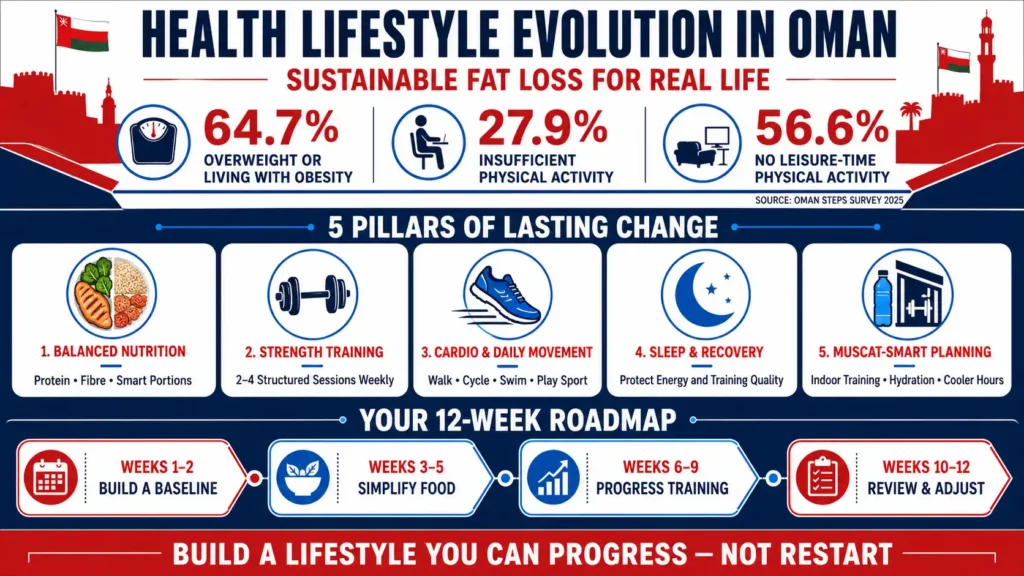
Fat loss still requires an energy deficit, but lasting results depend on far more than a calorie target. Food quality affects appetite, strength training helps protect lean mass, daily movement changes energy expenditure, and recovery influences how well someone can follow the plan. This guide turns those connected factors into a practical Muscat fitness strategy.
Listen
What Is Driving the Health Lifestyle Evolution in Oman?
Oman’s health conversation is becoming more urgent because modern convenience has reduced everyday movement while making energy-dense food easier to obtain. The latest national picture is significant. The Oman STEPS Survey 2025 reported that 64.7% of adults were overweight or living with obesity, 27.9% had insufficient physical activity, and 56.6% did no leisure-time sport, fitness, or recreational activity.
Those figures do not mean every individual needs the same body-weight goal. BMI is a population screening measure, not a complete assessment of health or body composition. They do show why lifestyle change matters at scale: many adults need easier ways to move regularly, eat with more awareness, maintain muscle, and manage health risks with qualified support.

The encouraging part is that the same environment creating the challenge is also producing better options. Muscat now has more climate-controlled training spaces, specialist coaches, indoor sports, pools, health tracking, and public awareness. The next stage is not collecting more fitness information; it is converting good information into repeatable behaviour. A broader guide to healthy living in Muscat helps place fat loss within that complete wellness picture.
The Real Evolution: From Weight-Loss Events to a Health System
A diet has an end date; a lifestyle system has a way to adapt. This distinction changes how goals are set. Someone chasing a rapid scale drop may remove entire food groups, train excessively, and judge success every morning. Someone building a system creates a manageable deficit, protects strength, plans for difficult days, and reviews progress over several weeks.
| Old fat-loss approach | Evolved lifestyle approach | Why it matters |
|---|---|---|
| Choose the fastest diet | Choose an eating pattern you can repeat | Adherence determines whether the deficit continues |
| Use scale weight as the only result | Track waist, strength, energy, habits, and weight trend | Body weight fluctuates for reasons unrelated to fat |
| Rely mainly on intense cardio | Combine resistance training, cardio, and daily movement | The plan supports fitness and lean mass as well as expenditure |
| Train harder after a missed day | Return to the normal schedule | Consistency grows without punishment or burnout |
| Demand perfection at social meals | Plan portions and flexible choices | Omani hospitality can remain part of normal life |
The useful implication is simple: the best plan is not the one that creates the largest possible deficit today. It is the one that creates a sufficient deficit while protecting training quality, social flexibility, and the ability to continue. This is where systems for workout discipline become more valuable than waiting to feel motivated.
Fat Loss Begins With Energy Balance, but Food Environment Shapes Adherence
Body fat decreases when energy intake remains below energy expenditure over time. Exercise contributes, but many people find it easier to create most of the deficit through food choices while using training to improve fitness and preserve function. A moderate plan usually leaves more room for protein, fibre, micronutrients, and productive workouts than an aggressive crash diet.
This does not require eating “diet food.” It means managing the high-impact variables: portion size, liquid calories, frequent snacks, restaurant meals, and foods that are easy to overconsume. The detailed guide to a sustainable calorie deficit in Oman explains the energy-balance side without turning it into starvation.
“We have to be mindful that it takes more time and more money to prepare less-processed foods.”
Kevin D. Hall, PhD, NIDDK researcher — NIH Research Matters
Hall’s point matters in Muscat because convenience is a real constraint, not a character flaw. An NIH-controlled feeding study found that participants consumed more energy and gained weight on an ultra-processed diet than on a minimally processed diet, even though the presented diets were matched for several nutrients. The practical response is preparation, not moral judgment.
Build Around Omani Life, Not Against It
Traditional meals can fit a fat-loss plan. Grilled fish or chicken, rice, vegetables, lentil dishes, yoghurt, fruit, and dates can all serve a useful purpose. The deciding variables are proportions and frequency. At a shared meal, start with protein and salad, take a deliberate rice portion, eat slowly, and pause before returning for more. No cultural food needs to be labelled forbidden.
- Build most meals around a clear protein source and vegetables or fruit.
- Pre-plan two or three convenient meals for demanding workdays.
- Keep water accessible; do not confuse Muscat heat and thirst with hunger.
- Use a weekly average, not one restaurant meal, to judge consistency.
Intermittent fasting can help some people control meal frequency, but it has no automatic advantage if the eating window leads to overeating or poor training. The local guide to intermittent fasting and body goals can help readers decide whether that structure suits their routine.
Train for the Body You Want to Maintain
Training during fat loss should do more than burn calories. A well-designed program builds or maintains strength, supports cardiovascular health, improves movement capacity, and gives the body a reason to retain lean tissue. Calories burned on a machine are only one small part of the return.
“Exercise and physical activity should be part of any weight management program due to their positive impact on both mental and physical health.”
Sarah M. Camhi, PhD, FACSM, ACSM-EP — American College of Sports Medicine
Make Resistance Training the Anchor
Two to four resistance sessions per week can work well, depending on experience, recovery, and schedule. Beginners often progress with full-body training built around a squat or leg press, hinge, push, pull, and loaded carry or core exercise. The objective is not to leave exhausted; it is to complete quality work and gradually improve repetitions, load, range of motion, or control.

Coaches often see people in a calorie deficit add more exercises while their performance is already falling. A better adjustment may be to keep the key lifts, reduce unnecessary volume, and protect technique. Readers new to programming can use the strength training guide for Oman as a foundation and seek qualified supervision where needed.
Use Cardio and Daily Movement Strategically
Cardio improves fitness and expands energy expenditure, but more is not always the immediate answer to a plateau. Start with a repeatable amount: brisk walking, cycling, swimming, squash, or another activity you enjoy. Then monitor hunger, recovery, and progress before adding volume. Daily movement outside formal workouts also matters; short walks after meals, stairs, and movement breaks can accumulate without creating the fatigue of another hard session.
“Being physically active is critical for health and well-being – it can help to add years to life and life to years.”
Dr Tedros Adhanom Ghebreyesus, WHO Director-General — World Health Organization
WHO recommends 150–300 minutes of moderate-to-vigorous aerobic activity per week for adults, alongside muscle-strengthening work. Someone currently inactive does not need to reach the upper end immediately. Begin below the target if necessary and build capacity without turning every session into a test.
Muscat Changes the Plan, Not the Goal
A plan built for another climate or culture may fail even when its science is sound. During the hottest months, lunchtime outdoor exercise can be impractical or unsafe. Climate-controlled strength and cardio areas, indoor courts, and pools make consistency easier. Outdoor walking or running can move to early morning or evening, with pace and duration adjusted to the conditions.

Hydration deserves deliberate planning. Arrive at training already hydrated, keep fluids available, and replace electrolytes appropriately when sweat losses are high. Dizziness, confusion, faintness, severe weakness, or symptoms that do not settle require stopping exercise and seeking suitable medical attention.
Busy professional schedules create a second local challenge. A realistic week may use three 45-minute gym sessions rather than six ambitious sessions that keep getting cancelled. During Ramadan, training time, intensity, food, fluids, sleep, and individual health status must be coordinated. People with medical conditions, those who are pregnant, or anyone using medication that affects glucose or hydration should seek clinical guidance rather than copying a generic fasting plan.
This adaptability is central to the Health Lifestyle Evolution in Oman. The routine changes with the season, but the core behaviours remain: planned eating, regular movement, progressive training, and sufficient recovery.
Recovery and Measurement Keep the System Honest

Sleep cannot directly create a calorie deficit, but inadequate sleep can make the plan harder to follow by affecting appetite, decision-making, mood, and training readiness. A late, intense workout is not automatically better than a shorter session that allows a consistent bedtime. Recovery should help you return capable, not simply provide another trend to optimize.
Practical recovery starts with enough sleep, appropriate training volume, regular meals, hydration, and lower-intensity days. Massage, heat, cold, and other tools may feel useful, but they do not replace those foundations. The guides to post-workout recovery habits and sleep for training adaptation offer deeper support.
Measure the Trend, Then Adjust One Variable
Daily scale readings can move because of hydration, sodium, carbohydrate intake, digestion, and the menstrual cycle. Use a weekly weight average when appropriate and combine it with waist measurements, photos under consistent conditions, gym performance, energy, and habit completion. A two- to four-week trend is usually more informative than a single day.
- If weight and waist are trending down while strength is broadly stable, continue.
- If progress is flat but adherence is inconsistent, repair consistency before reducing food.
- If adherence is high and the trend is flat for several weeks, adjust portions or movement modestly.
- If performance, mood, sleep, or menstrual function deteriorates, reassess the deficit and consult an appropriate professional.
Pain is not a fat-loss metric. Persistent or worsening pain needs assessment rather than extra stretching or harder training. The article on safer training and avoidable setbacks explains how movement quality and load management support consistency.
A 12-Week Lifestyle Evolution You Can Actually Run
Twelve weeks is long enough to observe meaningful patterns but short enough to plan clearly. Treat it as a learning cycle, not a deadline for a perfect body.
- Weeks 1–2: establish the baseline. Record meals without judgment, measure a weight trend and waist if suitable, schedule three training sessions, and note average sleep and daily movement.
- Weeks 3–5: simplify food. Create repeatable breakfasts and workday lunches, include protein in main meals, reduce the easiest excess calories, and retain planned social flexibility.
- Weeks 6–9: progress training. Build resistance exercises gradually, maintain two or more cardio or sport sessions, and increase daily movement only if recovery remains good.
- Weeks 10–12: review and individualize. Compare trends, identify the habits that survived difficult weeks, and adjust the smallest variable capable of restarting progress.
A coach can make this process more precise by assessing movement, matching volume to experience, and separating a real plateau from inconsistent execution. Structure is especially valuable for beginners, people returning after a long break, or anyone overwhelmed by conflicting online advice.
Make the Change Strong Enough to Survive Real Life
The Health Lifestyle Evolution in Oman will not be defined by one diet, device, or workout trend. It will be defined by people building routines that improve body composition without sacrificing strength, culture, work, family life, or long-term health.
Start with the next repeatable action: schedule three sessions, improve one daily meal, add a walk, or protect bedtime. If you want a plan shaped around your current fitness, schedule, and fat-loss goal, discuss it with a qualified coach at 5D Fitness and build a structure you can progress rather than repeatedly restart.
FAQ
It means replacing temporary diets with sustainable nutrition, training, movement, sleep, and recovery habits suited to life in Oman.
Use a manageable calorie deficit, resistance training, regular movement, sufficient protein, sleep, and a plan adapted to Muscat’s climate.
Yes. Control portions, prioritize protein and vegetables, manage rice and sweets, and judge consistency across the whole week.
Many adults progress with three structured weekly sessions, although experience, recovery, health, and schedule should guide the final plan.
Combine them. Cardio raises expenditure and fitness; strength training supports muscle, function, and body composition during a calorie deficit.
No. Sweating mainly regulates temperature. It reflects fluid loss, not a direct measurement of calories or body-fat reduction.
Expect gradual change. Track several weeks of weight, waist, strength, energy, and habit data instead of demanding daily scale movement.
It can simplify eating for some people, but it works only when it helps sustain an appropriate energy intake.
Choose climate-controlled facilities or cooler hours, manage hydration, reduce outdoor intensity when necessary, and watch for heat-related symptoms.
Seek help when medical conditions, pain, medication, disordered eating, repeated plateaus, or uncertainty make a generic plan inappropriate.