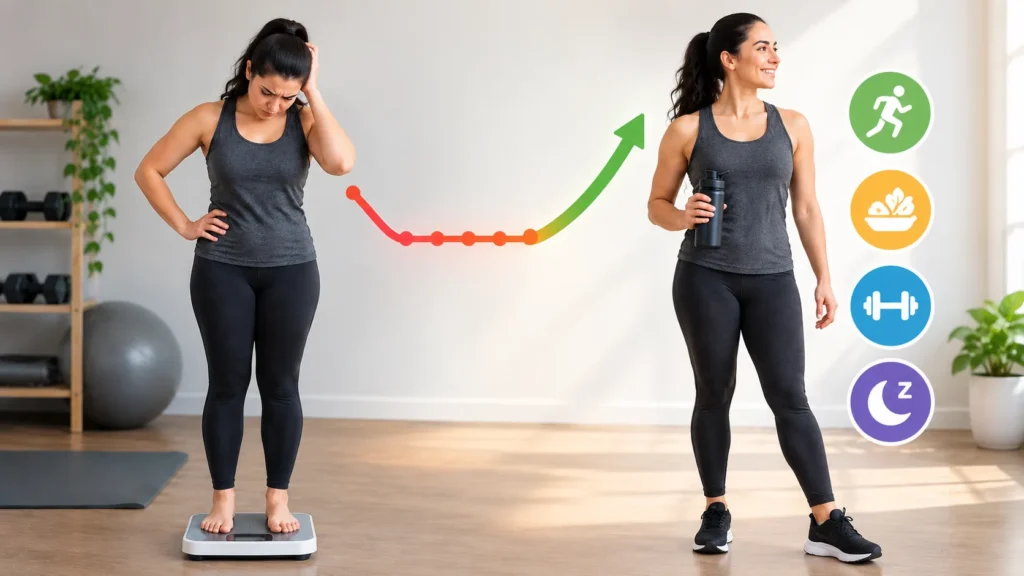
You can train consistently, lose weight from your face or shoulders, and still feel that the lower stomach changes last. That frustration drives many searches for Stubborn Belly Fat in Oman—and often leads to more crunches, harder circuits, or severe food restriction.
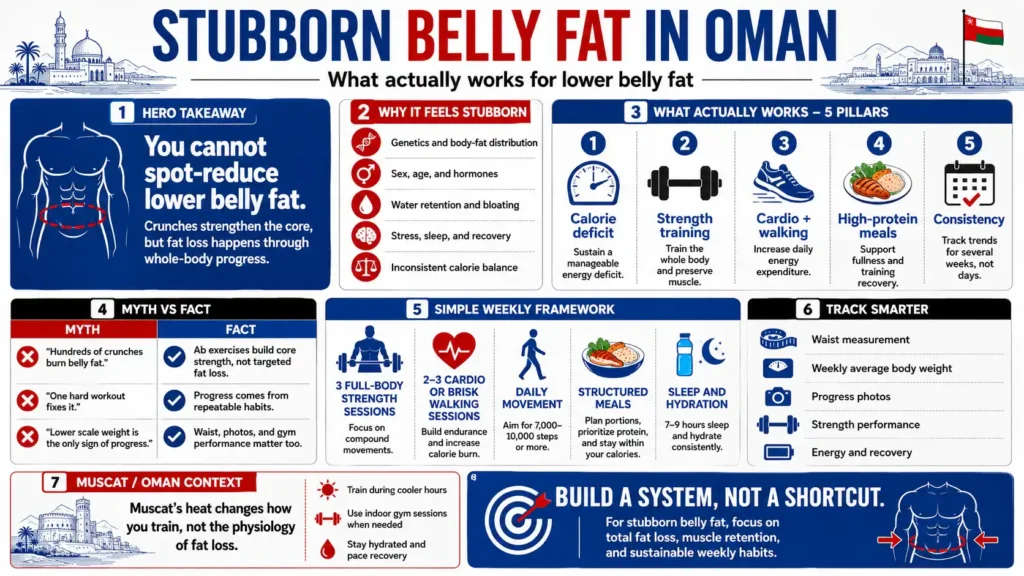
Lower belly fat cannot be selected for removal. Abdominal exercises strengthen the muscles underneath, but visible change usually comes from reducing total body fat while preserving muscle, staying active, and sustaining an appropriate calorie intake.
Listen
Your Lower Belly Is Not a Separate Fat-Loss Zone
Spot reduction is the idea that training one body part makes the body remove fat from that exact area. It is attractive because it turns a complex body-composition goal into a simple exercise list. Unfortunately, repeated sit-ups do not give you control over where stored fat is released first.
“Six weeks of abdominal exercise training alone was not sufficient to reduce abdominal subcutaneous fat and other measures of body composition.”
Sachin S. Vispute et al., Kinesiology Researchers — Journal of Strength and Conditioning Research
Core training still matters. Planks, carries, controlled trunk flexion, anti-rotation exercises, and good bracing can improve strength, posture, lifting skill, and muscular endurance. Treat them as part of a complete program—not as a method for melting lower belly fat. For broader training options, review these fat-burning exercise approaches in Oman.
Why Belly Fat Can Feel More Stubborn Than Other Areas
Fat distribution is influenced by genetics, sex, age, hormones, and total body-fat level. Some people see their waist reduce early; others lose from the upper body first. A slow-changing abdomen does not prove that your metabolism is broken.
Subcutaneous fat sits under the skin and is the soft tissue you can pinch. Visceral fat sits deeper around the organs. Waist size cannot distinguish them precisely, but it adds useful context alongside body weight, strength, health history, and professional assessment.
- Daily scale changes may reflect water, sodium, carbohydrate intake, digestion, or the menstrual cycle.
- Abdominal appearance can change with posture, bloating, lighting, and time of day.
- A small waist change may occur even when scale weight temporarily stalls.
- A muscular person may have a BMI that does not reflect body-fat level accurately.
If your abdomen changes suddenly, feels painful, remains unusually swollen, or is accompanied by unexplained symptoms, do not assume it is ordinary fat gain. Seek assessment from a qualified healthcare professional.

Build the Energy Deficit Before Adding More Ab Work
Reducing Stubborn Belly Fat in Oman requires a sustained energy deficit: average energy intake must remain below average energy expenditure over time. The deficit should be meaningful enough to create progress but moderate enough to protect training quality, recovery, and adherence. The detailed fat-loss guide for Oman explains the wider system.
Your total daily energy expenditure is an estimate, not a perfect prescription, but it creates a more rational starting point than copying a generic 1,200-calorie diet. Use the calculator below to estimate daily needs based on your profile and activity level.
Your actual daily calorie burn, adjusted for activity — use this number to set your intake target.
Used to adjust the metabolic formula for hormonal differences.
Metabolic rate and max heart rate both change with age.
Your standing height without shoes.
Your current body weight, not the weight you lift.
How active you are on a typical week, including exercise and daily movement.
Interpret the result as a planning estimate. Track your intake and progress for several weeks, then adjust modestly if the trend does not match the goal. Medical conditions, pregnancy, medications, eating-disorder history, and clinical nutrition needs require individualized professional advice.
Food quality does not override calories, but it affects hunger and consistency. Build meals around protein, vegetables or fruit, a suitable carbohydrate portion, and dietary fat. Watch sweet drinks, café calories, sauces, snacks, and restaurant portions.
"We have to be mindful that it takes more time and more money to prepare less-processed foods."
Kevin D. Hall, PhD, NIDDK Researcher — National Institutes of Health
The practical lesson is environmental design. Keep two or three reliable meals available for demanding workdays, decide restaurant choices before arriving extremely hungry, and use flexible portions rather than an all-or-nothing diet. This aligns with a realistic fitness lifestyle in Oman.
Train the Whole Body, Then Condition Strategically
Exercise supports belly-fat reduction by increasing expenditure, preserving lean tissue, and improving fitness. A productive plan combines resistance training, aerobic work, and daily movement.
| Approach | What It Does Well | Common Mistake |
|---|---|---|
| Full-body resistance training | Builds strength and supports lean tissue | Changing exercises before progression is measurable |
| Moderate cardio | Adds repeatable energy expenditure and aerobic fitness | Assuming only exhausting sessions count |
| HIIT | Provides time-efficient hard conditioning | Using it too frequently for current recovery capacity |
| Walking and daily movement | Raises weekly activity with low recovery cost | Ignoring it because it feels too easy |
| Abdominal exercises | Strengthens the core and improves muscular endurance | Expecting direct lower-belly fat loss |
For many beginners, three full-body sessions per week provide enough exposure to squats or leg presses, hinges, pushes, pulls, single-leg work, and core training. Add two or three controlled cardio sessions or brisk walks according to fitness and recovery. The beginner gym workout guide can help establish the foundation.
"Being physically active is critical for health and well-being – it can help to add years to life and life to years."
Dr Tedros Adhanom Ghebreyesus, WHO Director-General — World Health Organization
Progress one variable at a time: load, repetitions, range of motion, movement control, walking duration, or cardio pace. Random high-fatigue workouts can feel effective without producing a measurable training adaptation. A structured metabolism and daily-expenditure strategy places the workout inside the larger week.
Muscat Changes the Delivery, Not the Physiology
The principles behind Stubborn Belly Fat in Oman are universal, but Muscat affects execution. Heat can reduce outdoor activity, increase sweat losses, and make a poorly timed workout harder to repeat. Climate-controlled training, early-morning walks, evening activity, and deliberate hydration can protect consistency.

A morning session may work well for a busy professional, but it is not metabolically superior simply because it happens before breakfast. Use the timing that protects attendance, sleep, and performance. The morning fat-loss routine guide compares practical options without treating fasted training as mandatory.
- Schedule outdoor walking during cooler hours when conditions are suitable.
- Use indoor cardio for demanding intervals during hotter periods.
- Arrive hydrated instead of trying to catch up during the workout.
- Reduce training intensity if heat, sleep loss, fasting, or illness changes recovery.
Ramadan, travel, family meals, and long workdays may require changes in timing and volume. The goal is not to preserve the exact routine every week. It is to preserve the system: appropriate intake, regular training, daily movement, and enough recovery to continue.
Measure the Trend Without Obsessing Over One Number
Use at least three indicators: a weekly average of scale weight when appropriate, waist circumference measured consistently, and gym performance. Progress photos under similar lighting and clothing can add context. Review two to four weeks of data rather than reacting to one meal or weigh-in.
- If weight and waist are trending down while strength remains broadly stable, continue.
- If progress is flat and execution is inconsistent, repair adherence before cutting more food.
- If adherence is high and the trend is flat for several weeks, adjust one variable modestly.
- If energy, sleep, mood, performance, or menstrual function deteriorates, reassess the plan.
Expect the lower stomach to change at its own pace. A useful program cannot promise which centimetre disappears first. It can make the process measurable and improve the variables you control.

Turn a Stubborn Area into a Structured Plan
The solution to Stubborn Belly Fat in Oman is not a special ab circuit. Build a manageable calorie deficit, train the whole body progressively, use cardio and walking strategically, recover well, and judge trends over several weeks. Core work belongs in the program, but it supports strength rather than selecting where fat disappears.
If you keep restarting, cannot translate your TDEE estimate into a workable week, or need exercise progression matched to your current level, contact 5D Fitness. A coach can review your training structure, schedule, movement quality, and measurable next steps without promising instant or targeted fat loss.
FAQ
No. Ab exercises strengthen the core, but overall fat loss determines whether the lower stomach becomes leaner.
Genetics, sex, age, hormones, and individual fat distribution affect where your body stores and loses fat first.
Combine progressive resistance training, regular cardio, and daily walking. No single movement can selectively remove abdominal fat.
Many beginners progress with three full-body sessions, plus controlled cardio or walking adjusted to fitness and recovery.
Crunches improve abdominal strength and endurance, but they do not create meaningful spot reduction without overall fat loss.
Yes. Walking increases weekly energy expenditure and can support overall fat loss when paired with suitable nutrition.
No. It is an estimate. Track several weeks of progress and adjust modestly according to real results.
They can make appetite, recovery, activity, and dietary adherence harder, indirectly slowing body-composition progress.
Use cooler hours or climate-controlled facilities, start hydrated, adjust intensity, and stop if you feel faint or unwell.
Seek assessment for sudden abdominal change, persistent swelling, pain, unexplained symptoms, or concerns related to medication or health conditions.