Exercising in a hot climate requires a different approach from training in comfortable temperatures. For people living in Oman, maintaining fitness during hot weather means balancing exercise intensity, hydration, nutrition, recovery, and heat exposure. While exercising in the heat can increase cardiovascular and thermoregulatory strain, sweating more does not automatically mean burning more body fat.
Instead, the goal should be to maintain consistent physical activity while managing heat-related stress intelligently. 5dfitness focuses on practical, evidence-based strategies that can help athletes, fitness enthusiasts, bodybuilders, and active adults continue training safely while managing energy expenditure in hot conditions.
Listen
Does Exercising in Hot Weather Help You Burn More Calories?
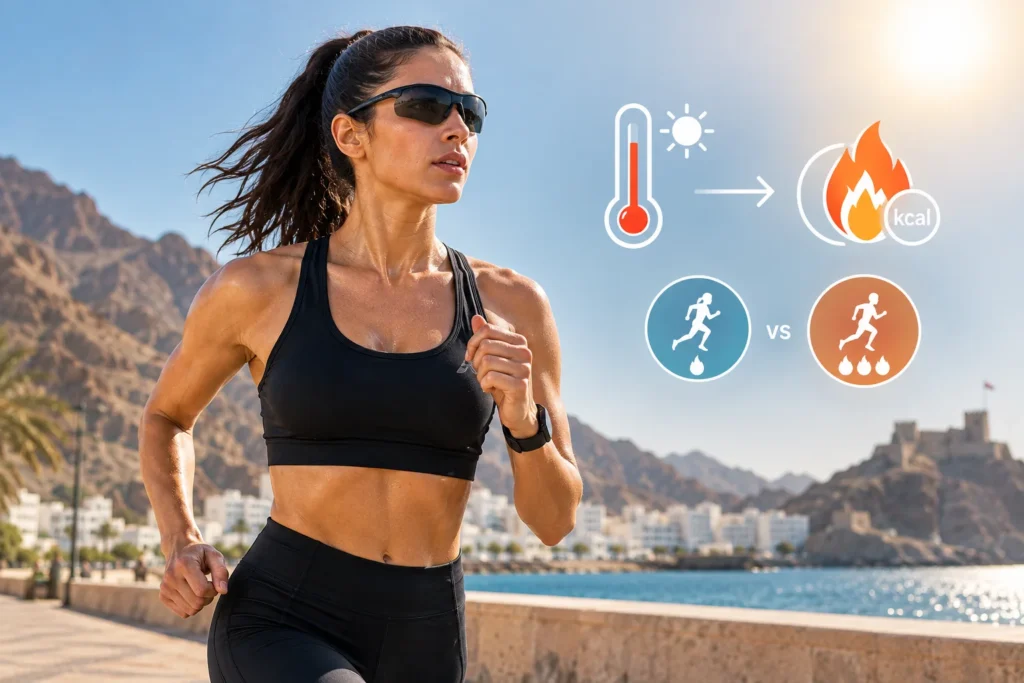
Exercising in hot weather can make a workout feel harder because the body must simultaneously produce energy for movement and regulate its temperature. Heart rate and sweating can increase, while prolonged exposure to heat can accelerate fluid loss and contribute to fatigue. However, this does not mean that exercising in the heat automatically produces substantially greater fat loss.
Energy expenditure during exercise depends primarily on factors such as body mass, exercise intensity, duration, movement efficiency, and the type of activity. Heat adds physiological stress, but sweating itself is not a reliable measure of calories or fat burned. Therefore, people training in Oman should focus on maintaining a sustainable exercise routine rather than intentionally seeking extreme heat to increase calorie expenditure.
Does Heat Increase Metabolic Rate During Exercise?
Heat stress can alter the body’s physiological and metabolic responses to exercise. Research shows that exercising in very high temperatures can change substrate utilization, with some evidence indicating greater carbohydrate use and lower fat use during exercise in the heat.
This is important because a higher heart rate or greater perceived effort does not necessarily mean that the body is burning proportionally more body fat. Heat places additional demands on thermoregulation, including increased blood flow to the skin and sweating.
For someone trying to lose body fat, the most important factor remains the overall energy balance created over time. A sustainable combination of resistance training, aerobic activity, appropriate nutrition, sufficient sleep, and recovery is generally more useful than deliberately exercising in extreme heat.
The practical takeaway is simple: heat increases physiological strain, but it should not be treated as a shortcut to fat loss.
Can Sweating More Mean You Are Burning More Fat?
No. Sweating is primarily a mechanism for cooling the body, not a direct measurement of fat oxidation.
When you exercise in hot weather, your body may produce more sweat because it needs to dissipate heat. Losing water through sweat can temporarily reduce body weight, but this change mainly reflects fluid loss rather than a meaningful reduction in body fat.
Once fluids are replaced, much of that temporary weight loss disappears. This is why using sweat volume or post-workout scale weight as the main indicator of fat loss can be misleading.
For people exercising in Oman, the better metrics are consistency, training performance, body-composition trends over time, waist measurements, recovery, and nutrition quality. These indicators provide a much more useful picture of progress than how much sweat appears on a shirt after a workout.
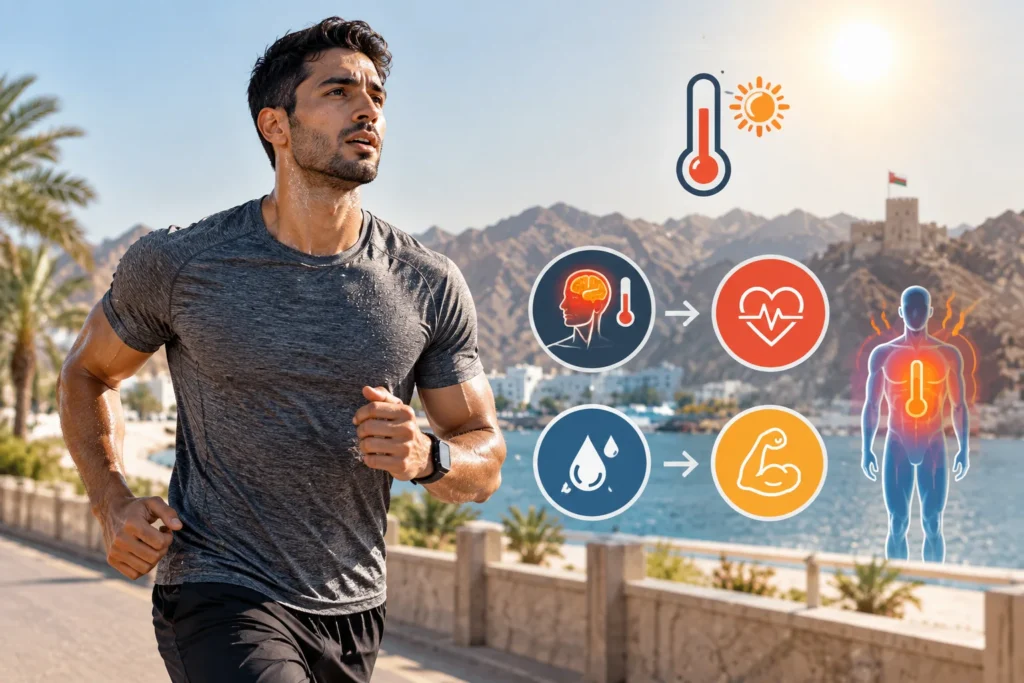
How Does Hot Weather Affect Metabolism and Exercise Performance?
The human body works continuously to keep its internal temperature within a safe range. During exercise in hot environments, muscles generate heat while the surrounding environment can make heat dissipation more difficult. The body responds by increasing sweating and directing more blood toward the skin.
These adaptations help regulate temperature but can also increase cardiovascular strain. A review of exercise under heat stress notes that prolonged exercise in the heat naturally raises core temperature and causes water loss through sweating, which can influence performance.
For athletes and fitness enthusiasts, this means that the same workout may feel substantially harder in hot conditions than it would in a cooler environment.
Why Does Exercise Feel Harder in Hot Weather?
Exercise can feel harder in the heat because the cardiovascular system has to support both working muscles and temperature regulation.
As body temperature rises, more blood is directed toward the skin to help release heat. At the same time, sweating causes fluid loss. If the workout continues for a long time without adequate fluid replacement, cardiovascular strain and perceived exertion can increase.
This can reduce exercise quality even when the planned workout appears moderate on paper.
For this reason, training intensity should not always be judged solely by pace, weight, or repetitions. In hot weather, perceived exertion and environmental conditions become important factors when deciding whether to maintain, reduce, or stop an exercise session.
Can Heat Reduce Exercise Performance?
Yes. Heat stress can negatively affect exercise performance, particularly when exercise is prolonged, intense, or performed in conditions that make heat dissipation difficult.
The combination of elevated core temperature, sweating, cardiovascular strain, and dehydration can make it harder to maintain the same pace or workload.
This does not mean that people should stop exercising during hot weather. Instead, training should be adjusted to the environment. A shorter workout, lower intensity, indoor session, or cooler training time may provide a better balance between fitness benefits and heat-related risk.
ACSM guidance notes that people who are suddenly exposed to a hot environment should reduce exercise intensity and duration, and that heat adaptation can take roughly 10–14 days of repeated exposure.
Can the Body Adapt to Exercising in the Heat?
Yes. Repeated exposure to exercise in hot conditions can lead to physiological adaptations commonly referred to as heat acclimatization.
However, adaptation takes time. Someone who is accustomed to exercising indoors in air conditioning should not immediately attempt long, high-intensity outdoor workouts in extreme heat.
A gradual approach is more appropriate. Exercise duration and intensity can initially be reduced, followed by progressive increases as the body adapts.
Heat acclimatization does not eliminate the risk of dehydration or heat-related illness. Even experienced athletes still need appropriate hydration, pacing, clothing, recovery, and environmental awareness.
What Nutrition and Hydration Are Best for Exercising in Hot Weather?
Nutrition and hydration become especially important when exercising in hot conditions because sweating increases fluid loss and prolonged exercise can increase the need for carbohydrate and electrolyte replacement.
A 2024 review on nutritional considerations during heat acclimation highlights that heat stress can affect metabolism, gastrointestinal function, and appetite, while inadequate energy, carbohydrate, or protein intake may reduce exercise and heat tolerance.
For everyday fitness, the goal is not to consume large amounts of supplements simply because the weather is hot. Instead, nutrition should match exercise duration, intensity, sweat losses, and individual needs.
What Should You Eat Before Exercising in Hot Weather?
A pre-workout meal should provide enough energy without causing unnecessary gastrointestinal discomfort.
For moderate or longer sessions, carbohydrate-rich foods can help provide readily available fuel. Examples include oats, rice, potatoes, bananas, fruit, yogurt, or other foods that an individual tolerates well.
Large, high-fat meals immediately before intense exercise may feel uncomfortable for some people because digestion takes longer. In hot conditions, gastrointestinal comfort becomes even more relevant because exercise already places additional physiological stress on the body.
The ideal pre-workout meal therefore depends on workout timing, duration, intensity, and personal tolerance. There is no single food that is required for exercising in hot weather.
How Important Are Water and Electrolytes During Exercise in the Heat?
Hydration is particularly important during exercise in hot conditions because sweating causes fluid loss.
The exact amount of fluid needed varies according to sweat rate, body size, exercise duration, environmental conditions, clothing, and individual physiology. Rather than relying on a universal number, athletes can monitor their own responses and adjust fluid intake accordingly.
Electrolytes can also become relevant during prolonged or heavy-sweating sessions, especially when sodium losses are substantial.
However, more is not always better. Excessive fluid consumption can also create problems. Hydration strategies should therefore be individualized rather than based on the assumption that everyone needs large quantities of sports drinks or electrolyte supplements.
What Should You Eat After Exercising in Hot Weather?
Post-workout nutrition should support recovery, especially after longer or harder sessions.
A meal containing protein can support muscle repair, while carbohydrate can help replenish glycogen after demanding exercise. Replacing fluids lost through sweating is also important.
Good post-workout options can include rice with lean protein, potatoes with eggs, yogurt with fruit and oats, or a balanced meal containing carbohydrates, protein, vegetables, and fluids.
If the workout was long or involved substantial sweating, replacing sodium and other electrolytes may also be appropriate depending on individual sweat losses.
The key principle is recovery rather than simply replacing every calorie burned during exercise.
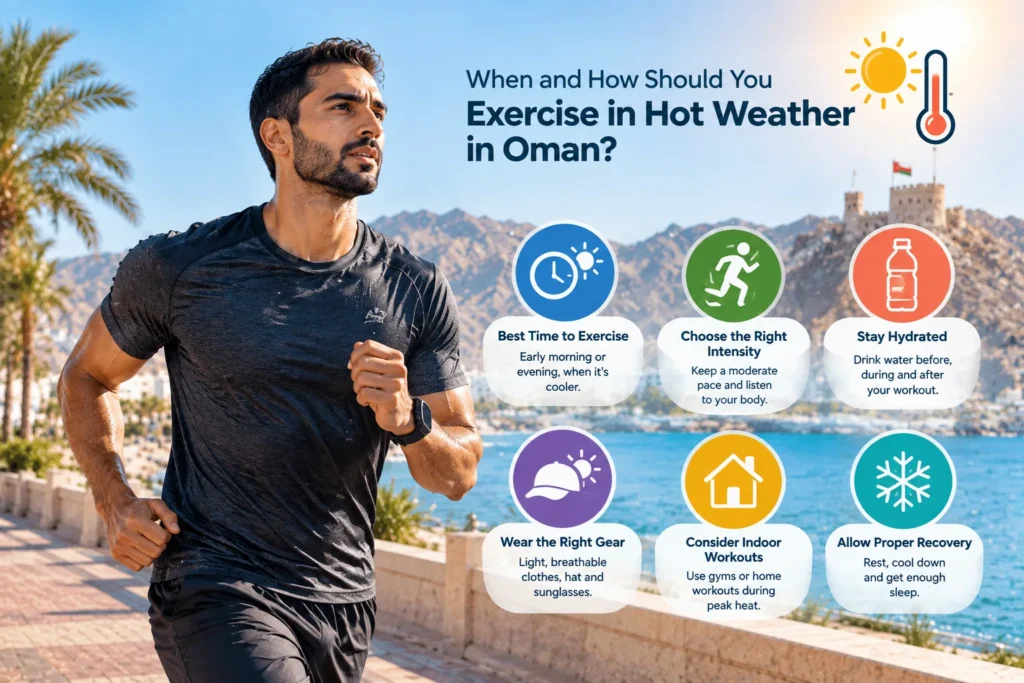
When and How Should You Exercise in Hot Weather in Oman?
Choosing the right time and environment can make exercise considerably more manageable during hot weather. The CDC recommends limiting outdoor activity during the hottest part of the day when possible and scheduling workouts earlier or later when temperatures are cooler.
For people in Oman, this principle is particularly practical during periods of intense heat. Indoor gyms, air-conditioned spaces, shaded areas, and cooler parts of the day can provide safer alternatives when outdoor conditions become difficult.
What Is the Best Time to Exercise in Hot Weather?
Earlier morning and later evening are generally preferable to the hottest part of the day for outdoor exercise.
Morning sessions can allow people to complete their workout before temperatures rise substantially. Evening sessions can also be useful after the environment begins to cool.
However, the best time depends on actual weather conditions, humidity, sun exposure, and the individual’s ability to tolerate heat.
If outdoor conditions remain excessively hot, moving the workout indoors is often the more sensible choice. The objective is not to prove that you can tolerate extreme heat; it is to maintain a consistent training routine without unnecessary risk.
Which Exercises Work Best in Hot Weather?
Moderate-intensity activities are often easier to manage than prolonged high-intensity sessions when environmental heat is high.
Depending on the conditions, suitable options may include:
- Brisk walking
- Indoor cycling
- Resistance training
- Treadmill walking
- Swimming
- Low-impact aerobic exercise
- Mobility and functional training
- Shorter interval sessions performed in a controlled environment
High-intensity outdoor training should be approached more cautiously, particularly during the hottest periods of the day.
Exercise selection should also account for the individual’s fitness level. Someone who is not acclimatized to heat may benefit from reducing both intensity and duration until adaptation occurs.
Should You Exercise Outdoors or Indoors During Extreme Heat?
Indoor training can be the better option when outdoor heat, humidity, or sun exposure makes safe exercise difficult.
Air-conditioned gyms provide a more controlled environment and can make it easier to maintain training intensity without excessive heat strain.
Outdoor exercise can still be appropriate when conditions are favorable, particularly during cooler periods of the day. However, people should pay attention to how they feel rather than relying only on the planned workout.
The CDC specifically advises people exercising in hot weather to pace activity, drink more water than usual, and stop activity if they feel faint or weak.
How Can You Stay Fit and Burn Calories Safely During Hot Weather?
Maintaining fitness during hot weather is less about finding a special heat-burning workout and more about maintaining consistent activity while managing the environmental stress.
A balanced weekly program can combine aerobic exercise, resistance training, mobility work, and active recovery.
WHO recommends that adults accumulate 150–300 minutes of moderate-intensity aerobic activity per week, or 75–150 minutes of vigorous activity, together with muscle-strengthening activities on at least two days per week.
The exact structure should be adjusted according to fitness level and heat conditions.
How Can You Adjust Training Intensity During Hot Weather?
One of the simplest strategies is to reduce intensity when environmental stress is high.
For example, instead of attempting to maintain a normal running pace, an athlete may reduce speed and monitor perceived exertion. A strength-training session may use slightly longer rest periods or fewer total sets.
This does not mean every hot-weather workout must be easy. It means training load should reflect the conditions.
If the body is already working harder to regulate temperature, forcing the same external workload used in cooler conditions may unnecessarily increase fatigue.
Progress should therefore be judged over weeks and months rather than by whether one hot workout matches a cooler-weather performance.
How Can You Create a Weekly Fitness Plan for Hot Weather?
A practical weekly schedule could include a combination of strength and aerobic exercise:
| Day | Training | Hot-Weather Strategy |
|---|---|---|
| Monday | Full-body strength | Indoor or air-conditioned |
| Tuesday | Moderate cardio | Early morning or evening |
| Wednesday | Recovery walk + mobility | Low intensity |
| Thursday | Full-body strength | Indoor |
| Friday | Moderate cardio | Cooler time of day |
| Saturday | Functional or aerobic workout | Adjust duration to conditions |
| Sunday | Rest or light activity | Recovery focus |
This type of schedule provides variety without requiring every workout to be performed outdoors.
The goal is to maintain the weekly amount of physical activity while modifying individual sessions according to environmental stress.
What Are the Warning Signs That You Should Stop Exercising?
Heat-related symptoms should never be ignored.
The CDC advises stopping activity and moving to a cool location if you feel faint or weak. People exercising in hot weather are also more likely to become dehydrated and develop heat-related illness.
Warning signs can include unusual weakness, dizziness, headache, nausea, confusion, faintness, or other concerning symptoms.
If significant symptoms of heat-related illness develop, medical attention may be necessary.
The correct response to heat-related symptoms is not to push harder in order to “burn more calories.” Safety takes priority over the workout.
How to Exercise Safely in Hot Weather: A Simple 5-Step Plan
- Step 1: Check the Conditions
Before exercising outdoors, consider temperature, humidity, sun exposure, and the expected duration of the session. If conditions are extreme, choose an indoor workout.
- Step 2: Choose a Cooler Training Time
Schedule outdoor exercise earlier in the morning or later in the evening when conditions are generally more manageable.
- Step 3: Reduce Intensity if Necessary
Do not assume that your normal pace or workload must remain unchanged. Adjust intensity according to perceived exertion and environmental stress.
- Step 4: Manage Fluids and Nutrition
Start exercise appropriately hydrated and replace fluids during and after longer or sweat-heavy sessions. Match nutrition to the duration and intensity of the workout.
- Step 5: Monitor Your Body
Pay attention to dizziness, weakness, unusual fatigue, nausea, headache, or other signs of heat-related stress. Stop exercising and move to a cooler environment if concerning symptoms occur.
Hot-Weather Exercise: What to Adjust and Why?
| Training Factor | What to Adjust in Hot Weather | Why It Matters |
|---|---|---|
| Workout Time | Prefer early morning or later evening | Reduces heat exposure |
| Intensity | Reduce pace or workload when needed | Limits excessive physiological strain |
| Duration | Shorten sessions during extreme heat | Helps manage accumulated heat stress |
| Hydration | Replace fluids according to sweat losses | Helps manage fluid loss |
| Electrolytes | Consider them during prolonged, heavy-sweat sessions | Supports replacement of sodium losses |
| Exercise Location | Move indoors when conditions are extreme | Provides a more controlled environment |
| Recovery | Allow adequate rest between sessions | Helps manage fatigue |
| Heat Adaptation | Increase exposure gradually | Gives the body time to adapt |
Conclusion
Exercising in hot weather in Oman does not need to mean choosing between fitness and safety. The more effective strategy is to adapt the workout to the environment. Heat can increase cardiovascular and thermoregulatory strain, but sweating more does not automatically mean burning more body fat.
A sustainable approach combines appropriate exercise intensity, cooler training times, hydration, suitable nutrition, resistance training, aerobic activity, recovery, and gradual heat adaptation. Rather than intentionally seeking extreme temperatures for additional calorie burn, focus on maintaining consistent physical activity throughout the week.
For most adults, the long-term objective should be a balanced fitness routine that can be maintained across changing environmental conditions. 5dfitness supports this practical approach by emphasizing sustainable training, evidence-based exercise principles, and smart adaptation to the demands of hot-weather environments.
FAQ
Not necessarily. Heat increases physiological strain and sweating, but greater sweating does not automatically mean greater fat loss. Total energy expenditure depends mainly on exercise duration, intensity, body size, movement, and overall activity.
Heat stress can alter metabolic responses during exercise, including fuel utilization, but it should not be considered a reliable strategy for increasing fat loss. Research has found that exercise in heat can shift substrate use toward greater carbohydrate utilization.
For outdoor exercise, earlier morning or later evening is generally preferable to the hottest part of the day. When conditions are extreme, an indoor workout may be the safer option.
Choose foods that provide appropriate energy and are easy for you to digest. Carbohydrate-rich foods such as oats, rice, potatoes, fruit, or yogurt can work well depending on the workout and timing.
Electrolytes may be useful during prolonged or heavy-sweating exercise, particularly when sodium losses are substantial. However, requirements vary between individuals, so electrolyte intake should reflect exercise duration and sweat losses rather than simply the temperature.
Exercise can contribute to weight loss by increasing energy expenditure, but heat itself should not be viewed as a special fat-loss tool. Sustainable exercise and appropriate nutrition are more important for long-term weight management.
Not necessarily. When outdoor conditions are excessively hot or humid, indoor training can provide a safer and more controlled environment.
WHO recommends 150–300 minutes of moderate-intensity aerobic activity or 75–150 minutes of vigorous activity per week, plus muscle-strengthening activity on at least two days.