
Rest between sets is an important part of resistance training because it affects how well you recover, how many repetitions you can perform, and how much training volume you can maintain. However, the ideal rest period depends on your goal, exercise type, and training intensity.

Strength athletes often need longer recovery periods than people performing lighter endurance-focused workouts. For muscle growth, both shorter and longer rest periods can be effective when training is structured appropriately. In this guide from 5dfitness, we explain how to choose practical rest intervals for strength, hypertrophy, and muscular endurance.
Listen
How Long Should You Rest Between Sets for Different Fitness Goals?
The appropriate rest between sets depends primarily on what you want to achieve. Heavy strength training generally requires more recovery because it places high demands on the muscles and nervous system. Muscle-building workouts need enough rest to maintain effective training quality, while muscular endurance sessions often use shorter intervals.
These are general starting points rather than strict rules: your recovery, exercise selection, and effort level may require adjustments. The goal is to begin each set sufficiently recovered to perform it with good technique and the intended intensity.
How Long Should You Rest for Muscle Growth?
For muscle growth, a practical starting point is 1–3 minutes between sets. Some demanding exercises or hard sets may require longer rest, particularly when maintaining repetitions and technique is important.
Muscle hypertrophy is influenced by several factors, including training volume, effort, and progressive overload. Shortening rest periods simply to make a workout feel harder does not automatically produce more muscle growth. If your rest is too short, you may lose repetitions or reduce the load you can use in subsequent sets.
A 2024 systematic review and meta-analysis found that muscle growth can occur with different rest intervals. It suggested a possible small benefit from resting longer than 60 seconds, potentially because longer rest helps preserve training volume. The evidence does not establish one universally optimal duration.
How Long Should You Rest for Strength?
For maximal strength training, around 3–5 minutes is a useful starting point, especially during heavy sets of compound exercises such as squats, deadlifts, and bench presses.
Strength-focused training often involves high loads and substantial effort. Inadequate rest can reduce force production and make it harder to complete later sets at the intended intensity. Longer recovery periods allow you to maintain performance across demanding sets.
You may not need five minutes after every exercise. Lighter accessory movements or less demanding sets may require less recovery. Adjust the interval according to load, repetitions, technique, and how ready you feel for the next set.
ACSM resistance-training guidance distinguishes programming variables according to training goals, including strength and muscular endurance. This supports choosing rest intervals in the context of the overall program rather than using one duration for every exercise.
American College of Sports Medicine
ACSM — Resistance Training
How Long Should You Rest for Muscular Endurance?
For muscular endurance, approximately 30–90 seconds can be a practical starting point. This approach may suit lighter resistance exercises performed for higher repetitions, circuit training, or workouts designed to challenge repeated muscular effort.
Shorter rest periods can make a session more time-efficient and maintain a higher level of activity. However, they should not compromise safe technique or prevent you from completing the intended work.
Muscular endurance training does not mean that every set must be performed with minimal rest. If your form deteriorates or you cannot complete the target repetitions, extend the recovery period. Choose rest intervals that support the purpose of the session rather than following a timer regardless of performance.
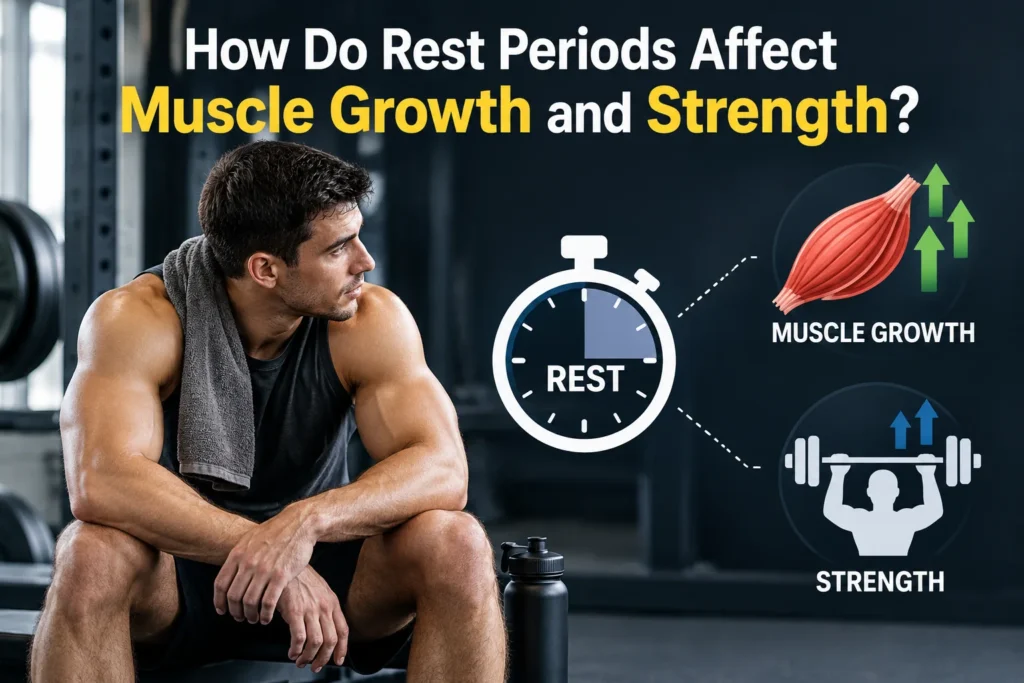
How Do Rest Periods Affect Muscle Growth and Strength?
Rest intervals influence the quality of your workout by affecting fatigue, repetition performance, and the amount of work you can complete. Short rest periods may increase the feeling of fatigue and keep workouts brief, while longer rest periods can help preserve performance during demanding sets.
Neither approach is automatically superior for every fitness goal. The important question is whether your rest interval allows you to perform enough high-quality training to support your intended adaptation. Understanding this relationship can help you avoid rushing through sets or resting longer than your workout requires.
Can Longer Rest Periods Help You Maintain Training Volume?
Yes. Longer rest periods can help you maintain repetitions and training load across multiple sets, particularly during challenging resistance exercises.
For example, if you perform a demanding set of squats and immediately begin another, fatigue may prevent you from completing the same number of repetitions. Taking more time to recover may allow you to perform the next set with better technique and comparable effort.
This matters because training volume and performance are relevant components of a well-designed resistance program. However, longer rest is not a reason to extend every workout unnecessarily. Use enough recovery to maintain the quality of the work that matters for your goal.
Do Short Rest Periods Improve Muscle Growth?
Short rest periods can be useful, but they are not inherently better for hypertrophy. They may increase workout density and produce a strong sensation of muscular fatigue, yet this does not guarantee greater muscle growth.
If short intervals consistently reduce your repetitions, load, or technique, they may make it harder to complete the planned training. On the other hand, shorter rests can work well for lighter exercises, accessory movements, or time-limited sessions when performance remains adequate.
Choose your interval based on the exercise and your ability to complete quality sets. The aim is productive training, not simply making every workout feel exhausting.

How Much Rest Do Different Exercises Require?
Not all exercises create the same recovery demands. Heavy compound movements typically involve multiple muscle groups and require substantial coordination, while many isolation exercises use lighter loads and involve fewer joints. The number of repetitions, proximity to muscular failure, and overall effort also affect recovery.
For this reason, using the same rest timer for every exercise may not be practical. A flexible approach allows you to recover appropriately after demanding sets while keeping less strenuous parts of your workout moving efficiently.
How Long Should You Rest After Compound Exercises?
For demanding compound exercises, start with 2–5 minutes, depending on your training goal and set intensity. Heavy squats, deadlifts, presses, and rows may require longer recovery than lighter variations.
These exercises involve several muscle groups and can produce considerable whole-body fatigue. If you begin the next set too soon, you may notice reduced repetitions, slower movement, or difficulty maintaining technique.
For strength-focused sets, rest toward the longer end of the range. For moderate loads and less demanding sets, shorter intervals may be sufficient. Prioritize consistent, safe execution rather than forcing yourself to start at an arbitrary time.
How Long Should You Rest After Isolation Exercises?
For many isolation exercises, around 1–2 minutes is a reasonable starting point. Movements such as biceps curls, lateral raises, and leg extensions may not require the same recovery as heavy compound lifts.
However, isolation exercises can still be demanding, especially when performed close to muscular failure or with higher loads. If your repetitions drop sharply or your technique changes, take more time before the next set.
The purpose of an isolation movement is to train the target muscles effectively. Do not sacrifice control or range of motion simply to keep rest periods short. Adjust the interval to the difficulty of the set and the quality of your performance.
Should You Rest Longer After Heavy Sets?
Usually, yes. Heavy sets and sets performed close to muscular failure often require more recovery than lighter, easier sets.
A useful approach is to consider both the load and how demanding the set felt. If you completed a heavy set with substantial effort, give yourself enough time to regain control of your breathing and prepare to repeat the movement safely.
Resting longer does not mean you are being inefficient. For strength training especially, preserving performance can be more important than finishing the workout as quickly as possible. Use your planned interval as a guide, then adjust it when your performance indicates that more recovery is needed.
A 2024 review found that muscle growth can occur across different rest durations. It suggested a possible small advantage to resting longer than 60 seconds, potentially because this helps preserve training volume. The evidence does not establish one universally optimal rest period.
Systematic review and meta-analysis on rest intervals and hypertrophy (2024)
Read the systematic review via PubMed
What Factors Determine Your Ideal Rest Between Sets?
Your ideal rest interval is not determined by your fitness goal alone. Exercise selection, training load, repetition range, proximity to failure, conditioning, and personal recovery all influence how much time you need. Two people performing the same exercise may not recover at exactly the same speed.
Even one person may need different intervals on different days depending on sleep, fatigue, and workout demands. Use general recommendations as a starting point, then pay attention to whether you can maintain good technique and complete the intended work.
How Does Training Intensity Affect Rest Time?
Training intensity and effort influence how much recovery you may need. Heavy loads and hard sets generally create greater demands than lighter sets performed comfortably far from failure.
For example, a low-repetition set of heavy bench presses may require several minutes of rest, while a lighter set of cable curls may need much less. The difference is not simply the exercise name; it is also how challenging the set is.
If you consistently lose repetitions or cannot maintain technique, increase your rest interval. If you recover quickly and perform the next set well, your current interval may be sufficient. Use performance as feedback rather than assuming one fixed duration is always correct.
Does Your Fitness Level Change How Long You Should Rest?
Yes. Training experience and conditioning can influence how quickly you recover between sets, although the exercise and effort level still matter.
Beginners may benefit from taking enough time to understand the movement, regulate breathing, and maintain technique. More experienced lifters may be familiar with their typical recovery needs, but heavy or near-failure sets can still require substantial rest.
Do not assume that advanced athletes always need less recovery. Higher training loads and demanding programming may increase their recovery requirements. Start with a sensible interval, then adjust it according to your ability to complete the next set safely and effectively.
How Can You Tell When You’re Ready for the Next Set?
You are generally ready when you can begin the next set with appropriate technique and a reasonable expectation of completing the planned repetitions. Your breathing should be sufficiently controlled, and you should feel prepared to perform the movement safely.
There is no single physical sensation that perfectly measures recovery. A brief pause may be enough after a light set, while a heavy compound movement may require several minutes.
Use your workout plan and a timer as guides, not absolute commands. If you still feel significantly fatigued or your technique is likely to suffer, rest longer. The quality of the next set is more important than starting at an exact second.

How Can You Choose the Right Rest Interval for Your Workout?
A practical rest strategy should be easy to follow and flexible enough to accommodate different exercises. Begin with a range that matches your training goal, then adjust it based on the difficulty of each set and your performance. Avoid changing rest periods randomly from workout to workout, because consistency makes it easier to evaluate progress.
At the same time, do not force yourself to follow a timer when you clearly need more recovery. The best approach balances workout efficiency with safe, high-quality training.
How Can Beginners Set Their Rest Periods?
Beginners can start with approximately 1–3 minutes for most resistance-training sets, using longer intervals for challenging compound exercises and shorter ones for lighter movements.
Focus first on learning correct technique, choosing manageable loads, and completing the planned repetitions. There is little benefit in rushing between sets if it causes you to lose control of the movement.
Keep a simple training log with the exercise, load, repetitions, and approximate rest interval. Over time, you can identify which movements require more recovery and make your workouts more consistent. If you are unsure how to structure a program, a qualified fitness professional can help you choose appropriate training variables.
How Should You Adjust Rest Time When Performance Drops?
If your repetitions or technique decline noticeably, first consider whether you are resting long enough. A small increase in recovery time may help you complete the next set with better quality.
Also consider whether the load, total number of sets, or proximity to failure is appropriate for your current ability. Poor sleep, accumulated fatigue, and insufficient recovery between workouts can also affect performance.
Do not automatically respond to every difficult session by adding more rest indefinitely. Review the whole training plan and make one adjustment at a time. If performance remains unusually poor or you experience pain, reassess the workout rather than pushing through blindly.
Can a Rest Timer Improve Your Workout Consistency?
A timer can help you avoid both rushing and unintentionally taking very long breaks. It is particularly useful when you are following a structured program or trying to compare performance across sessions.
For example, you might use a three-minute timer for heavy compound sets and a shorter interval for less demanding accessory work. When the timer ends, check whether you are ready rather than automatically starting if you still feel unprepared.
A timer is a tool for consistency, not a replacement for judgment. Record your intervals when useful, and adjust them when the exercise or your recovery needs change.
How-To: Choose Your Rest Between Sets
- Identify your goal:
Strength, muscle growth, or muscular endurance.
- Choose a starting interval:
Use the table below as a general guide.
- Consider the exercise:
Heavy compound movements often need more rest than lighter isolation exercises.
- Assess your recovery:
Check breathing, fatigue, technique, and readiness.
- Adjust when needed:
Add time if performance or form is compromised.
- Track consistently:
Record your rest intervals alongside loads and repetitions.
Recommended Rest Between Sets by Training Goal
| Training Goal | General Starting Range |
|---|---|
| Maximal strength | 3–5 minutes |
| Muscle growth | 1–3 minutes or longer as needed |
| Muscular endurance | 30–90 seconds |
| Heavy compound sets | 2–5 minutes, depending on effort |
| Isolation exercises | Around 1–2 minutes |
These are general starting ranges, not strict prescriptions. Adjust them based on exercise difficulty, training intensity, and performance.
Conclusion
The ideal rest between sets depends on your training goal, exercise selection, and how demanding each set is. Strength-focused training often benefits from longer recovery, muscle growth can be supported by a range of rest intervals, and endurance-focused workouts may use shorter breaks. The key is to recover enough to maintain safe technique and productive performance.
Rather than following one rigid rule, begin with a practical range, observe your performance, and adjust when needed. For athletes, bodybuilders, and fitness enthusiasts, consistent training quality is more valuable than rushing through every set.
Explore more practical training guidance with 5dfitness, and use these principles to build a workout routine that supports your strength, muscle growth, and long-term fitness goals.
FAQ
It may be enough for some light or endurance-focused exercises, but it is often too short for demanding strength or muscle-building sets. Extend the interval if your performance or technique suffers.
Two minutes can be a useful interval for many hypertrophy-focused sets and moderate resistance exercises. Heavy strength sets or very demanding efforts may require longer.
No. Longer rest does not automatically reduce muscle growth. It can help preserve repetitions and training quality, especially during challenging sets.
Yes. You may need additional time when moving between exercises, particularly if the next movement is demanding or uses different equipment. Base the transition on readiness and safe setup.
Not necessarily. Your rest intervals can vary by exercise, goal, load, and effort. Consistency within similar workouts can help you compare performance, while flexibility allows you to recover appropriately.
Shorter rest periods may make a workout more time-efficient, but they do not guarantee greater fat loss. Overall energy balance, physical activity, nutrition, and sustainable training habits matter more than simply minimizing rest.