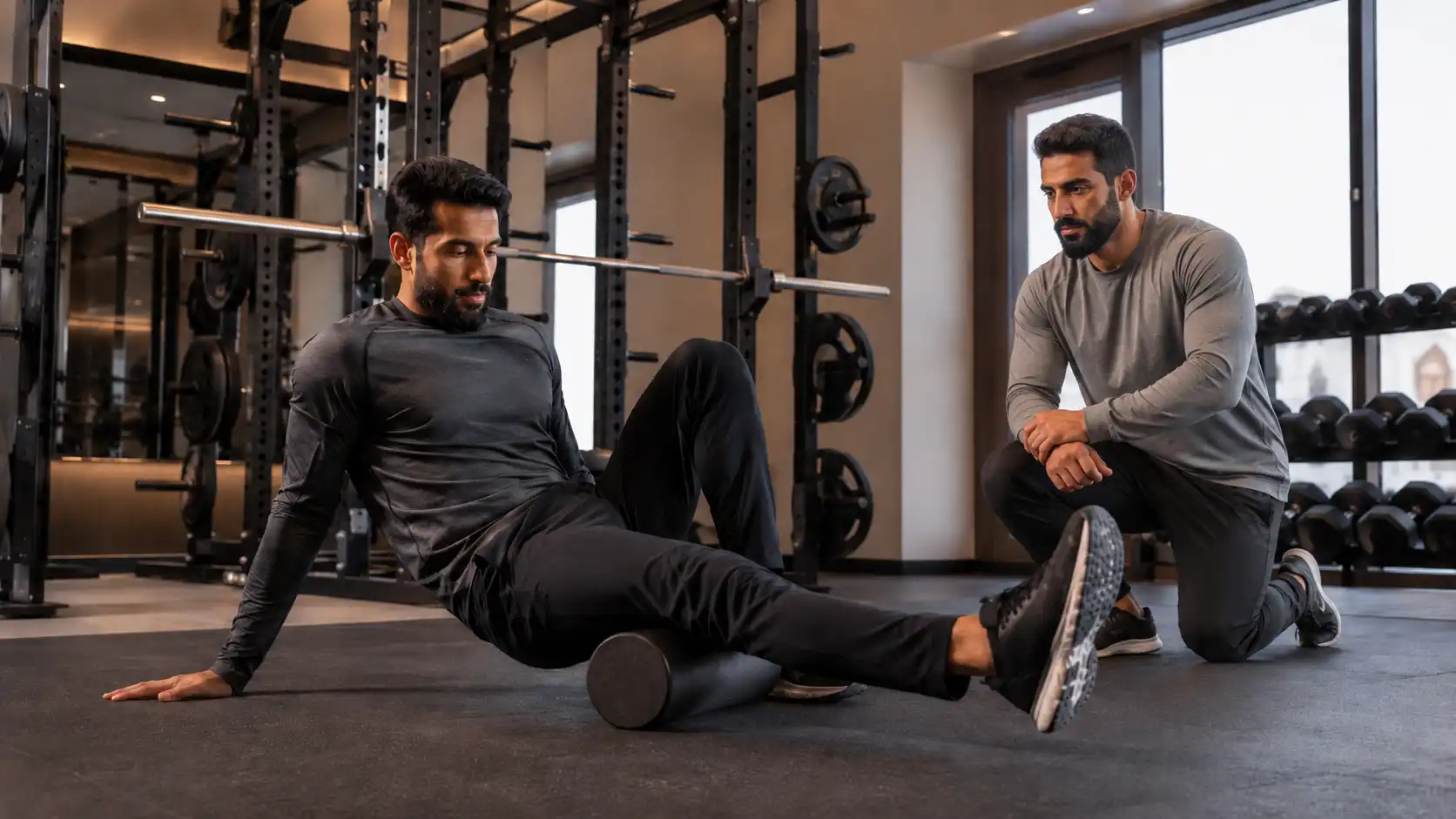
A foam roller often appears at the exact moment training becomes uncertain. Your hips feel stiff before squats, your calves are tender after running, or yesterday’s session has made stairs uncomfortable. You roll the area, feel a strong sensation, and wonder whether you improved recovery or simply tolerated discomfort.
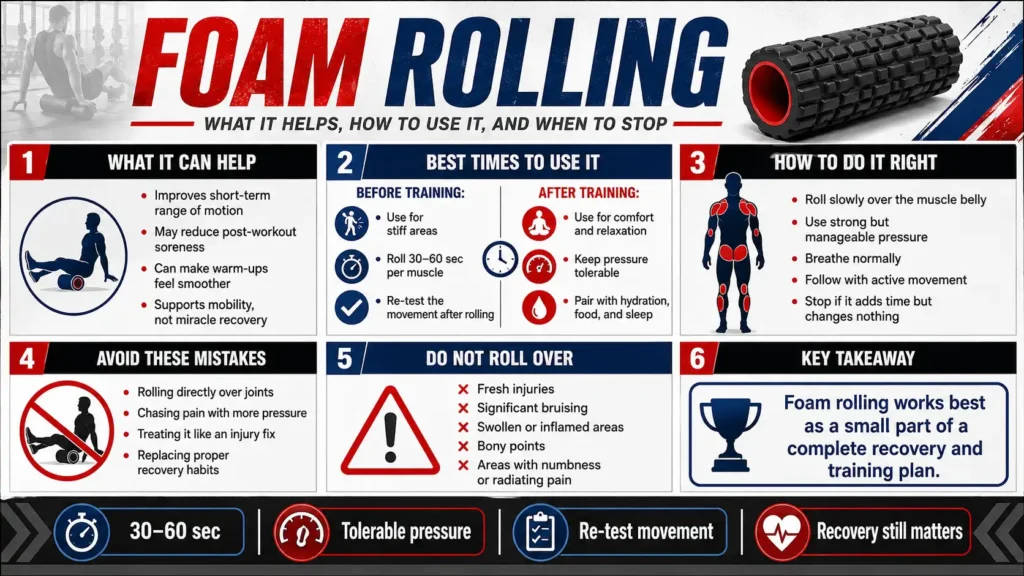
Foam Rolling is most useful when it has a defined job. It can temporarily improve range of motion, may reduce how sore a muscle feels after demanding exercise, and can help some people move into a warm-up with less restriction. It cannot repair an injury, replace sleep and nutrition, or correct a training plan that repeatedly creates more fatigue than you can recover from.
Listen
Foam Rolling Is a Tool, Not a Tissue Reset
Foam Rolling is a form of self-massage in which body weight applies pressure through a cylinder or similar muscle release tool. The immediate outcome is usually a change in sensation or movement tolerance. The exact mechanism remains debated, so claims that the roller literally “breaks up” fascia, scar tissue, or knots should be treated cautiously.
A systematic review and meta-analysis concluded that foam rolling can increase range of motion and may support recovery from exercise-induced muscle damage. That is useful evidence, but it does not make rolling a complete recovery strategy.
“Foam rolling increases range of motion, appears to be useful for recovery from exercise induced muscle damage.”
Brendon Skinner, Richard Moss and Lucy Hammond, research authors — Journal of Bodywork and Movement Therapies
Think of the roller as an accessory beside smarter muscle recovery habits, not as the foundation. Training load, food intake, hydration, sleep, and session spacing usually matter more.
The Benefits Are Specific, Not Universal
The strongest practical case for Foam Rolling is short-term mobility. Reviews have found acute improvements in joint range of motion without a clear reduction in strength, jump, or sprint performance. Longer-term rolling practice may also improve range, although responses differ between muscle groups and joints.
| Goal | What the Evidence Supports | Practical Use | Main Limitation |
|---|---|---|---|
| Pre-workout mobility | A temporary increase in range of motion | Roll a relevant muscle briefly, then rehearse the exercise | The effect does not guarantee better technique |
| Post-workout soreness | A modest reduction in pain perception for some people | Use comfortable pressure after demanding training | It does not erase muscle damage or fatigue |
| Performance | Usually neutral, with small effects in some tests | Keep the dose short enough to avoid unnecessary fatigue | It is not a strength or power enhancer |
| Long-term flexibility | Possible improvement with repeated practice | Track a meaningful movement over several weeks | Results are joint- and muscle-specific |
Range of Motion Is the Clearest Benefit
Foam rolling is not clearly superior to a well-designed stretching and mobility routine for improving range of motion. Choose the method that fits the movement and the session. If rolling makes a squat feel smoother, that can be useful; if nothing changes when you re-test the squat, more pressure is not automatically the answer.
Before Training, Use It to Open a Window
Before exercise, use Foam Rolling to create a short window of easier movement, then convert that window into active control. Rolling the quadriceps before squats may make knee flexion feel more comfortable, but the warm-up still needs ankle movement, hip control, trunk position, and progressively heavier rehearsal sets.
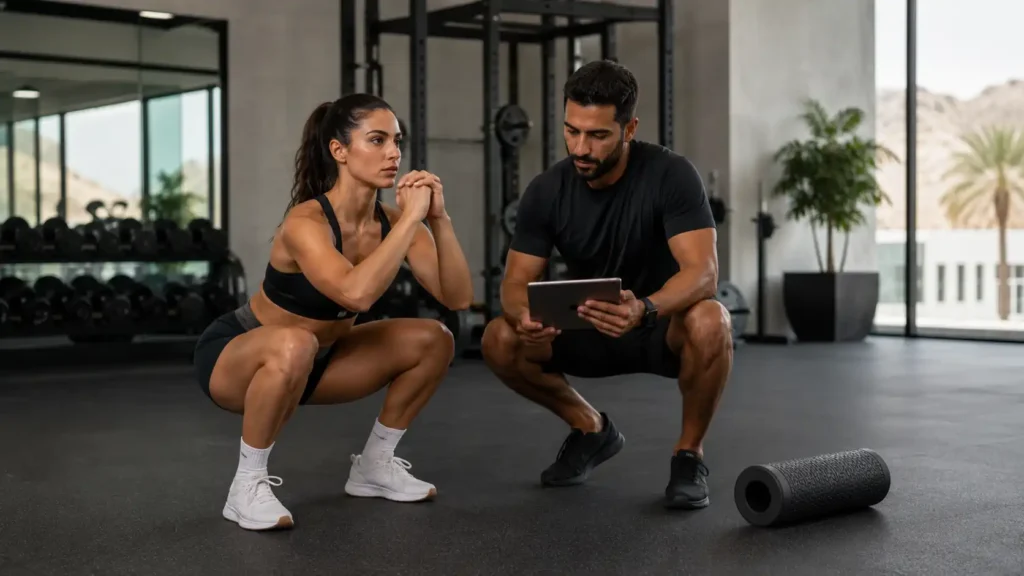
The 30–60 Second Test-Retest Sequence
- Roll one or two relevant muscle groups for roughly 30–60 seconds each.
- Keep the pressure strong but tolerable; breathe rather than bracing.
- Re-test the target movement immediately.
- Follow with dynamic mobility and exercise-specific warm-up sets.
- Remove the rolling drill if it adds time without changing readiness.
This test-retest approach prevents a common gym mistake: collecting recovery rituals without checking whether they improve the next task. It also keeps the warm-up short enough for busy professionals training before work or after a long drive through Muscat.
After Training, Reduce Discomfort Without Chasing Pain
Post-workout foam rolling may reduce perceived soreness and slightly support recovery of some performance measures, but average effects are not dramatic. A meta-analysis of 21 studies found that many performance and recovery outcomes were small or negligible.
“The effects of foam rolling on performance and recovery are rather minor and partly negligible.”
Thimo Wiewelhove et al., sport science researchers — Frontiers in Physiology
That is not a reason to discard the tool. A small improvement in comfort may help you walk normally, perform gentle mobility, or approach the next session with less apprehension. It is a reason to keep expectations proportionate.
Use rolling after training when it feels calming and does not irritate the area. Then return attention to the larger post-workout recovery system: rehydration, a suitable meal, sleep, and enough time before the next hard exposure. Severe soreness, swelling, weakness, or sharp pain should not be treated as a challenge to roll harder.
How to Use a Foam Roller Safely and Efficiently
A productive dose is usually brief and targeted. Research protocols vary widely, and there is no universally accepted combination of pressure, roller density, speed, and duration.
Start conservatively:
- Place the roller under the muscle belly, not directly under a joint or bony point.
- Move slowly across a manageable area instead of racing from end to end.
- Pause on a sensitive spot only while the sensation remains tolerable and local.
- Reduce body weight with your hands or opposite leg when pressure is excessive.
- Stop for sharp, electrical, radiating, numb, or worsening pain.
Do not roll directly over a fresh injury, significant bruising, an inflamed area, a suspected fracture, or unexplained swelling. People with medical conditions affecting circulation, sensation, bone health, or clotting should seek individualized clinical guidance. Good injury-prevention habits involve appropriate assessment and load management, not simply pressing on every painful area.
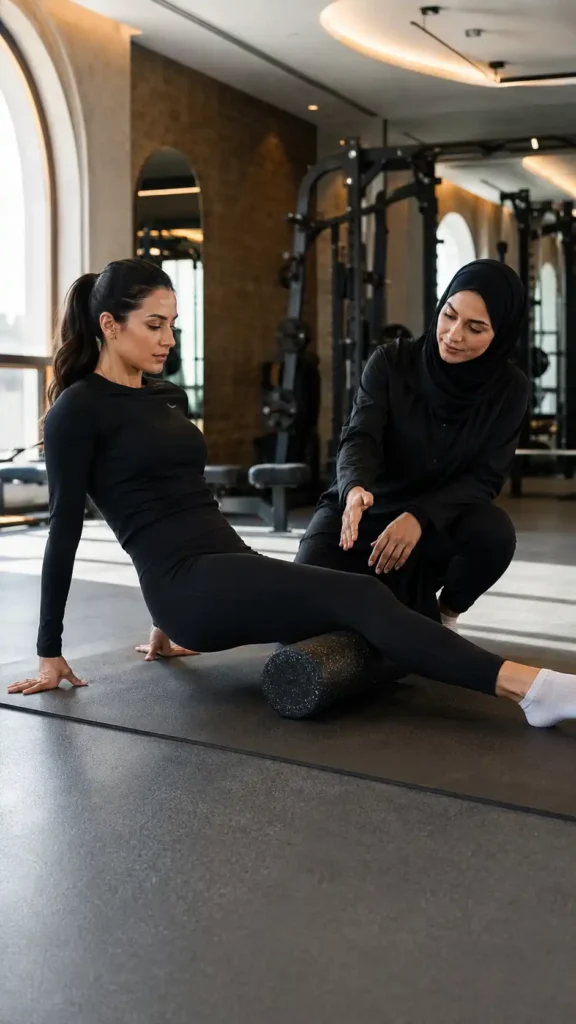
“There currently is no consensus on the optimal SMR program.”
David Cheatham et al., research authors — International Journal of Sports Physical Therapy
When the Roller Is Not the Real Fix
Repeated stiffness can be a programming signal. If your quads require aggressive rolling before every leg session, review weekly volume, exercise selection, technique, sleep, and the distance between demanding sessions. Persistent performance decline and heavy fatigue belong in a broader discussion of under-recovery and overtraining symptoms.
Keep Recovery Cardio Easy
Easy movement can support a recovery day, but it must remain easy. A heart-rate estimate can help stop a walk or bike session from becoming another workout.
Treat the calculated zones as estimates. Heat, dehydration, medication, health conditions, and individual physiology can shift actual heart rate. On a recovery session, finish feeling better rather than depleted, and use a full rest day when fatigue is high.
A roller also cannot compensate for a poor sleep schedule. If the same area remains painful, range keeps decreasing, or symptoms affect normal activity, seek assessment from a qualified healthcare professional rather than repeatedly self-treating the sensation.
Build a Routine That Earns Its Place
For most gym members, five purposeful minutes are more valuable than twenty minutes of random rolling. Choose one limitation, apply a tolerable dose, and re-test a movement that matters. Before training, follow rolling with active preparation. After training, use it for comfort while protecting the basics of recovery.

In Muscat, the habit also needs to fit early sessions, late workdays, air-conditioned offices, and heat-related fatigue. Keep a roller available if it helps you start consistently, but do not let the tool become a substitute for structured training.
Foam Rolling works best as one small decision inside a complete plan. At 5D Fitness, coaching can connect mobility and recovery work to your actual squat, hinge, running, racquet-sport, or strength demands. To stop guessing which recovery tools matter, contact the coaching team to discuss a more individualized training approach.
FAQ
Foam rolling is self-massage using body weight and a roller to apply pressure to muscles and temporarily change movement or soreness perception.
The mechanism is uncertain. It may change sensation and movement tolerance, but claims that it mechanically breaks fascia are not established.
Use it before training for short-term mobility or after training for comfort. The timing should match a specific purpose.
About 30–60 seconds is a practical starting point. Longer is not automatically better, especially when pressure becomes excessive.
It may feel uncomfortable, but avoid sharp, electrical, radiating, numb, or worsening pain. Reduce pressure when you cannot breathe normally.
It may modestly reduce perceived delayed-onset muscle soreness, but it cannot eliminate muscle damage or replace recovery fundamentals.
It can temporarily increase range of motion, and repeated practice may improve flexibility. Responses differ across muscles, joints, and individuals.
Daily use may be acceptable when pressure is tolerable and symptoms do not worsen. A clear goal matters more than frequency.
Avoid direct pressure over joints, bony points, fresh injuries, significant bruising, unexplained swelling, or areas with altered sensation.
Seek help for persistent pain, swelling, weakness, radiating symptoms, reduced function, or discomfort that worsens despite sensible training adjustments.