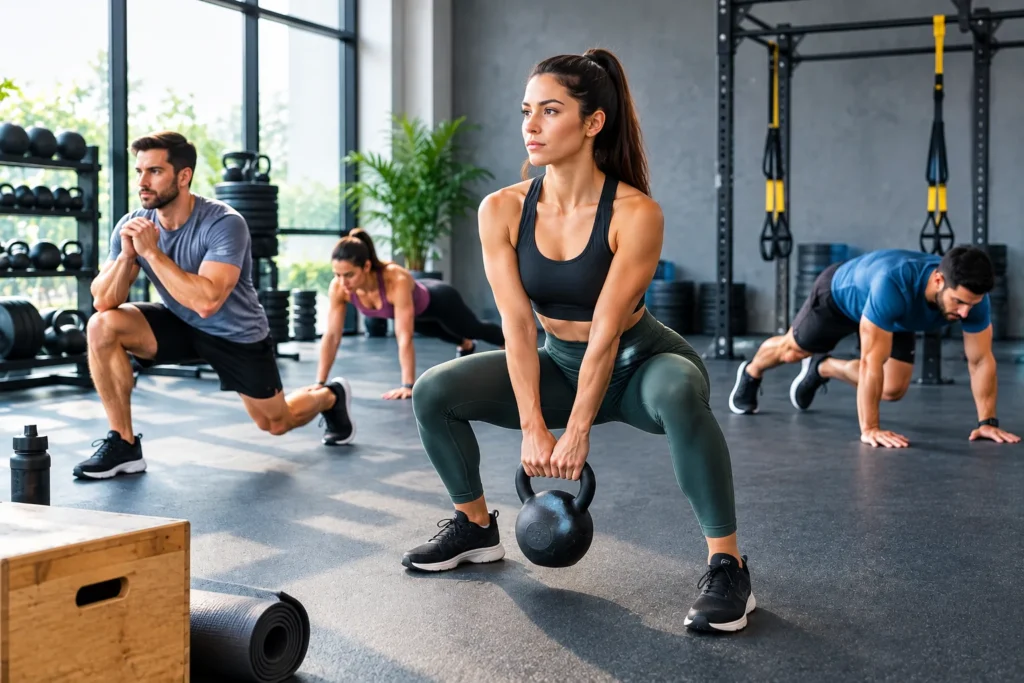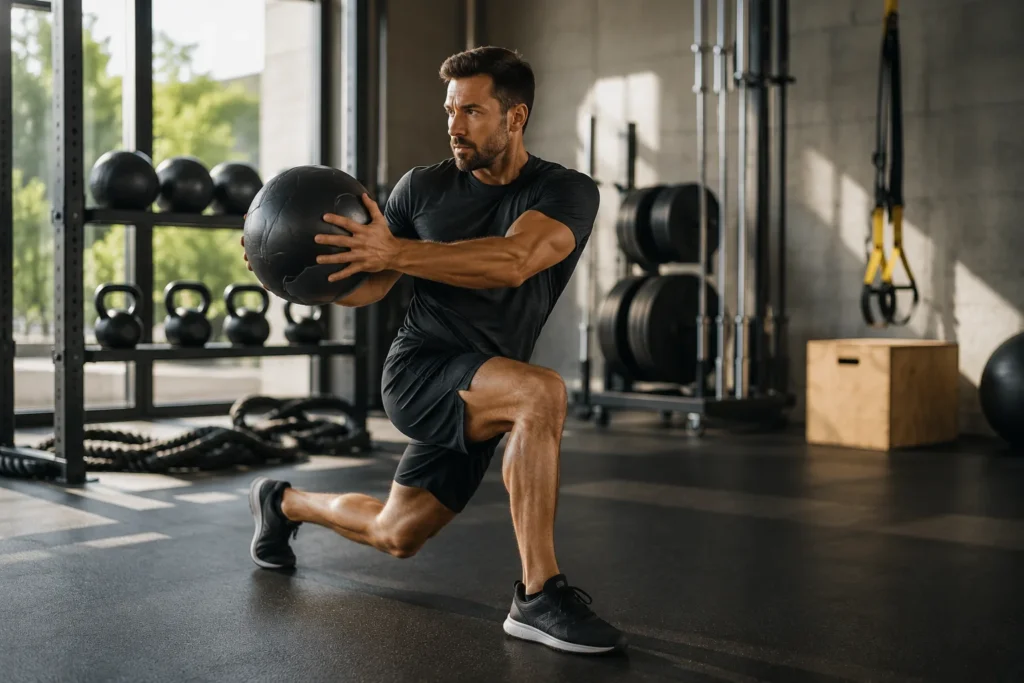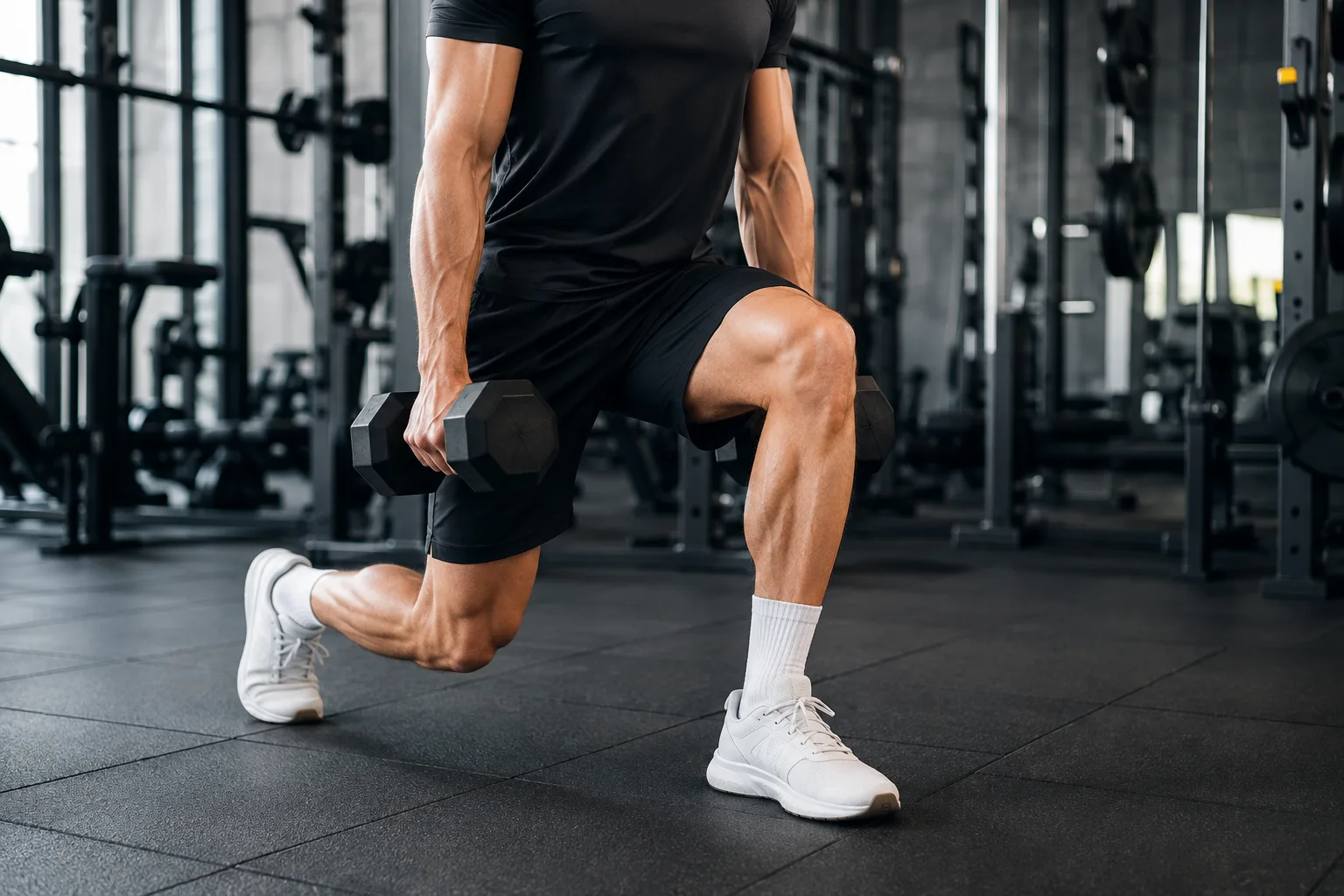
Strong legs and glute muscles are essential for movement, athletic performance, balance, and overall physical fitness. The best exercises to strengthen legs do more than build muscle size; they can improve lower-body strength, movement control, stability, and the ability to perform everyday and athletic activities. A well-designed lower-body program should target the quadriceps, hamstrings, glutes, calves, and supporting muscles through a combination of compound and targeted movements.
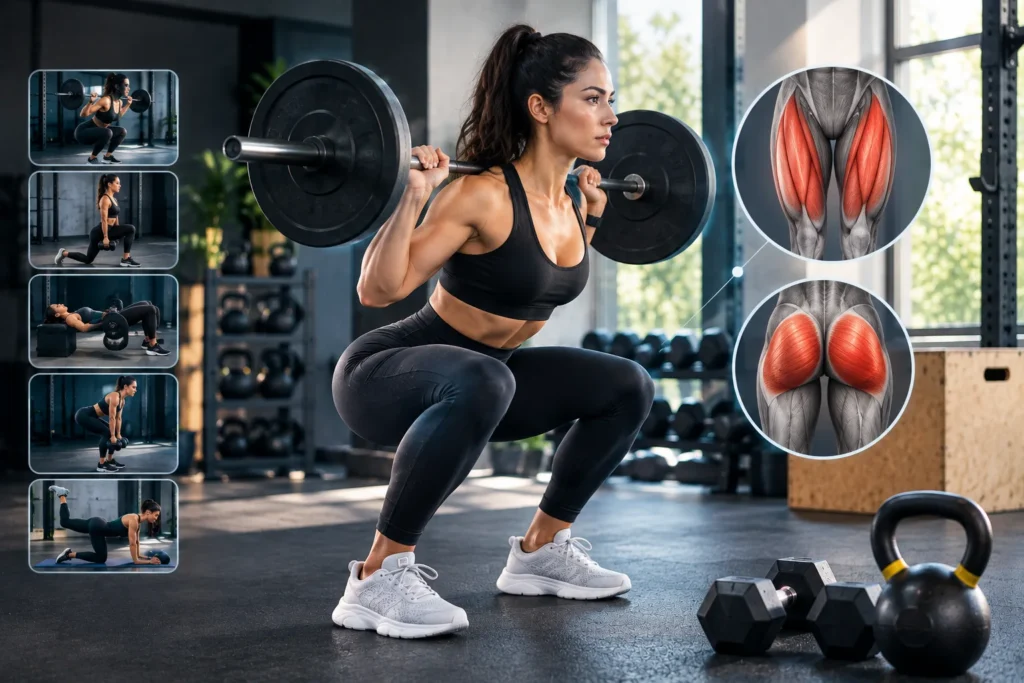
For athletes, bodybuilders, fitness enthusiasts, and beginners, choosing the right exercises depends on training experience, goals, available equipment, and individual movement capacity. In this guide, we will examine effective lower-body exercises, compare squats and lunges, discuss equipment options, and explain how appropriate exercises can support knee function and lower-body performance.
Listen
What Are the Best Exercises to Strengthen Your Legs and Glutes?
The most effective lower-body strengthening exercises are usually those that train several muscles and joints together while allowing progressive increases in resistance or training volume. Movements such as squats, lunges, Romanian deadlifts, hip thrusts, step-ups, and calf raises can collectively target the major muscles of the lower body.
Rather than relying on a single exercise, a balanced training program should include different movement patterns. Squatting emphasizes knee and hip extension, hip-hinge movements target the posterior chain, and unilateral exercises challenge strength and balance between the legs. This combination can provide a more comprehensive approach to lower-body development.
Which muscles should lower-body exercises target?
An effective leg and glute workout should address several major muscle groups:
- Quadriceps: Located at the front of the thigh, they contribute strongly to knee extension.
- Hamstrings: Positioned at the back of the thigh, they contribute to knee flexion and hip extension.
- Gluteal muscles: The gluteus maximus, medius, and minimus contribute to hip extension, stabilization, and movement control.
- Calves: The gastrocnemius and soleus contribute to ankle movement and force production during walking, running, and jumping.
- Hip and core stabilizers: These muscles help maintain alignment and control during lower-body movements.
Training these muscle groups through different movement patterns can create a more balanced lower-body program.
Which exercises are effective for building stronger glutes?
Several exercises can effectively train the gluteal muscles when performed with appropriate technique and progressive resistance.
Hip thrusts strongly emphasize hip extension and can be performed using body weight, dumbbells, or a barbell. Glute bridges provide a simpler alternative and can be useful for beginners.
Romanian deadlifts train the posterior chain, including the glutes and hamstrings, through a controlled hip-hinge movement. Step-ups and lunges also involve the glutes while challenging balance and unilateral strength.
The most important factor is not simply choosing a particular exercise. Consistent training, appropriate resistance, sufficient recovery, and gradual progression are essential for long-term strength and muscle development.
Can bodyweight exercises strengthen the legs?
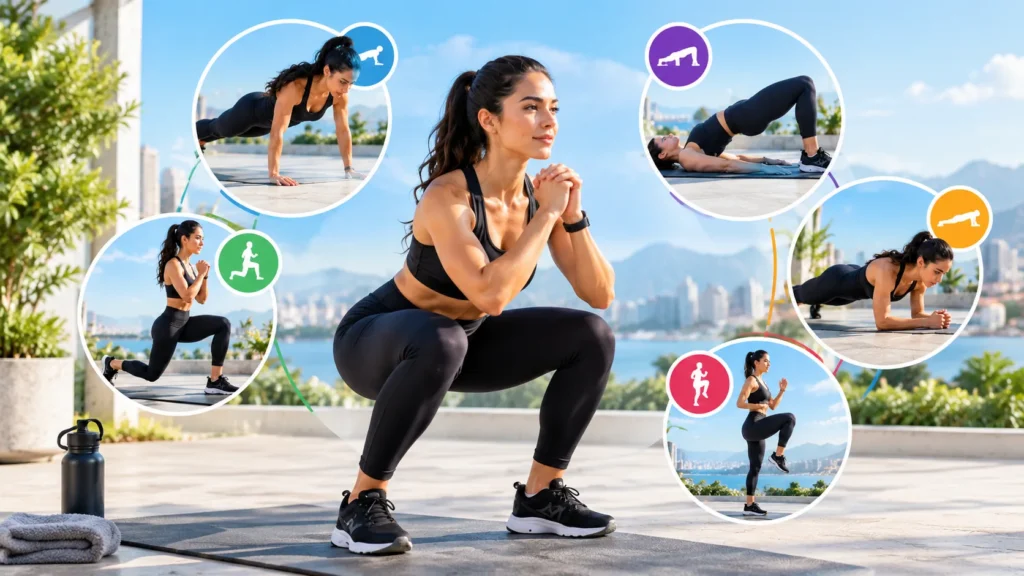
Yes. Bodyweight exercises can provide meaningful resistance, especially for beginners and people training at home.
Bodyweight squats, reverse lunges, step-ups, glute bridges, single-leg variations, and calf raises can all challenge the lower body without requiring gym equipment.
As strength improves, bodyweight exercises can become more challenging by increasing repetitions, slowing the eccentric phase, increasing the range of motion, using unilateral variations, or eventually adding external resistance.
For advanced trainees, however, external resistance is often useful for continuing to provide enough stimulus for strength and hypertrophy.
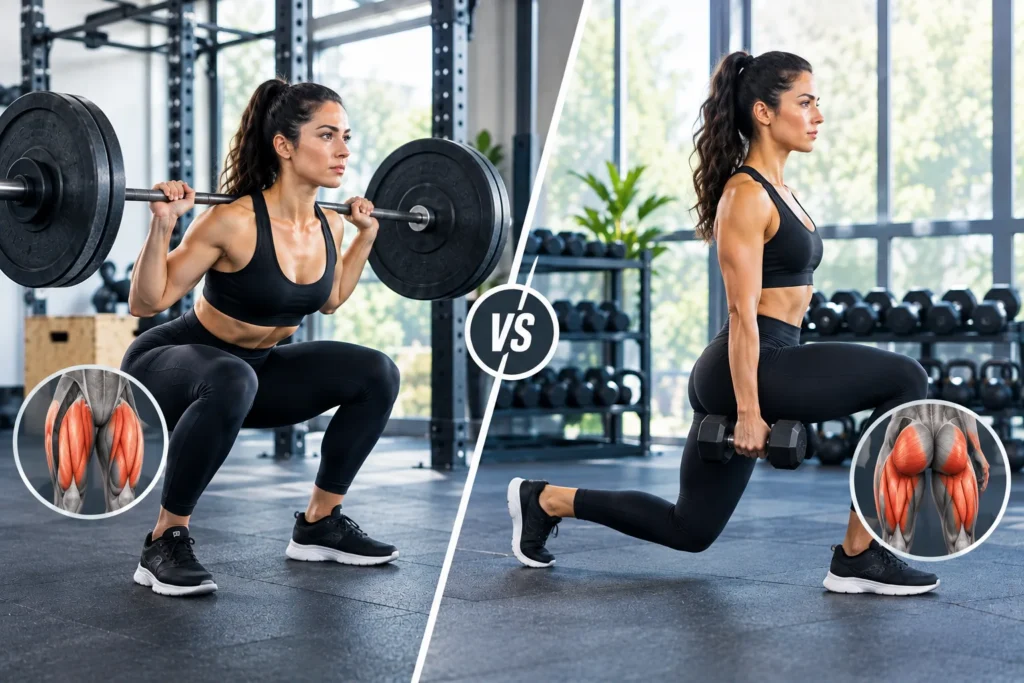
Is Squatting or Lunging Better for Strengthening the Legs?
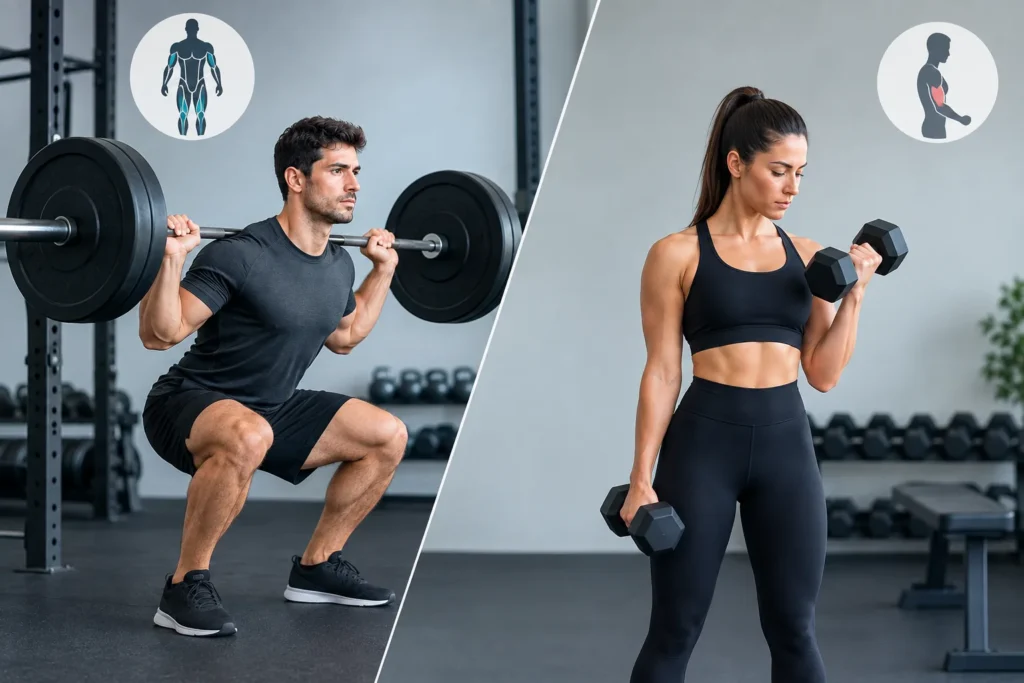
The comparison between squats and lunges is common because both exercises are highly effective lower-body movements. However, neither is universally better. They train overlapping muscles but create different mechanical and coordination demands.
Squats are generally bilateral movements, meaning both legs work together. Lunges are typically unilateral or alternating movements, which can place greater emphasis on individual-leg strength, balance, and coordination.
The best choice depends on the individual’s goals, experience, mobility, and training program. In many cases, including both exercises provides greater variety and more complete lower-body development.
What are the main benefits of squats?
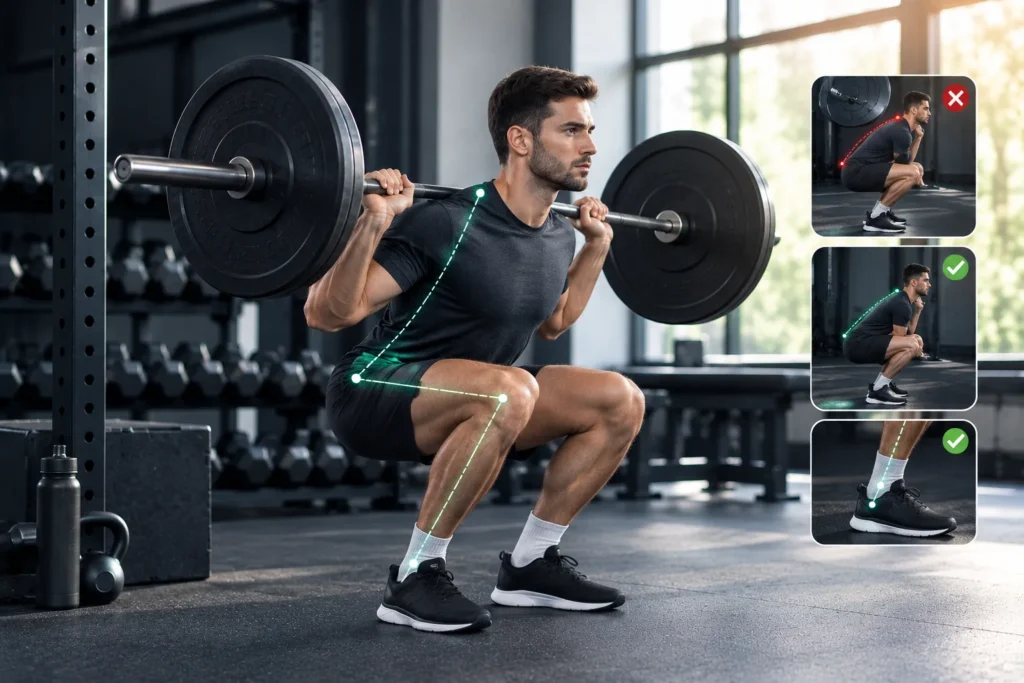
Squats are compound exercises that train the quadriceps, glutes, and other muscles involved in controlling the hips, knees, and trunk.
They are particularly useful for developing lower-body strength because resistance can be progressively increased. Beginners can start with bodyweight squats before progressing to goblet squats, dumbbell squats, or barbell variations.
Squats also allow different variations based on training goals. For example, changing stance width, load position, or depth can alter the movement demands.
Good technique remains important. The appropriate squat depth and resistance should be based on the person’s mobility, experience, and ability to maintain control.
What are the benefits of lunges?
Lunges train the legs and glutes while adding a unilateral component to the workout. Depending on the variation, lunges can challenge balance, coordination, and control more than bilateral exercises.
Reverse lunges are often easier to control than forward lunges and can be a practical starting point for beginners. Walking lunges, lateral lunges, and Bulgarian split squats provide additional variations for more experienced trainees.
Because each leg works more independently, unilateral exercises can also help identify differences in strength or control between the sides.
However, balance limitations can make lunges more technically demanding. Beginners should prioritize stability and controlled movement before increasing resistance.
Should you choose squats or lunges?
For most people, the answer does not need to be either-or.
A well-rounded lower-body program can include squats for bilateral strength and lunges or split squats for unilateral strength and coordination.
For example, a workout could use squats as the primary strength movement followed by reverse lunges as a unilateral exercise. This approach allows both movement patterns to contribute to lower-body development.
The most important consideration is whether the exercise can be performed safely, consistently, and progressively.
The American College of Sports Medicine also emphasizes progressive resistance training as an important component of physical fitness and recommends individualized exercise programming based on goals and fitness level.
American College of Sports Medicine (ACSM)
Which Exercises Are Best for Strengthening the Lower Body?
A complete lower-body program should include exercises that cover several movement patterns, including squatting, hinging, lunging, stepping, hip extension, and ankle movement.
Using different exercises also allows you to distribute training stress across different muscles and joints rather than repeatedly relying on the same movement.
Which exercises are best for the quadriceps?
The quadriceps can be trained effectively through movements that involve knee extension under resistance.
Useful options include:
- Squats
- Split squats
- Reverse lunges
- Step-ups
- Leg presses
- Bulgarian split squats
The resistance and volume should match the individual’s training experience. Beginners can start with bodyweight variations, while advanced trainees may use progressively heavier external loads.
Which exercises are effective for the hamstrings?
The hamstrings contribute to both knee flexion and hip extension, so they can be trained through more than one movement pattern.
Romanian deadlifts are particularly useful for training the hamstrings through hip extension. Other options include leg curls, stability-ball leg curls, and controlled single-leg hip-hinge exercises.
Combining hip-hinge and knee-flexion movements can provide more comprehensive hamstring training.
Which exercises effectively target the glutes?
Glute training can include both compound movements and exercises that emphasize hip extension.
Effective options include:
- Hip thrusts
- Glute bridges
- Squats
- Lunges
- Bulgarian split squats
- Step-ups
- Romanian deadlifts
For muscle growth, the exercise should provide sufficient resistance and be performed consistently over time.
Which exercises should you use for the calves?
Calf raises are among the simplest exercises for strengthening the calf muscles.
Standing calf raises emphasize the gastrocnemius and can be performed using body weight or additional resistance. Seated calf raises place greater emphasis on the soleus because of the bent-knee position.
Athletes involved in running and jumping sports may benefit from combining strength exercises with appropriately programmed plyometric training.
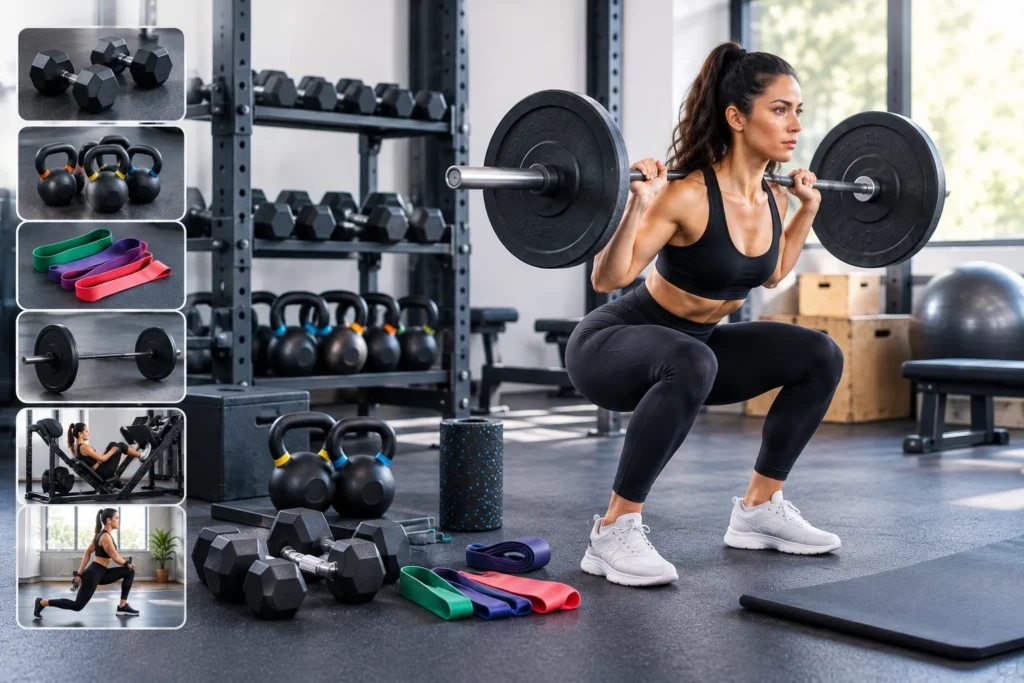
What Equipment Is Needed to Strengthen the Legs?
The equipment required for lower-body training depends on the exercise and training goal. Many effective exercises can be performed with body weight, while additional equipment can make progressive resistance easier.
For home workouts, a few basic pieces of equipment can provide considerable versatility. In a gym environment, barbells and resistance machines offer additional options for progressive loading.
Can dumbbells and kettlebells improve leg training?
Dumbbells and kettlebells are versatile tools for lower-body training.
Dumbbells can be used for goblet squats, lunges, Romanian deadlifts, step-ups, split squats, and loaded carries. Their independent loading also requires each hand and side of the body to control its own weight.
Kettlebells can be useful for goblet squats, deadlifts, swings, lunges, and other functional movements.
For home training, adjustable dumbbells can be particularly practical because they allow resistance to increase without requiring multiple sets of weights.
Are resistance bands useful for strengthening the legs?
Resistance bands can provide additional resistance for several lower-body exercises.
They can be used for:
- Lateral walks
- Glute bridges
- Squats
- Hip abduction exercises
- Hamstring exercises
- Resistance-assisted or resisted movement patterns
Bands are especially convenient for home workouts and travel because they are lightweight and require little storage space.
However, resistance bands do not always provide the same loading characteristics as free weights. For maximal strength development, progressively heavier resistance may eventually be necessary.
Do you need gym machines to build stronger legs?
No. Gym machines are not essential for building stronger legs, but they can be useful tools.
Leg presses, leg curls, leg extensions, and other machines can provide controlled resistance and make it easier to isolate particular muscle groups.
Free-weight and bodyweight exercises offer different benefits, including greater demands on balance and whole-body coordination. Machines can complement these exercises rather than replace them.
The most appropriate equipment is the equipment that allows the trainee to apply progressive resistance while maintaining good technique.
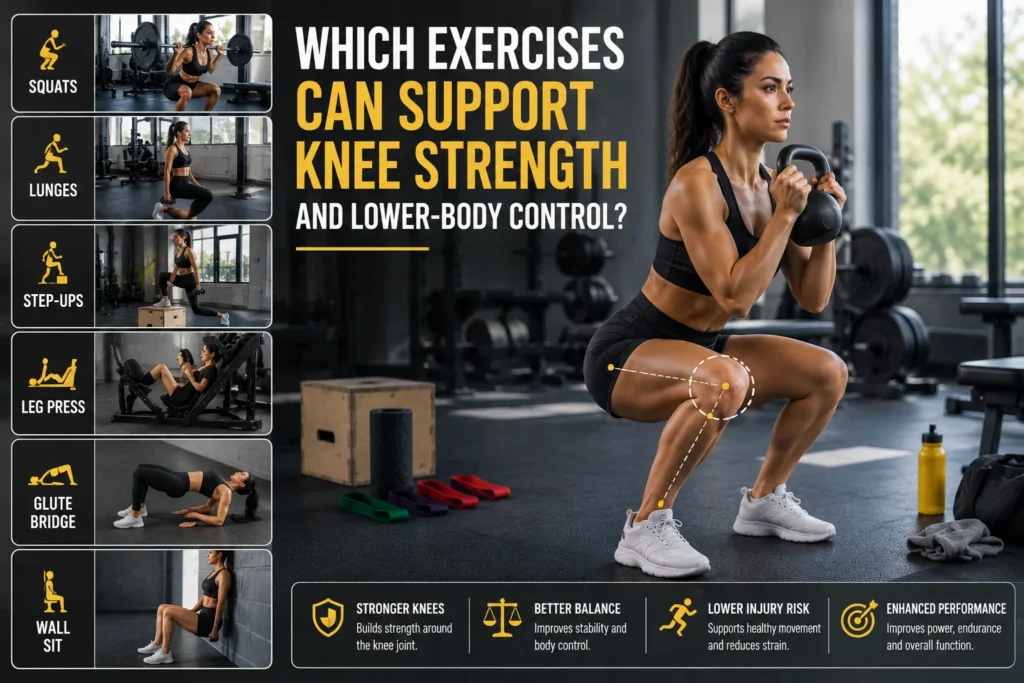
Which Exercises Can Support Knee Strength and Lower-Body Control?
Knee health depends on more than the knee joint itself. The muscles around the hip, thigh, and lower leg contribute to controlling movement and absorbing forces.
Appropriate strengthening exercises can help develop muscular capacity around the lower body, but exercise selection should be individualized when someone has pain, an injury, or a diagnosed knee condition.
For people without an injury, gradual strengthening and good movement control are generally more useful than avoiding lower-body exercise altogether.
Which exercises can strengthen the muscles around the knee?
Exercises that progressively train the quadriceps, hamstrings, glutes, and calves can contribute to overall lower-body strength.
Examples include:
- Controlled squats
- Step-ups
- Reverse lunges
- Glute bridges
- Calf raises
- Split squats
- Low-impact strengthening exercises
The appropriate range of motion and resistance depend on the individual’s ability and training history.
A movement should be performed with control rather than forcing a depth or load that the person cannot manage.
Can corrective exercises improve knee movement?
Corrective exercises may be useful when they address a specific movement limitation or muscular weakness.
However, there is no universal corrective exercise that fixes every knee problem. Knee symptoms can have different causes, and an exercise that is appropriate for one person may not be appropriate for another.
If someone experiences persistent pain, swelling, instability, locking, or significant difficulty performing normal activities, professional assessment is more appropriate than simply adding corrective exercises to a workout.
How can you make leg training more knee-friendly?
Several training principles can help manage lower-body training demands:
- Start with an appropriate resistance.
- Use controlled movement.
- Progress gradually.
- Choose a range of motion you can control.
- Strengthen the hips, thighs, and calves.
- Avoid suddenly increasing training volume.
- Allow sufficient recovery between demanding sessions.
The goal is not to eliminate all knee loading. Instead, the objective is to develop the capacity to tolerate appropriate levels of training progressively.
How to Start a Leg and Glute Strengthening Routine?
A practical lower-body routine should cover the major movement patterns while keeping training volume appropriate for the individual’s experience.
- Step 1: Define your primary goal
Decide whether your main goal is strength, muscle growth, athletic performance, general fitness, or improving lower-body movement capacity.
Your goal will influence exercise selection, resistance, repetitions, rest periods, and weekly training frequency. - Step 2: Select the fundamental movement patterns
Build your program around movements such as:
Squat
Hip hinge
Lunge
Step-up
Hip extension
Calf raise
Core stabilization
This creates a balanced foundation for lower-body development - Step 3: Start with manageable resistance
Choose a resistance that allows you to perform the exercise with consistent technique.
Beginners do not need to start with heavy weights. The initial goal should be learning the movement and developing tolerance to training. - Step 4: Progress gradually
As the exercise becomes easier, increase resistance, repetitions, sets, or another appropriate training variable.
Progression should be gradual rather than sudden. Increasing every training variable at once is usually unnecessary. - Step 5: Allow adequate recovery
Muscles adapt during recovery, not only during the workout.
Sleep, nutrition, hydration, and appropriate rest between demanding sessions all contribute to training quality and long-term progress.
Practical Summary
The best exercises to strengthen legs and glute muscles are not limited to one movement. A well-designed lower-body program combines squats, lunges, hip-hinge exercises, hip-extension movements, step-ups, and calf exercises to train different muscles and movement patterns.
Squats and lunges are both valuable, but they serve slightly different purposes. Squats are excellent for bilateral lower-body strength, while lunges and split-squat variations add unilateral strength, balance, and coordination.
Equipment such as dumbbells, kettlebells, resistance bands, barbells, and gym machines can make progressive resistance easier, but effective leg training is also possible with bodyweight exercises.
For people concerned about their knees, gradual strengthening, controlled movement, appropriate resistance, and individualized exercise selection are more useful than assuming that one corrective exercise works for everyone.
A consistent program, progressive overload, appropriate recovery, and good technique are the foundations of long-term lower-body strength and muscle development.
FAQ
Squats, lunges, split squats, Romanian deadlifts, step-ups, hip thrusts, and calf raises are among the most useful exercises for developing lower-body strength.
Neither is universally better. Squats are excellent for bilateral strength, while lunges provide unilateral training that challenges balance and coordination. Using both can create a more complete program.
Yes. Bodyweight squats, lunges, glute bridges, step-ups, and calf raises can be performed at home. Dumbbells and resistance bands can provide additional loading as strength improves.
Training frequency depends on experience, intensity, total training volume, and recovery. Many people can make progress with lower-body resistance training two or three times per week when sessions are appropriately programmed.
No single piece of equipment is universally best. Dumbbells, kettlebells, resistance bands, barbells, and machines can all be useful depending on the training goal and available space.
Progressive strengthening of the quadriceps, hamstrings, glutes, and calves can contribute to lower-body capacity and movement control. However, people with persistent knee symptoms should seek individualized professional assessment.