
Injury during exercise is one of the most important barriers to maintaining a consistent fitness routine. Although regular physical activity provides substantial benefits for cardiovascular health, metabolic function, mental well-being, mobility, and longevity, exercise also creates mechanical and physiological demands that can lead to acute injuries or overuse problems when training is poorly planned. The World Health Organization recommends that adults accumulate 150–300 minutes of moderate-intensity aerobic activity or 75–150 minutes of vigorous activity per week, alongside muscle-strengthening activities on at least two days.
For people balancing demanding careers, international relocation, business responsibilities, and long working hours, injury prevention is not simply a fitness issue. An injury can interrupt routines, reduce productivity, increase healthcare costs, and undermine long-term physical capacity. This guide from 5dfitness examines the major factors behind exercise-related injuries and explains how training load, technique, recovery, equipment, strength, mobility, and individual risk factors can be managed more intelligently.
The objective is not to eliminate all physical risk—an unrealistic goal—but to reduce avoidable risk while preserving the benefits of regular exercise. The following analysis combines practical training principles with guidance from major health and sports-medicine organizations.
Listen
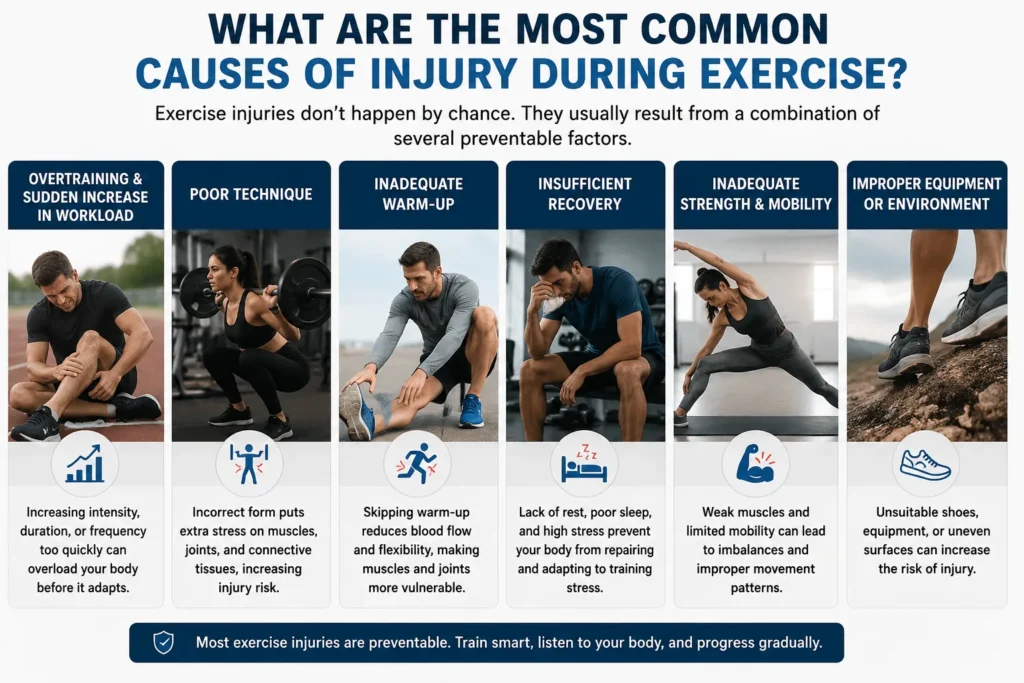
What Are the Most Common Causes of Injury During Exercise?
Understanding why injuries happen is the foundation of prevention. Exercise-related injuries rarely result from one isolated mistake. In many cases, they emerge from an interaction between training load, inadequate recovery, technical limitations, previous injuries, insufficient physical preparation, environmental conditions, and individual differences.
The risk profile also varies considerably by activity. Running places repeated impact forces on the lower extremities, resistance training creates substantial muscular and connective-tissue loading, while contact sports introduce collision-related risks. Even apparently low-risk activities can cause problems when performed excessively or progressed too quickly.
The CDC notes that musculoskeletal injuries are among the most common adverse events associated with physical activity, while injury risk is influenced by both fitness level and total activity volume. Its guidance specifically emphasizes gradually increasing activity rather than making abrupt changes.
Why does increasing training volume too quickly cause injuries?
One of the most important principles in injury prevention is that the body needs time to adapt to increased physical stress. Muscles, tendons, bones, ligaments, and the nervous system do not necessarily adapt at the same speed. A person may feel cardiovascularly capable of completing a demanding workout while their connective tissues are not yet prepared for the same workload.
This creates a common problem among people returning to exercise after a long period of inactivity. They may remember what they were capable of several years ago and attempt to reproduce that performance immediately. The result can be excessive soreness, tendon irritation, joint pain, stress reactions, or acute muscular injuries.
The CDC’s Physical Activity Guidelines explain that both physical fitness and the total amount of activity influence musculoskeletal injury risk. The guidelines recommend increasing physical activity gradually over time to minimize risk.
A practical approach is to treat training progression as an adaptation process rather than a test of motivation. Instead of increasing duration, intensity, frequency, and resistance simultaneously, increase one major variable at a time. For example, a new runner might initially increase running frequency while keeping pace relatively stable. A strength trainee might increase repetitions before substantially increasing weight.
Training history matters as much as current motivation. Someone who exercised consistently for years may tolerate a workload that would be excessive for a beginner. Similarly, a person recovering from injury may require a substantially slower progression.
The objective should therefore be progressive overload with controlled exposure, not maximum effort at every session. A sustainable training plan creates enough stimulus to produce adaptation while leaving sufficient capacity for recovery.
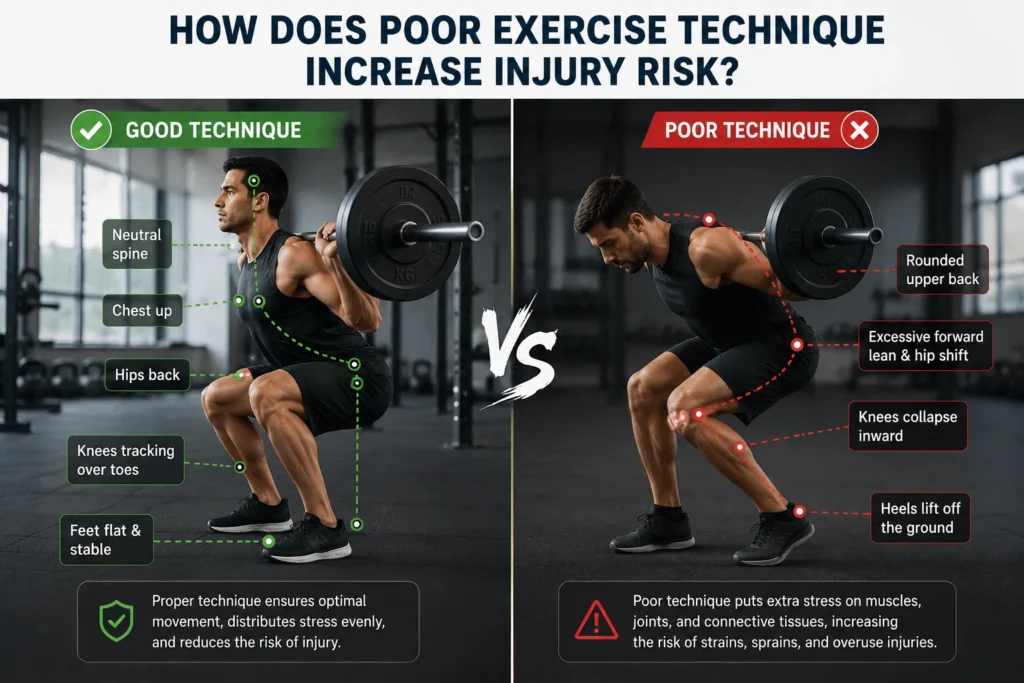
How does poor exercise technique increase injury risk?
Exercise technique determines how mechanical forces are distributed throughout the body. When movement patterns are inefficient or inappropriate for an individual’s current strength and mobility, certain tissues may repeatedly experience loads they are not prepared to tolerate.
This does not mean that there is always one universally “perfect” movement pattern. Human anatomy varies, and different people can safely perform the same exercise using slightly different techniques. The more important principle is whether the technique is appropriate for the individual’s anatomy, training objective, load, fatigue level, and experience.
For example, during resistance training, losing control of a movement because the load is too heavy can change joint positions and increase stress on muscles and connective tissues. In running, excessive fatigue can alter stride mechanics. In cycling, an inappropriate bike setup can create repetitive stress across the knees, hips, back, or shoulders.
Technique also deteriorates under fatigue. An athlete may perform ten repetitions with excellent control and then compensate during the final repetitions because the target muscles can no longer maintain the required movement pattern.
This is why technique should be evaluated not only at the beginning of a workout but also under realistic training conditions. Reducing the load, shortening a session, or increasing rest periods can sometimes improve technical quality more effectively than simply telling someone to “use better form.”
Professional instruction can be particularly valuable for beginners, people returning after injury, and individuals entering technically demanding sports. The American College of Sports Medicine emphasizes preparticipation evaluation as a way to identify injuries, illnesses, or other factors that could affect safe participation.
Can fatigue itself make exercise more dangerous?
Fatigue is not automatically harmful, but excessive or poorly managed fatigue can compromise movement quality, concentration, coordination, and decision-making. These effects become particularly important during activities that require precision, balance, rapid changes of direction, or heavy external loads.
There is also an important distinction between normal training fatigue and warning signs of excessive stress. Burning muscles, elevated breathing, and temporary performance reduction can be normal responses to demanding exercise. Sharp pain, sudden weakness, loss of coordination, unusual dizziness, chest symptoms, or pain that changes movement mechanics should not simply be interpreted as evidence that a workout is “working.”
Fatigue can accumulate across several dimensions. A person may be physically fatigued because of training, neurologically fatigued because of inadequate recovery, or mentally fatigued because of work and life stress. Poor sleep and inadequate nutrition can further reduce the ability to tolerate a normal training load.
For professionals and entrepreneurs with irregular schedules, this is particularly relevant. A training program should account for the person’s actual lifestyle rather than assuming that every day offers identical recovery capacity.
One useful strategy is to establish a hierarchy of training priorities. On high-energy days, a person can complete the planned workload. On days of substantial fatigue, they can reduce volume, intensity, or exercise complexity while maintaining movement consistency.
The goal is not to avoid fatigue. The goal is to distinguish productive training stress from accumulating risk.

How Can Warm-Ups, Mobility, and Technique Reduce Injury Risk?
Preparation before exercise is frequently treated as an optional ritual, yet an effective warm-up has a practical purpose: it prepares the body and nervous system for the demands that are about to occur. The optimal warm-up depends on the activity, environmental conditions, training intensity, and individual characteristics.
A warm-up should not necessarily be long or exhausting. Its value comes from specificity. Someone preparing for heavy squats requires a different preparation strategy from someone preparing for a 5-kilometer run or a recreational tennis match.
Mobility should also be understood carefully. Limited range of motion can sometimes contribute to movement compensation, but aggressively stretching every muscle before every workout is not a universal injury-prevention solution. Preparation should instead focus on the movement requirements of the planned activity.
What should an effective warm-up include?
An effective warm-up generally progresses from low-intensity general movement toward activity-specific preparation. The purpose is to raise body temperature, increase circulation, rehearse movement patterns, and gradually expose tissues to the forces they will experience during the workout.
For aerobic exercise, this might involve several minutes of easy walking or cycling followed by progressively faster movement. For resistance training, a person may perform unloaded or lightly loaded versions of the target movement before reaching working weight.
A useful warm-up can contain three components:
- General movement: Low-intensity activity raises physiological readiness without creating substantial fatigue.
- Dynamic movement: Controlled movements through relevant ranges of motion prepare joints and muscles for the positions required during exercise.
- Specific preparation: Gradually increasing the intensity or resistance of the actual exercise allows the body to transition into the working demands.
Static stretching is not inherently dangerous, but prolonged static stretching immediately before maximal explosive performance may not be appropriate for every activity. The warm-up should therefore be designed around the session rather than copied from a generic routine.
Another important principle is efficiency. A warm-up that consumes excessive energy can become counterproductive. The person should finish feeling prepared rather than tired.
For beginners, a short and consistent warm-up is often more valuable than a complicated protocol they cannot maintain. Consistency matters because injury prevention is fundamentally a behavior and training-management problem, not merely a collection of exercises.
Is stretching necessary to prevent exercise injuries?
Stretching can be useful, but its role in injury prevention is often exaggerated. Flexibility is only one component of physical capacity, and increasing flexibility does not automatically guarantee lower injury risk.
Different activities require different ranges of motion. A gymnast, swimmer, runner, weightlifter, and office worker may have completely different mobility requirements. Attempting to maximize flexibility without considering functional demands can therefore be unnecessary.
Dynamic mobility exercises can be useful before training when they help an athlete access the positions required by the session. Static stretching can also have a place after training or in separate mobility sessions when improving range of motion is a specific objective.
The key distinction is between mobility limitation and mobility obsession.
If restricted ankle mobility prevents a person from performing a required squat pattern safely and comfortably, addressing that limitation can be valuable. If a recreational exerciser has sufficient range of motion for their chosen activity, aggressively trying to increase it may provide little additional benefit.
Mobility should also be paired with strength. A joint that can move through a large range but cannot control that range under load may not be functionally prepared for demanding exercise.
Therefore, a better strategy is to identify the ranges of motion required for the activity and develop sufficient mobility and control to perform them effectively.

How important is proper technique for beginners?
For beginners, technical learning should generally precede aggressive increases in training intensity. The nervous system needs time to learn movement patterns, coordinate muscles, and develop efficient strategies for controlling resistance or body weight.
A common mistake is selecting a weight based on ambition rather than movement quality. If someone can technically lift a heavier load but loses control, range of motion, or stability, the additional weight may provide little useful training benefit relative to the increased risk.
Beginners should prioritize repeatable movement patterns. A movement that looks good once but becomes unstable after several repetitions is not yet sufficiently developed for high-volume training.
Instruction from a qualified trainer can accelerate learning, particularly for technically demanding movements. Video analysis can also be useful when used carefully, although visual analysis should complement rather than replace professional assessment when pain or significant dysfunction is present.
Technique should evolve with experience. Advanced athletes may intentionally modify movement patterns to target specific muscles or accommodate individual anatomy, while beginners usually benefit from simpler, controlled variations.
Most importantly, technique should not be treated as an aesthetic performance. Its purpose is to help the individual perform the intended task efficiently and consistently.
When should someone stop an exercise because of pain?
Pain during exercise requires context. Not every uncomfortable sensation represents tissue damage, but neither should significant pain automatically be ignored.
A practical distinction is between expected exertion and potentially concerning symptoms. Muscle fatigue, temporary burning, and mild post-exercise soreness can occur during normal training. Sharp, sudden, escalating, or localized pain is more concerning, especially when it changes movement.
Pain accompanied by swelling, instability, loss of strength, numbness, significant bruising, inability to bear weight, or a sudden “pop” deserves professional assessment. Chest pain, severe shortness of breath, fainting, or other potentially serious systemic symptoms require immediate medical attention rather than continued exercise.
The “no pain, no gain” mentality is therefore an unreliable injury-prevention philosophy. Training stimulus can be challenging without being destructive.
When symptoms repeatedly appear during the same movement, the appropriate response is to investigate the cause rather than repeatedly testing the painful movement. Possible factors include excessive load, poor recovery, technique limitations, insufficient preparation, or an underlying injury.
Persistent or worsening symptoms should be evaluated by an appropriate healthcare professional. Exercise advice cannot replace individualized medical diagnosis.
How Should Training, Recovery, and Equipment Be Managed?
Injury prevention extends beyond what happens during the workout itself. Training frequency, sleep, nutrition, hydration, equipment, footwear, environment, and scheduling all influence how well the body handles physical stress.
The strongest prevention strategy is rarely one isolated intervention. Instead, it is a system in which several moderate protective factors work together. Consistent training develops fitness, sensible progression controls workload, adequate recovery supports adaptation, and appropriate equipment reduces unnecessary external stress.
The CDC reports that people who are physically fit generally have lower musculoskeletal injury risk than less-fit individuals, while higher total activity can increase risk. This illustrates an important paradox: regular exercise can make the body more resilient, but excessive or poorly progressed exercise can increase injury exposure.
How much recovery does the body need between workouts?
Recovery requirements vary according to exercise type, intensity, training status, age, sleep quality, nutrition, stress, and individual physiology. There is therefore no universal number of hours that guarantees complete recovery.
Resistance training that heavily loads a particular muscle group may require more recovery than low-intensity walking. High-impact running may place substantial repetitive stress on tissues even when the cardiovascular demand feels manageable.
Recovery should also be considered globally. Someone sleeping five hours per night and working under intense psychological stress may recover differently from someone sleeping eight hours with a lower overall stress burden.
Useful indicators include persistent soreness, declining performance, unusual fatigue, irritability, sleep disruption, elevated perceived effort at familiar workloads, and recurring minor pain.
Rest does not necessarily mean complete inactivity. Active recovery such as walking, gentle cycling, mobility work, or low-intensity movement can be appropriate when the person feels well enough.
The most effective recovery strategy is usually predictable rather than extreme. Regular sleep, adequate food intake, hydration, rest days, and sensible training distribution are more sustainable than attempting to compensate for excessive training with occasional recovery interventions.
For busy professionals, scheduling recovery can be particularly important. Treating rest as a deliberate component of the training plan makes it less likely that work obligations will consistently push recovery aside.

How important are shoes and other exercise equipment?
Equipment can influence comfort, biomechanics, performance, and exposure to environmental hazards, but equipment should not be treated as a substitute for appropriate training progression.
Footwear is a good example. Running shoes should be appropriate for the activity, comfortable, and replaced when they are excessively worn. However, buying increasingly expensive footwear does not eliminate the fundamental risks created by sudden mileage increases or inadequate recovery.
Resistance-training equipment should be stable, correctly adjusted, and used according to its intended purpose. Cycling equipment should be fitted appropriately, while protective equipment is essential in sports where collisions or falls are foreseeable.
Environmental equipment matters too. Outdoor athletes may need appropriate clothing, lighting, hydration, temperature management, and visibility measures depending on the conditions.
The risk profile of an activity can also change dramatically with the environment. Wet surfaces, poor lighting, uneven ground, extreme heat, and inappropriate training surfaces can introduce hazards that are unrelated to physical fitness.
The most useful approach is therefore to ask whether each piece of equipment solves a specific risk or performance problem. Equipment should support good training decisions, not create false confidence.
How do sleep, nutrition, and hydration affect injury prevention?
The body’s capacity to adapt to exercise depends partly on adequate energy, nutrients, fluids, and sleep. These factors influence tissue repair, neuromuscular performance, concentration, and the ability to tolerate repeated training.
Sleep is particularly important because insufficient sleep can impair reaction time, concentration, mood, and perceived exertion. These effects may become relevant when performing technically demanding or high-risk activities.
Nutrition also needs to match the training demand. Chronically inadequate energy intake can compromise recovery and may increase vulnerability to fatigue and other problems. Protein provides amino acids required for tissue maintenance, while carbohydrates support higher-intensity exercise and glycogen replenishment.
Hydration requirements depend on climate, sweat rate, exercise duration, and individual differences. In hot environments, fluid and electrolyte management can become particularly important.
There is no single “perfect” diet for injury prevention. The more important principle is adequate and consistent nutrition that supports the person’s actual training volume and health requirements.
For people traveling frequently or relocating internationally, nutrition and sleep can become unpredictable. Jet lag, long flights, unfamiliar food environments, and irregular work schedules can temporarily alter recovery capacity. During these periods, adjusting training intensity can be more intelligent than attempting to maintain a normal program regardless of circumstances.
How Can Different People Reduce Their Individual Risk of Injury?
There is no universal injury-prevention program because risk is influenced by age, previous injuries, physical condition, sport, occupation, training experience, health status, and environment.
A healthy recreational walker does not require the same precautions as a competitive football player. A beginner returning after several years of inactivity should not follow the same progression as an experienced athlete. Likewise, an individual with a previous injury may require specific rehabilitation or return-to-sport guidance.
The concept of individualization is therefore central to effective prevention. The objective is not to make every person train conservatively; it is to make training appropriate for the person’s actual risk profile.
ACSM’s preparticipation evaluation framework is designed to help identify medical and musculoskeletal factors that may influence safe participation.
Should beginners get medical clearance before starting exercise?
Not every healthy adult needs a medical examination before beginning moderate physical activity. However, medical assessment can be appropriate when someone has known health conditions, concerning symptoms, significant risk factors, or plans to begin unusually strenuous exercise.
ACSM’s screening framework focuses on identifying factors that could affect safe participation and determining whether medical clearance is appropriate before an exercise program.
This should not be interpreted as a reason to discourage physical activity. Screening exists to help people choose an appropriate level and type of activity.
Individuals with a history of significant cardiovascular, pulmonary, metabolic, neurological, or musculoskeletal problems should consider discussing their intended exercise program with an appropriate healthcare professional.
The same principle applies to people returning after major injury or surgery. Rehabilitation and return-to-exercise decisions should be based on the nature of the injury rather than a generic timetable.
The most important point is that medical screening is a risk-management tool, not an obstacle to exercise. ACSM and other organizations involved in preparticipation evaluation emphasize the objective of promoting safe participation rather than unnecessarily excluding people from sport.
“Some physical activity is better than doing none.”
How should older adults adapt exercise to reduce injury risk?
Older adults can benefit substantially from physical activity, but training should account for changes in strength, balance, recovery capacity, joint function, and fall risk.
WHO recommends that adults aged 65 and older include multicomponent physical activity emphasizing functional balance and strength training on three or more days per week to enhance functional capacity and help prevent falls.
The emphasis should therefore be on maintaining capability rather than simply pursuing intensity. Strength training can help preserve muscle function, while balance exercises can improve confidence and reduce fall-related risk.
Progression remains important. An older beginner does not necessarily need extremely light exercise forever; they need an appropriate starting point followed by gradual adaptation.
Exercises can also be modified according to joint comfort, balance, previous injuries, and functional goals. For example, supported strength exercises may initially be more appropriate than unstable movements.
Recovery becomes increasingly important when training frequency or intensity rises. Monitoring soreness, fatigue, and performance can help determine whether the workload is appropriate.
A well-designed program for older adults is not fundamentally different in its principles from a younger person’s program: progressive overload, adequate recovery, appropriate technique, and individualized exercise selection remain central.
How can people returning after an injury avoid getting injured again?
Previous injury is one of the most important factors to consider when returning to exercise. The CDC specifically notes that people who have experienced a previous injury may be at increased risk of reinjury in the affected area.
Returning too quickly because pain has disappeared can be problematic. Symptoms may improve before strength, coordination, endurance, tissue capacity, and confidence have fully recovered.
A return-to-exercise process should therefore progress through stages. Initially, the objective may be restoring comfortable movement. The next stage can involve rebuilding strength and capacity, followed by progressively greater exposure to the demands of the target activity.
For athletes, return-to-sport decisions can involve sport-specific testing, functional assessments, and medical or physiotherapy guidance. ACSM maintains consensus resources addressing return-to-sport and return-to-play considerations.
The person should also investigate why the original injury occurred. If the underlying issue was excessive workload, simply returning to the same workload recreates the original risk. If equipment, technique, recovery, or strength deficits contributed, those factors should be addressed before returning to full intensity.
The goal should not be merely to become pain-free. The goal is to restore sufficient capacity to tolerate the demands of the activity.
What injury-prevention principles apply to busy professionals and frequent travelers?
People with demanding careers often face a unique training problem: inconsistency. They may train intensely for several days when their schedule allows, stop during travel, and then attempt to compensate by performing excessive workouts when they return.
This pattern can create larger fluctuations in training load than a moderate, consistent routine.
A more sustainable strategy is to establish a minimum viable training routine. During busy weeks, this might consist of short strength sessions, walking, mobility work, or brief cardiovascular workouts. During periods with more time, volume can increase gradually.
Travel also introduces environmental variables. Long periods of sitting can make the first workout after travel feel different, while jet lag and disrupted sleep can reduce readiness for high-intensity training.
The solution is not to stop exercising during travel. Instead, training should become adaptable. A hotel-room strength session, walking-based activity, resistance bands, or a short gym session can preserve consistency without requiring maximal workloads.
For entrepreneurs, investors, and internationally mobile professionals, the most valuable fitness program may therefore be the one that survives schedule disruption.
Consistency creates adaptation. Adaptation increases capacity. Capacity allows the person to handle more demanding training with less relative stress.

What Practical Strategy Can Reduce Injury During Exercise Most Effectively?
The evidence suggests that injury prevention is best understood as a system rather than a single technique. No warm-up, shoe, supplement, stretching routine, or piece of equipment can compensate for chronically excessive training load or inadequate recovery.
WHO emphasizes that physical activity provides major health benefits across the lifespan and that any amount of activity is better than none. The objective should therefore not be to make exercise feel completely risk-free, but to create a sustainable balance between stimulus and recovery.
A strong prevention strategy combines progressive training, appropriate exercise selection, technical competence, recovery, environmental awareness, and individual risk assessment.
This principle is particularly important because fear of injury can itself become a barrier to physical activity. The correct response to injury risk is generally smarter participation, not inactivity.
What should an effective injury-prevention routine look like?
An effective routine should begin with a realistic assessment of the person’s current fitness and training history. Someone who has been inactive for months should start from their current capacity rather than their previous peak.
Before each workout, a short activity-specific warm-up can prepare the body. During the session, technique and effort should be monitored. Training volume should increase gradually, while recovery days and lower-intensity sessions should be deliberately included.
A simple framework is:
- Prepare: Use a warm-up appropriate to the planned activity.
- Progress: Increase workload gradually rather than making sudden jumps.
- Perform: Prioritize controlled technique and appropriate exercise selection.
- Recover: Protect sleep, nutrition, hydration, and rest.
- Monitor: Pay attention to persistent pain, unusual fatigue, performance changes, and recurring symptoms.
- Adapt: Modify the plan when circumstances change.
This approach is more useful than following rigid rules because it allows the training program to respond to real-world conditions.
The most effective injury-prevention system is one that the person can maintain for years. A technically sophisticated program that is impossible to follow consistently is less valuable than a simple program that supports regular, progressive activity.
What should you do if you notice recurring pain during exercise?
Recurring pain should be treated as information rather than an inconvenience to suppress. If the same movement repeatedly produces pain, continuing to perform it at the same intensity without investigation may increase the likelihood of a persistent problem.
The first step is to reduce or modify the provoking activity. This does not always mean stopping all physical activity. Often, an alternative movement can maintain fitness while reducing stress on the affected area.
Next, examine the training variables: Has the workload recently increased? Has frequency changed? Is the exercise technically demanding? Has recovery declined? Has equipment changed? Has the person recently returned from inactivity?
Persistent symptoms, significant functional limitations, swelling, weakness, instability, neurological symptoms, or acute traumatic events warrant professional evaluation.
It is also important not to self-diagnose based solely on internet information. Multiple conditions can produce similar symptoms, and an accurate diagnosis may require physical examination or other assessment.
The most rational injury-prevention mindset is therefore neither “ignore pain” nor “avoid all discomfort.” It is monitor, modify, investigate, and progress intelligently.
Which exercise choices generally have lower injury risk?
Exercise risk depends on intensity, technique, environment, participant experience, and whether the activity involves impact or collision. The CDC notes that moderate-intensity, low-impact activities generally have lower injury rates than vigorous, high-impact, or collision-based activities.
Walking, swimming, stationary cycling, recreational cycling, and controlled resistance training can provide effective ways to develop physical fitness while allowing relatively manageable progression.
However, a lower-risk activity can still cause injury when performed excessively. Walking several hours every day after months of inactivity, for example, may create an abrupt workload increase.
Similarly, resistance training is not inherently dangerous. Its risk depends heavily on load selection, technique, exercise complexity, training volume, supervision, and progression.
The best activity is therefore not necessarily the one with the lowest theoretical injury rate. It is the activity that matches the individual’s goals, preferences, physical capacity, environment, and ability to perform it consistently.
Enjoyment matters because adherence determines long-term exposure to physical activity. A sustainable program is more valuable than an “optimal” program that someone abandons after several weeks.
Practical Summary
Preventing injury during exercise requires a long-term risk-management approach rather than one isolated precaution.
| Prevention principle | Practical action |
|---|---|
| Manage training load | Increase duration, intensity, and resistance gradually |
| Improve technique | Learn movement patterns before aggressively increasing load |
| Warm up appropriately | Use activity-specific preparation before demanding sessions |
| Build strength | Train major muscle groups progressively |
| Maintain mobility | Address meaningful movement limitations without excessive stretching |
| Prioritize recovery | Protect sleep, nutrition, hydration, and rest |
| Use appropriate equipment | Select stable, comfortable, activity-specific equipment |
| Monitor symptoms | Do not repeatedly ignore recurring or worsening pain |
| Individualize training | Account for age, fitness, injury history, and lifestyle |
| Adapt during travel | Reduce intensity rather than compensating for missed sessions |
| Seek professional advice | Obtain medical or rehabilitation assessment when appropriate |
WHO’s global recommendations support regular physical activity because its overall health benefits are substantial. Adults should generally target 150–300 minutes of moderate aerobic activity or 75–150 minutes of vigorous activity per week, plus muscle-strengthening activities on at least two days, while individual circumstances may require modification.
The central lesson is simple: exercise should challenge the body without consistently overwhelming its ability to adapt.
For readers of 5dfitness, the most productive approach is to think of fitness as a long-term investment. Consistency, progressive adaptation, intelligent recovery, and informed decision-making create a stronger foundation than short-term intensity.
Conclusion
Preventing injury during exercise is not about eliminating physical stress; it is about managing stress intelligently. The strongest approach combines gradual progression, appropriate technique, effective preparation, adequate recovery, sensible equipment, individualized programming, and timely response to warning signs.
The broader evidence also shows why injury prevention should not become an excuse for inactivity. Regular physical activity provides major benefits for cardiovascular health, metabolic health, mental well-being, mobility, and long-term quality of life.
For investors, entrepreneurs, professionals, and internationally mobile individuals, physical capacity can be viewed as a long-term personal asset. Protecting that asset requires consistency rather than extremes.
Start intelligently, progress gradually, recover deliberately, and treat recurring symptoms as information—not something to ignore.
FAQ
Start below your maximum capacity, learn correct technique, warm up, and increase training gradually. Avoid simultaneously increasing workout frequency, duration, intensity, and resistance.
A warm-up can prepare the cardiovascular system, muscles, joints, and movement patterns for the upcoming activity. It should be appropriate to the exercise and should not leave you fatigued.
No. Stretching can improve flexibility when limited range of motion is relevant, but injury prevention also depends on strength, training load, technique, recovery, equipment, and individual risk factors.
There is no universal percentage that applies to everyone. Increase workload progressively and avoid sudden major changes, particularly after inactivity or injury. The CDC specifically recommends increasing physical activity gradually.
Mild muscle soreness after unfamiliar exercise can be normal. However, sharp pain, significant swelling, weakness, instability, or symptoms that worsen during movement should not be treated as ordinary soreness.
Musculoskeletal injuries are among the most common exercise-related problems. These include muscle strains, tendon problems, joint injuries, and overuse injuries.