
Yoga can look simple from the outside: choose a class, copy the poses, and expect better flexibility. In practice, the useful questions are more specific. Do you want calmer movement after work, improved balance, a stronger bodyweight challenge, or support alongside gym training? Yoga in Oman can serve each goal, but not every style, room temperature, or class pace produces the same training effect.
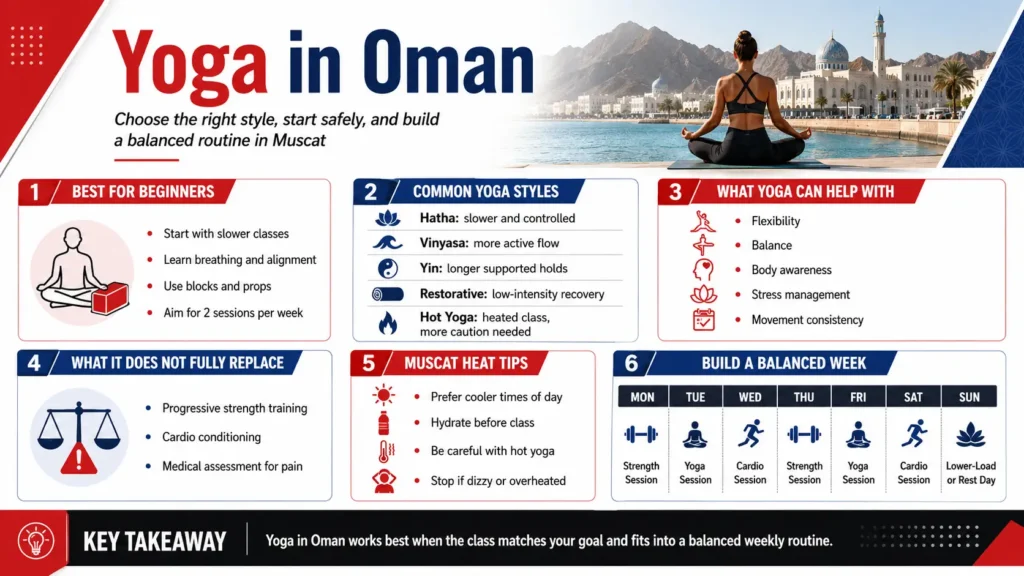
For people in Muscat, the decision also involves indoor comfort, outdoor heat, modest clothing, schedule consistency, and whether yoga will be the main activity or one part of a broader fitness plan. This guide helps you choose deliberately rather than joining a class based only on its name or popularity.
Listen
Why Yoga in Oman Appeals to Different Fitness Goals
Yoga combines physical postures, breathing, attention, and, depending on the tradition, meditative elements. Modern classes range from quiet, supported sessions to demanding flows that challenge balance, muscular endurance, coordination, and concentration. That range explains why two people can both practise yoga while experiencing very different sessions.
“Yoga is an ancient and complex practice, rooted in Indian philosophy.”
National Center for Complementary and Integrative Health — NIH
The National Center for Complementary and Integrative Health reports potential benefits relating to stress management, sleep, balance, and general wellness, while also noting that research includes different yoga styles and participant groups. The practical conclusion is not that one class solves every fitness problem. The style, instructor, frequency, intensity, and your starting point all shape the outcome.
Some people choose yoga to become more mobile. Others want a structured reason to slow down, breathe, and move after long hours at a desk. Athletes may use selected yoga sessions to complement resistance training or recreational sports. The right reason is the one that matches your actual needs and helps you remain consistent.
Choose the Class by Its Training Effect, Not Its Trend Name
Class names are useful labels, but they are not guarantees. A beginner vinyasa class may still move quickly, while a carefully coached hatha class can include challenging holds. Before booking yoga classes in Muscat, ask what the session actually involves: movement pace, pose duration, room temperature, use of props, expected experience, and whether the instructor offers practical alternatives.
| Style or format | Typical emphasis | May suit | Main caution |
|---|---|---|---|
| Hatha or beginner yoga | Slower postures, breathing, and basic alignment | New participants learning positions and transitions | The difficulty of a “beginner” class can still vary |
| Vinyasa or power yoga | Continuous sequences, transitions, and muscular endurance | People who enjoy a more active and energetic class | Speed can hide poor control or unstable positions |
| Yin yoga | Longer supported or relatively passive holds | Quiet flexibility-focused practice | Participants should not force end-range positions |
| Restorative yoga | Props, low effort, relaxation, and comfortable positioning | Lower-intensity days and stress management | It does not replace progressive strength or cardio |
| Hot yoga | Yoga performed in a deliberately heated environment | Experienced participants who tolerate heat well | Overheating and dehydration require additional caution |
This comparison provides a starting point, but the teaching method still matters. Clear instructions, manageable progression, sensible use of props, and permission to modify positions are more valuable than an impressive sequence of advanced poses.
What Yoga Can Improve—and What It Cannot Replace
Consistent yoga practice may improve flexibility, balance, movement confidence, coordination, and awareness of breathing or body position. It can also provide a lower-intensity way to move on days when a demanding workout would be poorly timed. However, the benefits depend on the style practised and the quality of the programme.
A targeted stretching and mobility routine may be more efficient when one joint or movement pattern is the main limitation. Yoga provides a broader practice that may combine mobility, balance, breathing, and muscular endurance in the same session.
“Any amount of physical activity is better than none, and more is better.”
World Health Organization — Guidelines on Physical Activity and Sedentary Behaviour
That principle makes yoga a legitimate entry point into regular physical activity, but complete fitness usually requires more than one modality. The World Health Organization also recommends aerobic activity and muscle-strengthening work. Someone seeking greater maximal strength, muscle development, or progressive loading should combine yoga with a structured strength-training plan.
People seeking better cardiovascular conditioning may also need walking, cycling, swimming, running, or another appropriately dosed aerobic activity. A fast yoga flow may elevate heart rate, but that does not automatically mean it provides enough sustained cardiovascular work for every goal.
Yoga should not be treated as a guaranteed treatment for pain. If a pose causes sharp, radiating, numb, unstable, or progressively worsening symptoms, stop and seek appropriate assessment. Feeling a strong stretch is not proof that a joint needs more range, and discomfort is not a reliable measure of session quality.
A Practical First Month for Beginners
For beginners considering Yoga in Oman, the first month should build familiarity, physical tolerance, and enough consistency to judge whether the practice fits. You do not need daily classes or advanced poses. Two well-chosen sessions per week can provide clearer feedback than an ambitious seven-day streak followed by fatigue or abandonment.
- Week 1: Choose a slower class and learn how the instructor explains breathing, stance, joint position, and transitions.
- Week 2: Repeat a similar class instead of constantly changing styles, instructors, and difficulty levels.
- Week 3: Add one short home practice of 10–15 minutes using positions already taught in class.
- Week 4: Review comfort, energy, balance, range of motion, recovery, and whether the schedule feels sustainable.
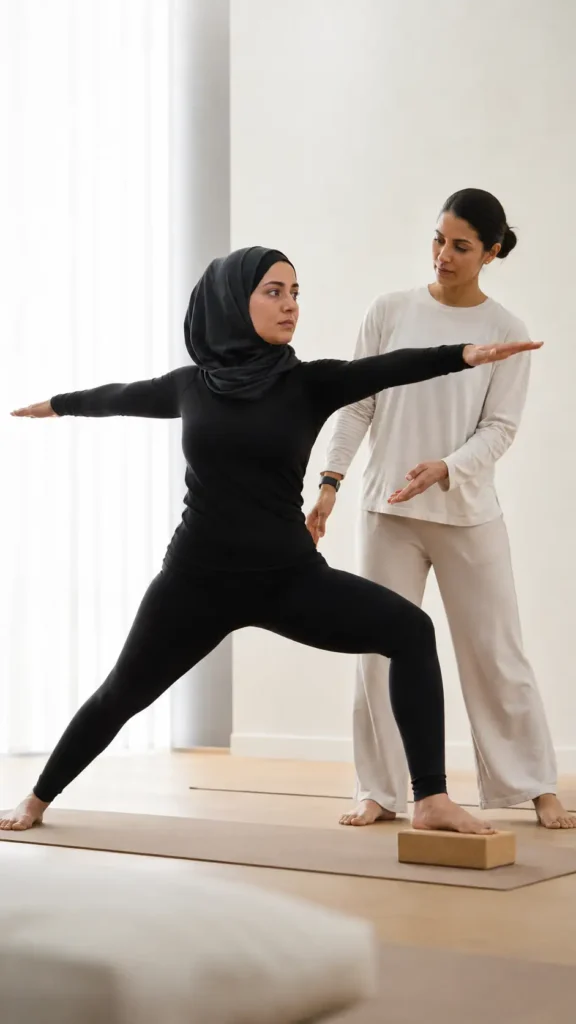
Use blocks, straps, bolsters, a wall, or a chair when they improve stability and control. These tools are not signs of poor performance. They allow the position to fit your current mobility rather than forcing your body to imitate someone else’s range.
Avoid turning flexibility into a competition. One of the most common training mistakes is progressing visible difficulty before the basic movement pattern is stable. In yoga, this may mean attempting a deeper pose while losing balance, holding the breath, or shifting stress into a joint that is not controlling the position well.
Where Yoga Fits Beside Strength and Cardio
Yoga can work before, after, or between harder training sessions, but the dose should match its intended role. A brief dynamic sequence may prepare movement before exercise. A demanding power yoga class is a workout in its own right and should not automatically be treated as recovery. Restorative practice may suit a lower-intensity day, although genuine accumulated fatigue may still require a complete rest day.

A balanced week could include two strength sessions, two yoga sessions, and two easy-to-moderate cardio exposures, with at least one lower-load day. That is only an example rather than a universal prescription. The correct balance depends on your goals, training history, available time, sleep, and ability to recover.
People deciding between home yoga and coached sessions can apply the same principles used when comparing home and gym training. Home practice may offer convenience, while an instructor can provide feedback, progression, accountability, and modifications that are difficult to obtain from a generic video.
Heart rate can help you understand whether an active class is contributing meaningful aerobic work. Estimate your training zones below, then compare the result with how your heart rate behaves during steady sections of a session.
Treat the calculated zones as estimates, not as a score for yoga quality. Pose changes, isometric effort, breathing patterns, room temperature, hydration, medication, and individual physiology can all affect heart rate. If most of the class remains below a moderate aerobic intensity, keep separate cardio in your week rather than assuming the yoga session replaces it.
Muscat Heat Changes Timing and Hydration Decisions
Indoor yoga can be comfortable throughout the year, but travel to the class, outdoor sessions, and deliberately heated studios change the risk profile. A mat on a shaded terrace shortly after sunrise is not equivalent to an exposed afternoon session. Humidity, direct sunlight, air movement, session intensity, clothing, and personal heat tolerance all matter.
"Do outdoor activities during the coolest parts of the day or evening, if possible."
Centers for Disease Control and Prevention — Heat Health Guidance
Bring water, begin the class reasonably hydrated, and avoid assuming that heavy sweating means a better or more effective session. The guide to hydration for workouts in Oman explains why fluid needs vary with environmental conditions, session duration, intensity, and individual sweat loss.

Stop exercising and move to a cooler environment if you experience dizziness, nausea, unusual weakness, confusion, severe headache, loss of coordination, or symptoms that continue after resting. Anyone with health conditions that affect heat tolerance, hydration, blood pressure, or heart rate should seek appropriate professional guidance before choosing hot yoga.
Good Instruction Makes Modification Normal
A responsible yoga instructor should ask about relevant injuries, health conditions, pregnancy, balance concerns, and previous experience. The instructor should explain alternatives without pressuring participants into headstands, deep backbends, extreme hip positions, painful stretches, or forceful breathing exercises.
The National Center for Complementary and Integrative Health advises beginners to avoid extreme practices and notes that hot yoga can carry overheating and dehydration risks. A class should make it normal to reduce the range of motion, rest, change a pose, or stop when something does not feel appropriate.
- The instructor explains the purpose of a movement rather than only demonstrating its final shape.
- Beginner and lower-intensity options are offered without embarrassment.
- Participants are not forced deeper into positions through aggressive manual pressure.
- Breathing cues do not require you to ignore dizziness or distress.
- Advanced poses are presented as optional skills rather than proof of fitness.

Choose a class where you can control transitions, breathe without panic, and leave with symptoms no worse than when you arrived. Sensible injury-risk reduction habits include gradual exposure, appropriate technique, recovery, and early response to warning signs. Yoga can complement medical care, but it should not delay assessment of persistent or concerning symptoms.
Build a Yoga Practice That Fits Your Real Week
Yoga in Oman works best when the class matches the outcome you actually value. Choose slower instruction when you need to learn positions, a more active flow when you want a challenging movement session, or restorative work when the goal is calm, low-load practice. Then check what is still missing from the week: progressive strength, aerobic conditioning, sufficient sleep, or a more complete recovery system.
Do not measure progress only by touching the floor, performing a handstand, or copying an advanced pose. Better control, steadier balance, smoother breathing, repeatable attendance, improved confidence, and greater comfort in daily movement are often more useful early markers.
A sustainable practice should fit around work, family responsibilities, recovery, and the rest of your training. If you want yoga integrated into a structured fitness plan rather than added randomly, contact 5D Fitness to discuss your goals, current routine, and the most practical next step in Muscat.
Frequently Asked Questions
Yes. Start with a slower class, tell the instructor you are new, and use props or simpler variations when needed.
A well-coached beginner hatha class is often accessible, but class pace and teaching quality matter more than the label.
Two sessions weekly is a practical start. Add frequency only when recovery, schedule, and movement quality remain comfortable.
Usually not for maximal strength or progressive muscle development. Combine yoga with resistance training when those outcomes matter.
Active flows may raise heart rate, but many classes do not provide sustained moderate aerobic work. Track intensity rather than assuming.
It may improve range of motion with consistent practice, but avoid forcing positions and build strength through the range you gain.
It adds overheating and dehydration risk. Beginners, pregnant people, older adults, and those with health conditions need extra caution.
Choose modest, breathable clothing that stays secure during bending and reaching without restricting movement or requiring constant adjustment.
Seek medical guidance for persistent or concerning pain. An instructor can modify poses but should not diagnose the underlying cause.
The better time is the one you can repeat. Morning may feel energizing, while evening practice may help you unwind.