
You train hard, sweat through a demanding session, and choose the “metabolism-boosting” drink afterward. Yet your body composition barely changes. The frustrating part may not be a lack of effort. Many popular metabolism tactics target a very small part of daily calorie expenditure while ignoring the larger levers.
A realistic Metabolism Boost in Oman does not come from one food, supplement, cold shower, or punishing workout. It comes from maintaining metabolically active tissue, moving more across the whole day, training with enough progression, eating in a way that supports adherence, and recovering well enough to repeat the plan.
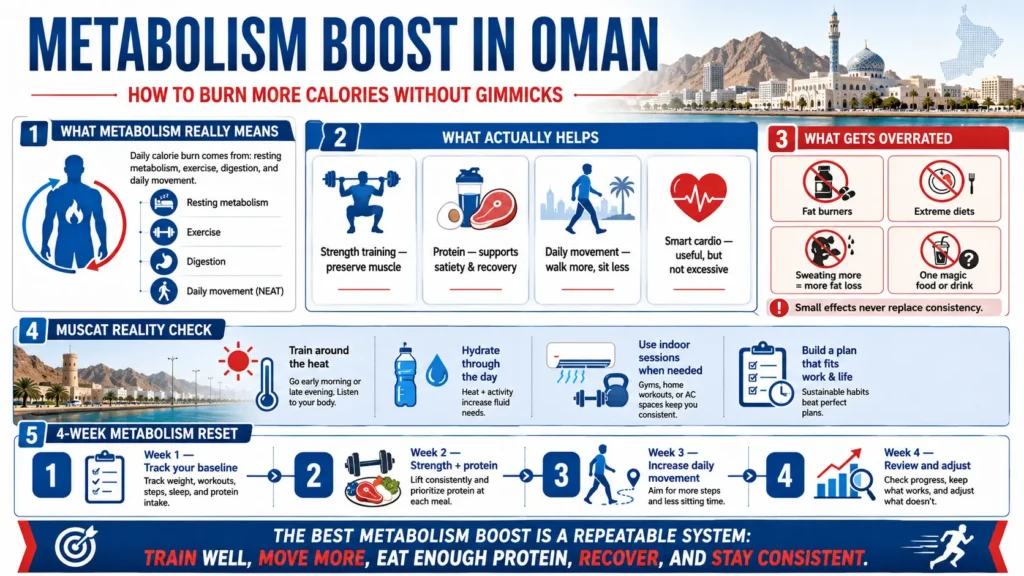
In Muscat, a successful strategy should also account for heat, hydration, work schedules, indoor routines, social meals, and periods when training times change. The useful question is not, “How can I force my body to burn calories faster today?” It is, “How can I build a week that keeps total energy expenditure, training quality, and consistency high?”
Listen
Your Metabolism Is a System, Not an On-Off Switch
Metabolism describes the chemical processes that keep the body functioning. In fat-loss conversations, people usually mean total daily energy expenditure: the calories used at rest, during digestion, through planned exercise, and through all other movement.
Resting energy expenditure is normally the largest component. It supports breathing, circulation, temperature regulation, organ function, and tissue maintenance. You cannot safely “hack” it upward by hundreds of calories with a tea, spice, or morning ritual. Body size, lean mass, age, genetics, health status, and energy intake all influence it.
The rest of daily expenditure comes from several adjustable areas:
- Thermic effect of food: Energy used to digest, absorb, and process nutrients.
- Exercise activity: Lifting, cardio, sport, swimming, classes, or conditioning.
- Non-exercise activity: Walking, standing, stairs, errands, household tasks, and general movement.
- Metabolic adaptation: Changes in expenditure as body weight, food intake, fatigue, and activity patterns change.
This explains why a hard gym hour may not overcome a very sedentary day. It also explains why an aggressive diet can feel effective initially, then become harder as body weight falls, hunger rises, training quality declines, and spontaneous movement drops.
Metabolic adaptation is real, but “my metabolism is broken” is usually too simplistic. Some reduction in energy needs is expected because a lighter body costs less energy to maintain and move. Research also suggests that an additional adaptive reduction can occur in some people, although its size varies and may diminish after weight stabilisation.
The correct response is not panic. It is to reassess calorie intake, movement, recovery, and the sustainability of the plan.
What Actually Produces a Useful Metabolism Boost?
The best metabolism strategy improves total weekly expenditure without creating so much hunger, soreness, or fatigue that the person compensates elsewhere. Coaches often see the opposite: a member adds daily high-intensity intervals, starts eating very little, then sits more, performs worse, sleeps poorly, and overeats at the weekend.
The following comparison separates meaningful metabolic levers from exaggerated ones.
| Approach | What It Can Realistically Change | Main Limitation |
|---|---|---|
| Progressive resistance training | Preserves or builds lean mass, improves strength, and supports higher-quality training | Requires progression and recovery; session calorie burn is not its only benefit |
| More daily walking and standing | Raises non-exercise activity with relatively low fatigue | Easy to overlook because it does not feel intense |
| Cardio and intervals | Increase exercise expenditure and cardiovascular fitness | Excessive volume may increase fatigue, soreness, or appetite |
| Higher-protein meals | Support satiety, muscle retention, recovery, and a higher thermic effect | Protein still contributes calories and must fit the overall diet |
| Caffeine, chilli, green tea, or cold exposure | May create small or temporary changes in energy expenditure | Effects are minor compared with food intake, movement, and training |
| Fasting or restricted meal timing | May simplify calorie control for some people | Does not override energy balance and may reduce performance for others |
The implication is clear: the most effective Metabolism Boost in Oman is usually built from ordinary behaviours performed consistently. Strength training, movement, nutrition, and recovery are less exciting than a “fat burner,” but they influence the parts of the system that matter most.
For the energy-balance foundation, review a sensible calorie deficit approach for fat loss. A deficit should be large enough to create progress but moderate enough to preserve training quality, muscle tissue, and adherence.
Strength Training Protects the Engine During Fat Loss
Resistance training does not transform metabolism overnight. Its main value is more durable: it gives the body a reason to retain or build lean tissue while weight is being lost. It also creates measurable progression through repetitions, load, range of motion, movement control, and work capacity.
A beginner does not need advanced bodybuilding methods. Two to four well-structured sessions can work, depending on training history, goals, schedule, and recovery. Each week should cover major movement patterns such as a squat or leg press, hinge, push, pull, single-leg movement, and loaded carry or core exercise.

“The best resistance training program is the one you’ll actually stick with.”
Stuart M. Phillips, PhD, FACSM — American College of Sports Medicine
That principle matters because consistency beats novelty. A simple full-body workout structure may be more useful for a busy professional than a six-day split that repeatedly gets interrupted. More experienced lifters may prefer a structured strength-training plan with greater weekly volume.
A Practical Metabolism-Focused Strength Session
A productive 45–60 minute session could include:
- Five to eight minutes of movement preparation.
- One squat or leg-press variation.
- One hip-hinge movement.
- One upper-body push and one upper-body pull.
- One carry, core drill, or single-leg exercise.
- Optional short conditioning if technique and energy remain good.
Use loads that allow controlled repetitions. Add difficulty gradually rather than turning every session into a calorie-burning test. If repetition quality collapses, the session may look intense while delivering less useful work and more unnecessary fatigue.
Progress can come from adding one repetition, improving range of motion, using a slightly heavier load, reducing unnecessary rest, or completing the same work with better control. These improvements build capacity without requiring a completely new programme every week.
Food Can Support Metabolism, but It Cannot Outperform Energy Balance
No individual food meaningfully “melts fat.” Nutrition supports metabolism by controlling total energy intake, supplying protein and micronutrients, maintaining training performance, and reducing the friction of staying consistent.

Protein deserves attention because it supports muscle retention and has a higher thermic effect than carbohydrate or fat. It also tends to improve satiety. The exact target should reflect body size, training status, total calories, food preferences, and medical context.
“Daily intakes of 1.4 to 2.0 g/kg/day operate as a minimum recommended amount…”
Ralf Jäger et al., Sports Nutrition Researchers — Journal of the International Society of Sports Nutrition
That range is intended for healthy, exercising people, not as a universal prescription. Anyone with kidney disease, pregnancy-related nutritional needs, an eating disorder history, or another medical concern should seek individualised advice from a qualified healthcare professional.
Meal composition also changes how easy calorie control feels. A plate built around a protein source, vegetables or fruit, a suitable carbohydrate portion, and some dietary fat is often easier to sustain than chasing “negative-calorie” foods.
Liquid calories, oversized café drinks, frequent snacks, and restaurant portions can quietly erase a planned deficit. This is especially relevant when weekday meals appear controlled but social meals and takeaway orders are not included in the estimate.
“Just telling people to eat healthier may not be effective for some people without improved access to healthy foods.”
Kevin D. Hall, PhD, NIDDK Researcher — National Institutes of Health
The coaching lesson is practical: design the environment. Keep reliable meals available, decide what to order before arriving hungry, and make the easier choice compatible with the goal. This is more useful than relying on willpower after a long Muscat workday.
Daily Movement Is the Most Underrated Calorie-Burning Tool
Many people focus on resting metabolism and workouts while ignoring non-exercise activity thermogenesis, commonly called NEAT. This includes nearly every movement outside formal exercise. Individually, each action is small. Across a full week, the total can become meaningful.

A person may complete four excellent gym sessions yet still reduce total expenditure by sitting for most of the remaining time. Dieting and hard training can also create fatigue that unconsciously lowers walking, standing, household activity, and general movement.
Useful ways to increase daily activity include:
- Walk for 10–15 minutes after one or two meals.
- Take suitable phone calls while standing or walking.
- Use stairs for manageable trips.
- Add a short evening walk instead of another exhausting interval session.
- Track steps for awareness, then increase gradually rather than chasing an arbitrary target.
- Break long desk periods with two or three minutes of movement.
This is where people often learn to burn calories faster without making every workout harder. “Faster” should mean improving total weekly output efficiently, not attempting to maximise exhaustion every day.
A protected morning training slot can also help when work or family commitments regularly disrupt evening sessions. The guide to a fat-burning morning routine explains why timing mainly works through consistency rather than a secret metabolic window.
More Sweat Does Not Always Mean More Fat Loss
High-intensity interval training, circuits, sled work, rowing intervals, and demanding group sessions can increase energy expenditure and improve conditioning. They are valuable tools, but they are not mandatory for every workout.
The afterburn effect, technically known as excess post-exercise oxygen consumption, is real. However, it is often marketed as though one workout keeps metabolism dramatically elevated all day. In practice, the additional expenditure is usually smaller than people imagine. The main calorie cost still comes from the exercise itself and the activity pattern built around it.
A balanced training week may combine:
- Two to four resistance-training sessions.
- One or two moderate cardio or interval sessions.
- Regular low-fatigue daily movement.
- At least one easier or complete rest day.
- Progression based on performance rather than sweat alone.
The detailed HIIT training guide can help determine where intervals fit. Beginners, people returning after a break, and anyone with limited recovery capacity may progress faster with controlled cardio before adding repeated maximal efforts.
Watch for compensation. If harder training causes severe hunger, declining daily steps, worsening sleep, persistent soreness, or missed workouts, weekly output may not improve. Review common fat-loss mistakes before automatically adding more volume.
Recovery is therefore part of metabolism management. Strong post-workout recovery habits help protect performance and consistency. Persistent fatigue, falling strength, irritability, and disrupted sleep may signal that the plan needs adjustment; the guide to overtraining symptoms explains when “push harder” becomes the wrong answer.
Muscat Changes the Plan, Not the Physiology
The fundamentals of energy balance do not change in Oman, but the environment affects how easily people apply them. During hotter months, outdoor activity may become less comfortable, and dehydration can reduce training quality. Heat is not a safe metabolism booster.

For a practical Metabolism Boost in Oman, use the climate strategically:
- Schedule outdoor walking earlier or later when conditions are cooler.
- Use a suitable indoor gym for progressive training during severe heat.
- Drink regularly across the day rather than trying to repair hydration during the workout.
- Adjust intensity after poor sleep, prolonged heat exposure, illness, or fasting.
- During Ramadan, place harder training where hydration and nutrition can be managed.
- Reduce volume when recovery opportunities are temporarily limited.
People who feel faint, weak, confused, unusually nauseated, or unwell during heat exposure should stop exercising, move to a cooler place, and seek appropriate medical help when symptoms are concerning.
Busy schedules matter as much as temperature. A realistic plan might use three full-body sessions, two short cardio sessions, and walking distributed across the week. A tailored weight-loss plan for Muscat should account for work, social meals, sleep, and recovery instead of copying a generic seven-day routine.
Build a Four-Week Metabolism Reset
Do not redesign everything at once. Use four weeks to identify which levers actually improve performance, movement, appetite control, and body-composition trends.
Week 1: Establish the Baseline
Record average steps, completed training sessions, sleep duration, and a normal week of food intake. Track body weight on several mornings and use the weekly average rather than reacting to one measurement. Note waist circumference if appropriate.
The aim is not to judge the first week. It is to understand what is currently happening before changing the plan.
Week 2: Anchor Strength and Protein
Complete two to four progressive resistance sessions. Build meals around reliable protein sources and minimally processed foods most of the time. Do not add aggressive cardio yet.
Record the exercises, loads, repetitions, and how difficult the final working sets feel. A programme becomes easier to adjust when performance is measured rather than remembered vaguely.
Week 3: Raise Low-Fatigue Movement
Increase walking or standing modestly. Add post-meal walks or movement breaks, but keep gym performance stable. The goal is to raise expenditure without creating another recovery problem.
A small step increase that can be repeated every week is more useful than one unusually active day followed by exhaustion.
Week 4: Review the Evidence
Look for a trend in body weight or waist measurement, stable or improving strength, manageable hunger, and acceptable daily energy. If nothing is changing, adjust one variable: food portions, step target, cardio volume, or training consistency.
Avoid changing all four variables at once. When too many adjustments happen together, you cannot identify what helped or what created unnecessary fatigue.
Make Your Metabolism Plan Measurable

The goal of a Metabolism Boost in Oman is not to make the body burn energy uncontrollably. It is to create a repeatable system that preserves muscle, supports daily movement, manages calorie intake, and survives real life in Muscat.
Supplements, thermogenic foods, and extreme workouts cannot replace that system. Progress should be judged through several indicators: body-weight trends, waist measurements, training performance, step consistency, hunger, sleep, and the ability to maintain the plan.
When progress is unclear, a coach can assess training structure, exercise quality, weekly movement, and recovery before simply prescribing more effort. At 5D Fitness, professional guidance can turn vague concerns about a “slow metabolism” into measurable actions built around your schedule, experience, and fat-loss goal.
FAQ
You can influence daily energy expenditure through muscle-preserving training, movement, protein, and regular activity. Large permanent increases from foods or supplements are unlikely.
Running, rowing, cycling, circuits, and vigorous sports can burn substantial calories. The best option is one you can perform and recover from consistently.
Strength training supports lean muscle, training capacity, and long-term body composition. Its value extends beyond the calories burned during one workout.
Increase daily walking, follow progressive full-body strength training, add moderate cardio, and reduce long periods of sitting.
Protein has a higher thermic effect and supports satiety and muscle retention, but it must still fit your total calorie requirements.
Severe calorie restriction can reduce training quality, spontaneous movement, and energy expenditure while increasing hunger and fatigue.
Most metabolism supplements produce small or temporary effects. Some contain stimulants or interact with medications, so medical guidance may be appropriate.
Heat may increase physical strain, but it is not a safe fat-loss shortcut. Dehydration can impair performance and increase heat-illness risk.
Many adults progress with three to five structured sessions per week, depending on experience, intensity, recovery, and daily activity.
Seek medical assessment for unexplained weight changes, persistent fatigue, cold intolerance, palpitations, menstrual changes, or other concerning symptoms.