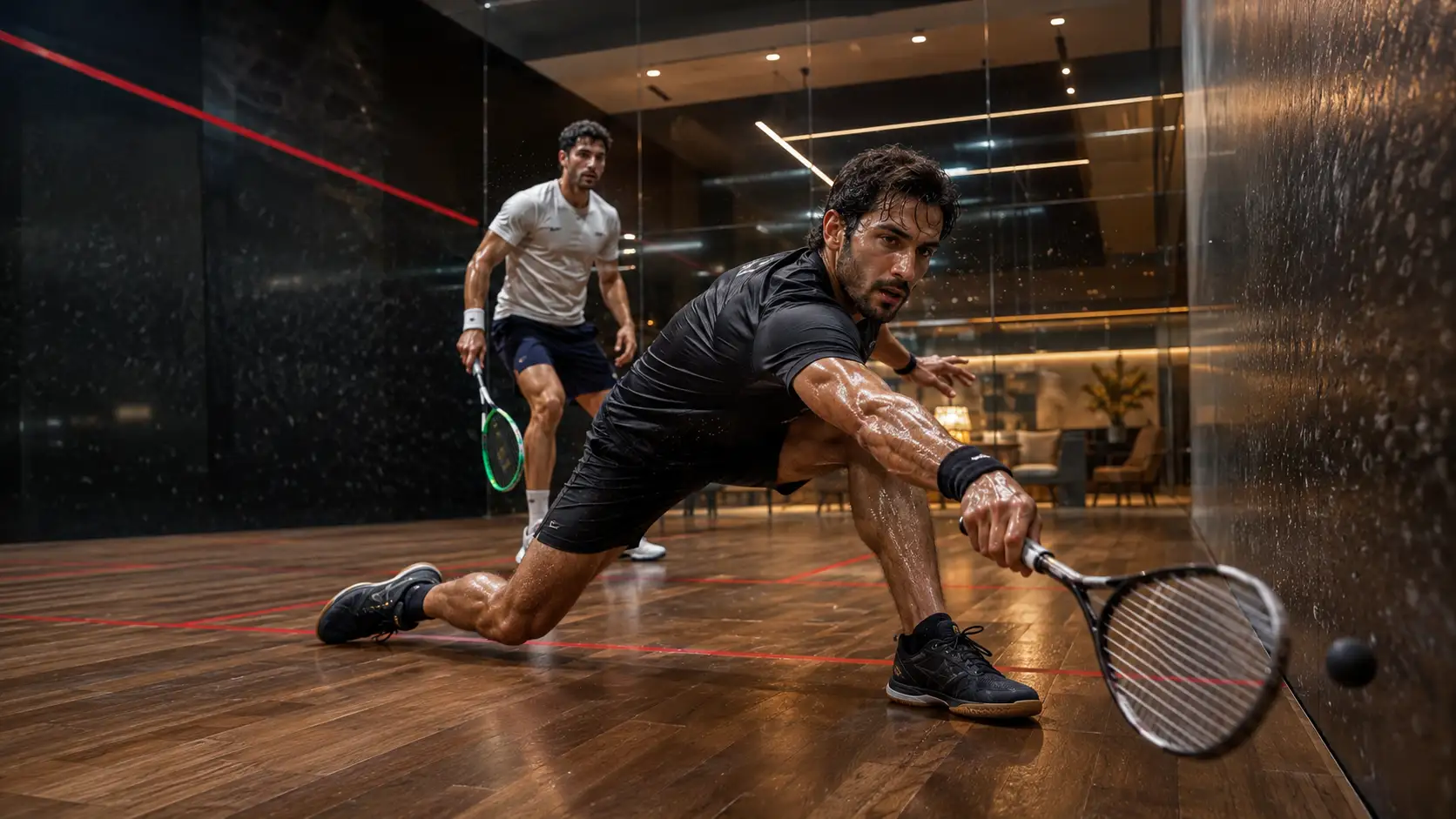
Another treadmill session can feel predictable. You know the speed, incline and when boredom will arrive. Squash is different. The ball changes direction, your opponent changes the problem, and your body responds before you overthink it.
That is why Squash in Oman deserves attention from people who want more than routine cardio. The sport combines fast movement, competitive pressure, coordination and tactical thinking. For adults in Muscat bored by repetitive training, squash can make effort feel purposeful.
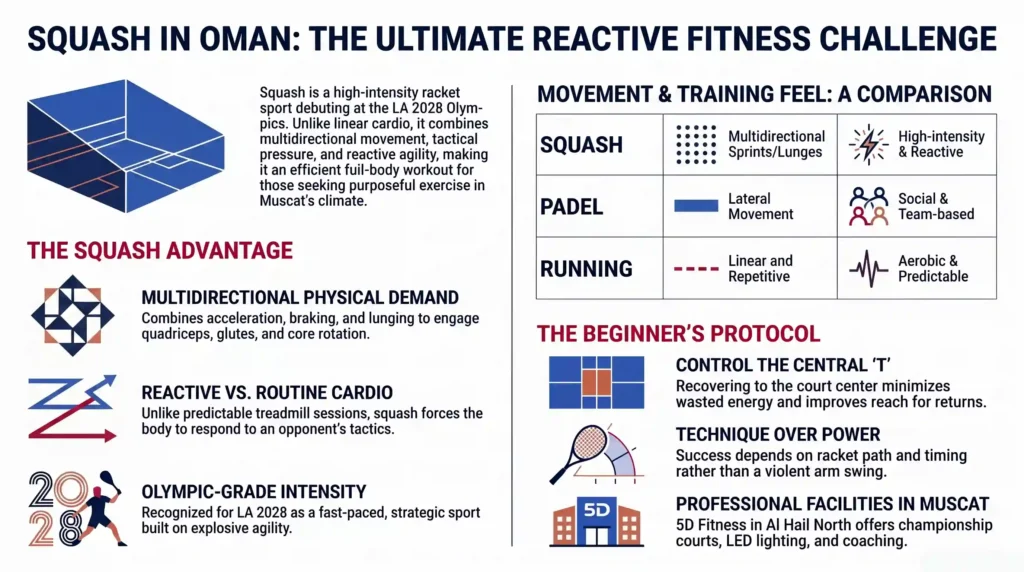
Squash will make its Olympic debut at Los Angeles 2028. LA28 describes the sport as fast-paced, high-intensity and strategic, with explosive agility central to play. A standard match is best of five games; each game is played to 11, with a two-point margin required after 10-
So, how fit do you need to be, what happens in a first session, and is squash in Muscat realistic for beginners? Let us break it down from a coaching perspective.
Listen
Why Is Squash Such an Effective Full-Body Sport in Oman?
Squash looks simple from outside the glass: hit, move, repeat. Step on court and the demand changes. Fast rallies compress endurance, balance and decision-making into a small playing space.
What does a squash match ask from your body?
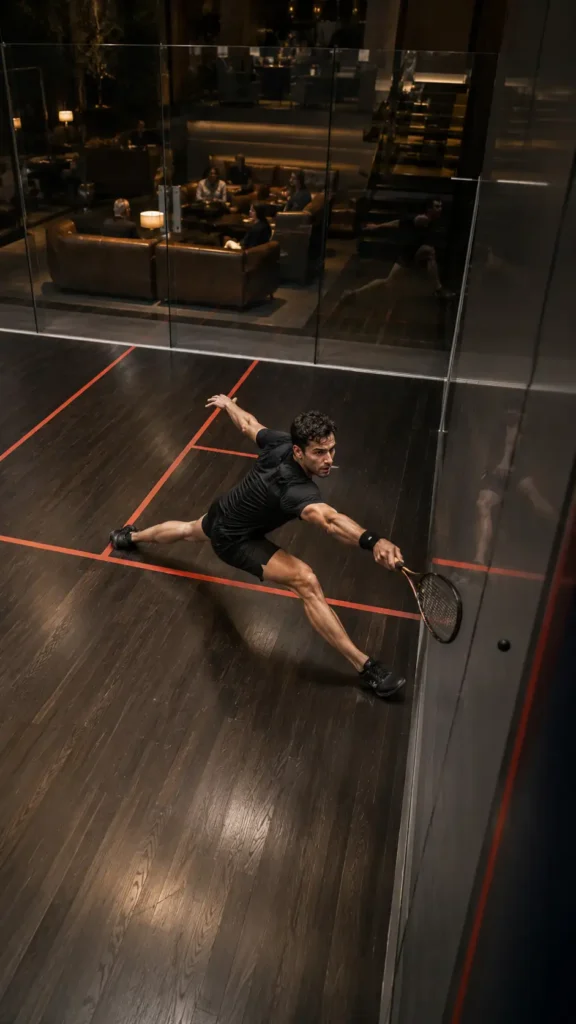
A squash rally can pull you forward for a drop shot, deep into a back corner and back toward the centre within seconds. That constant change of direction separates squash from steady cardio. You repeatedly accelerate, brake, lunge and reorganise your position.
The legs do much of the visible work, especially the quadriceps, glutes and calves, while the trunk and upper body stay involved. Your core controls rotation through the swing, and balance matters whenever you reach for a difficult ball but still need to recover.
This is why beginners should not judge the sport by how hard they hit. Efficient movement usually matters more. A player who returns toward the central T quickly can cover the court with less panic and wasted energy.
Squash legend Heather McKay explained the confidence that physical preparation creates:
“When you have the inner confidence in your conditioning, it takes pressure off your game and it builds belief.”
Heather McKay
Is squash cardio, strength or agility training?
The honest answer is all three, but not equally. Squash is primarily a high-intensity racket sport built around repeated efforts. Fast rallies raise cardiovascular demand, while pauses between points create an interval-like rhythm. Lunges, starts, stops and direction changes also challenge leg strength and movement control.
That does not mean squash replaces a complete fitness programme. Strength training develops force more directly. Planned cardio gives tighter control over aerobic intensity. Mobility work targets restrictions more specifically. Squash combines several qualities in a reactive environment where the next movement is not fully predictable.
Exercise scientist Alexios Batrakoulis, PhD, FACSM, described high-intensity interval training this way:
“HIIT seems to be an attractive exercise approach, representing a crucial component of exercise programming for diverse populations.”
American College of Sports Medicine
Squash is not a formal HIIT protocol, but its hard-effort and recovery pattern helps explain the physical demand. You are chasing a point, not watching a timer.
Is Squash in Muscat Beginner-Friendly If You Have Never Played?
Yes. You do not need elite fitness or a perfect backhand to start. The beginner challenge is learning court movement and control without turning every rally into a power contest.
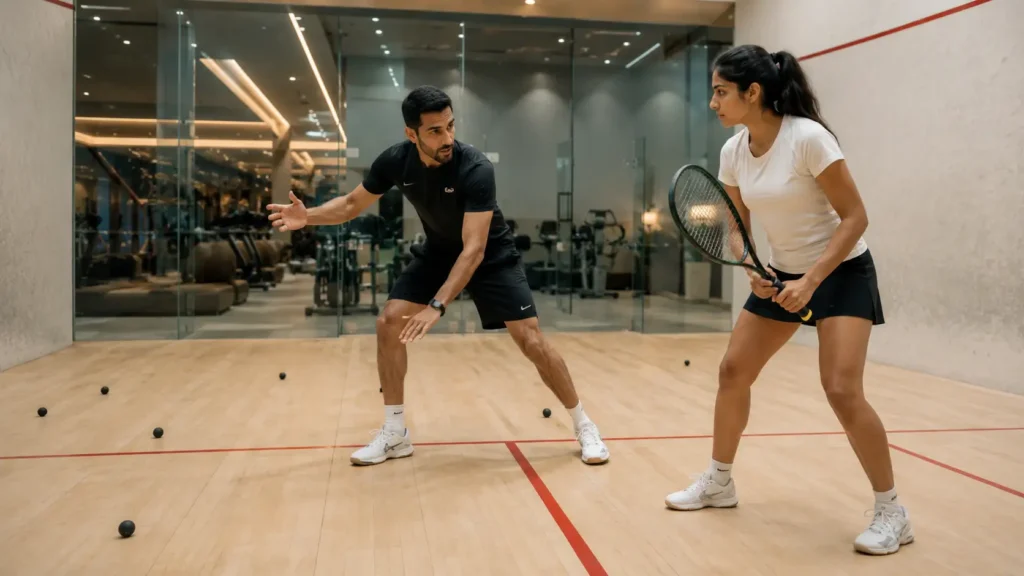
What should your first squash session actually feel like?
Your first session should introduce movement, timing and safe racket control. A coach may show you the service box, front wall, scoring and how to create space after hitting. You should also learn to stop your swing when another player is too close. Court awareness is a basic safety skill.
For a first visit, keep the setup simple:
- Wear clean, non-marking court shoes with lateral support.
- Choose a manageable racket instead of the heaviest option.
- Bring water and start the session properly hydrated.
- Practise straight drives before chasing difficult winners.
A beginner session does not need to become a five-game battle. Movement practice, feeding drills and controlled rallies can teach more than immediate exhaustion. The goal is to leave understanding the court better than when you entered.
This is similar to a well-designed beginner gym workout in Oman: technique first, progressive intensity second. Confidence develops faster when the body learns repeatable patterns instead of surviving random effort.
Which beginner mistakes slow squash progress the fastest?
The first common mistake is staying near the front wall after hitting. New players watch their shot and forget the next ball may travel behind them. Recovering toward the T improves your chance of reaching the return and makes the court feel smaller.
The second mistake is using too much arm. A violent swing does not guarantee a better shot. Good squash technique depends on preparation, timing, racket path and body position. Squeezing the grip and swinging at maximum effort often destroys accuracy before power becomes useful.
Another problem is chasing every ball without reading the opponent. Squash is tactical. The best shot may be the one that moves your opponent away from the centre or forces a weak reply.
Finally, do not ignore fatigue until footwork becomes messy. Poor recovery changes lunges, spacing and reaction time. If you stack hard court sessions on top of intense gym work, the guide to overtraining symptoms in Oman explains why more effort is not automatically better.
How Does Squash Compare With Padel, Running and Gym Cardio?
The best activity depends on what keeps you consistent and what you want to develop. Squash is not better than every workout, but its movement variety and direct competition create a distinct training feel.
Which activity fits your fitness goal best?
If you want controlled aerobic work, a treadmill or bike is easier to programme. If maximal strength is the priority, resistance training is more specific. For a social doubles format, padel offers a different way to train and stay motivated. Squash becomes especially valuable when you want reactive movement, repeated court coverage and direct competitive pressure.
| Activity | Main movement pattern | Training feel | Competitive element | Best fit |
|---|---|---|---|---|
| Squash | Multidirectional sprints, lunges and recovery | High-intensity, reactive | Direct one-to-one | Agility, conditioning, tactical play |
| Padel | Lateral movement and doubles positioning | Moderate to high, social | Team-based | Social racket sport and consistency |
| Running | Mostly linear and repetitive | Aerobic or pace-based | Optional | Endurance and simple progression |
| Treadmill cardio | Controlled linear movement | Predictable and measurable | Low | Structured indoor cardio |
| Strength training | Loaded movement patterns | Muscular and progressive | Low | Strength, power and muscle development |
The useful question is not which activity looks hardest on paper. Ask which one you will repeat. Squash in Oman can suit someone who abandons conventional cardio because every burst of effort has an immediate tactical reason: reach the ball, create space and win the rally.
How Can You Train to Move Better and Recover Faster for Squash?
More matches improve experience, but court time does not fix every weakness. A simple off-court plan can improve movement efficiency and help you tolerate repeated sessions without turning every game into survival.
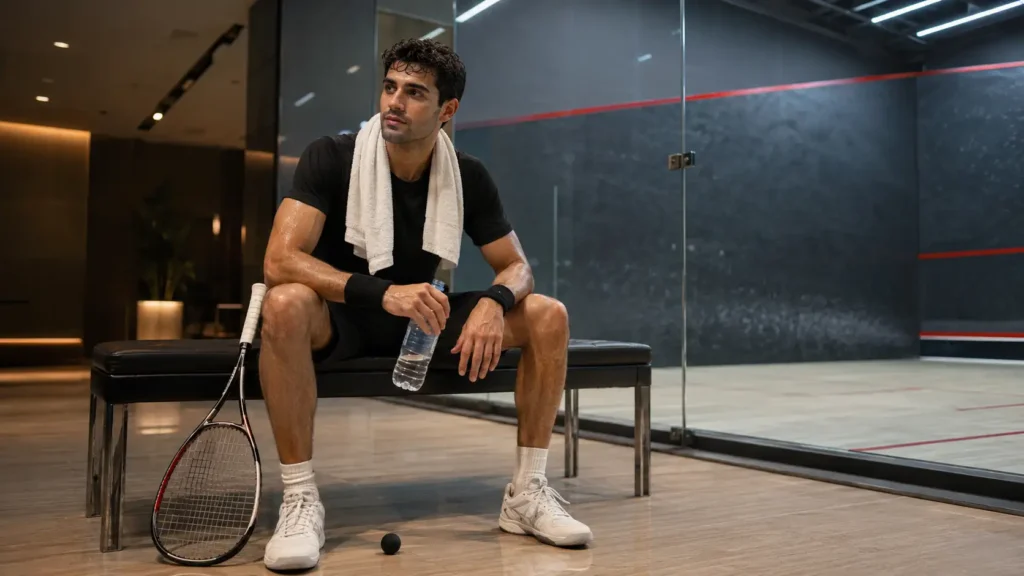
What gym training supports better squash performance?
Squash players benefit from strong legs, a stable trunk and the ability to produce force from awkward positions. Split squats, reverse lunges, step-ups, Romanian deadlifts, calf work and controlled squat variations can support those qualities. Rows, presses and rotational cable exercises add useful upper-body strength.
The key is specificity without imitation. You do not need to perform every gym exercise while holding a racket. Build general strength in the gym, then use court time to practise squash skills. For many recreational players, two organised resistance sessions are more useful than random daily circuits that leave the legs constantly sore.
Professor Stuart M. Phillips, PhD, FACSM, summarised the adherence principle clearly:
“The best resistance training program is the one you’ll actually stick with.”
Stuart M. Phillips
The same applies to squash conditioning. Build a plan that fits your real week. If you play two hard matches, do not automatically add three brutal leg sessions. Strength work should support court performance, not compete with it.
How should you warm up and recover after a squash session?
A useful squash warm-up should prepare you to accelerate, lunge and rotate. Raise body temperature first, then move the ankles, hips and thoracic spine before adding short court-specific efforts.
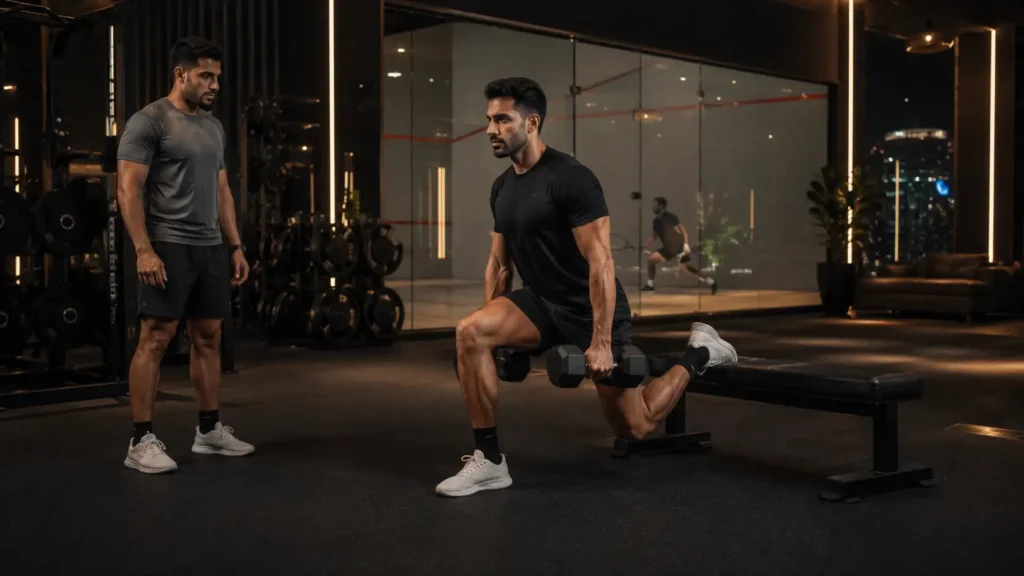
A practical sequence can include:
- Light jogging followed by side shuffles and controlled skipping.
- Walking lunges, ankle rocks and dynamic hip mobility.
- Shadow swings and ghosting patterns into the court corners.
- Short rallies that gradually increase speed before competitive games.
After the session, replace fluids, eat a balanced meal containing protein and carbohydrate, and monitor unusual soreness around the Achilles tendon, knee, groin or lower back. The guide to muscle recovery in Oman explains why adaptation depends on what happens after training as well as during it.
Track three simple signals:
- Does movement feel unusually heavy during the warm-up?
- Are normal rallies harder for several sessions in a row?
- Is soreness changing your footwork or making you avoid positions?
When these answers repeatedly look negative, reduce intensity and address the problem early. Smart recovery protects consistency, allowing squash technique and fitness to improve together.
Why Choose an Indoor Squash Court in Muscat?
For active adults in Muscat, consistency is affected by schedule and climate. An indoor racket sport creates a controlled training option and removes some friction from regular exercise.
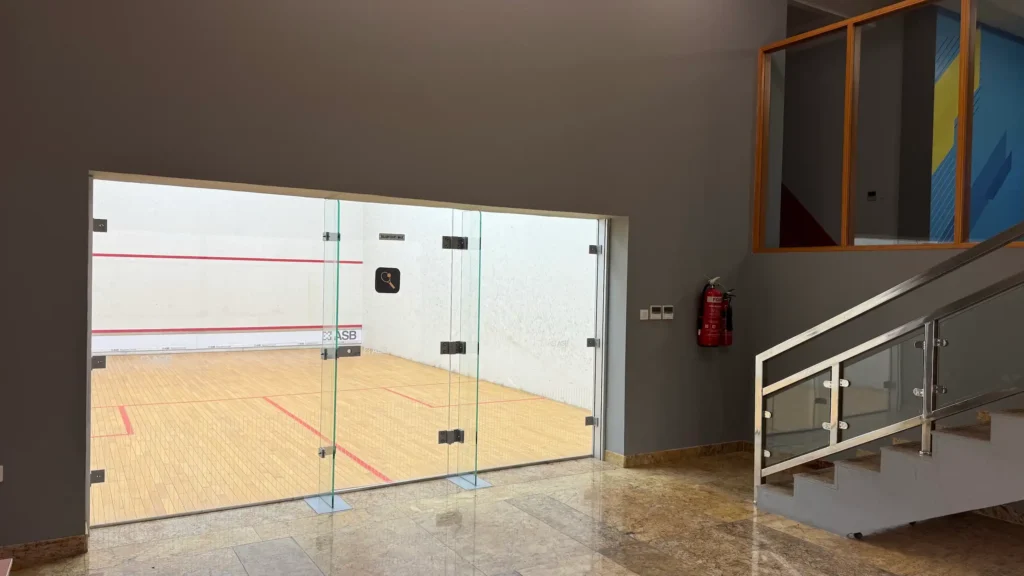
What should you look for in a squash facility in Muscat?
Start with the court. Visibility matters because the ball moves quickly and changes direction off four walls. Lighting should be even, the floor should provide reliable traction, and the playing area should support clear, safe movement. Coaching access is also valuable because poor spacing and recovery habits become harder to change after months of repetition.
The current 5D Fitness site lists two championship-quality squash courts with glass walls, LED lighting and professional coaching at its Al Hail North, Muscat club. Those details answer three practical questions for anyone comparing where to play squash in Muscat: court availability, visibility and access to instructi
The club also combines squash with gym, recovery and other sports facilities. That can help players place court sessions inside a broader training week rather than treating the sport as an isolated hob
Squash in Oman becomes easier to maintain when booking, coaching and supporting fitness work are convenient. The best court is not simply the most impressive one. It is the court you can reach consistently, use with purpose and associate with progress.
Conclusion: Ready to Play Squash in Oman?
Squash in Oman rewards movement, fitness and intelligent decision-making. You can start as a beginner, learn the rules quickly and still spend years improving court position, shot selection, conditioning and match awareness.
For people searching for Squash in Oman or a serious place to play squash in Muscat, the next step is simple. Start with one controlled session. Return toward the T. Keep the ball in play. Notice how quickly the game makes you forget you are “doing cardio.”
At 5D Fitness in Al Hail North, two squash courts with glass walls, LED lighting and professional coaching are listed on the club website. Book your squash court in Muscat today, bring your competitive side and turn your next workout into a game you will want to repeat.
FAQ
Squash has an established racket-sport audience in Oman, and interest may grow further as the sport approaches its Olympic debut at Los Angeles 2028.
You can play squash at clubs with dedicated indoor courts. In Al Hail North, 5D Fitness lists two squash courts with professional coaching available.
Yes. Beginners can start with basic court movement, straight drives and controlled rallies. Coaching can help you learn safe spacing, racket preparation and T-position recovery faster.
Yes. Squash uses repeated high-intensity rallies, rapid direction changes and short recovery periods, creating demanding conditioning while keeping attention focused on the game.
Calorie burn varies by body size, rally intensity, match duration and fitness level. Treat wearable estimates as approximations rather than a guaranteed number for every session.
Wear breathable sports clothing and clean, non-marking court shoes with lateral support. Good footwear matters because squash involves frequent braking, lunging and direction changes.
Not always. Facility policies differ, so check racket availability when booking. Regular players usually benefit from a racket weight and grip size that feel comfortable.
One or two sessions per week is a practical starting point for many beginners. Increase frequency gradually while monitoring leg soreness, movement quality and overall recovery.
Squash often feels more physically continuous because two players cover one enclosed court. Padel has different tactical and social demands, so “harder” depends on intensity and experience.
Squash can support fat-loss goals by increasing physical activity and energy expenditure. Sustainable weight loss still depends on nutrition, total activity, sleep and long-term consistency.