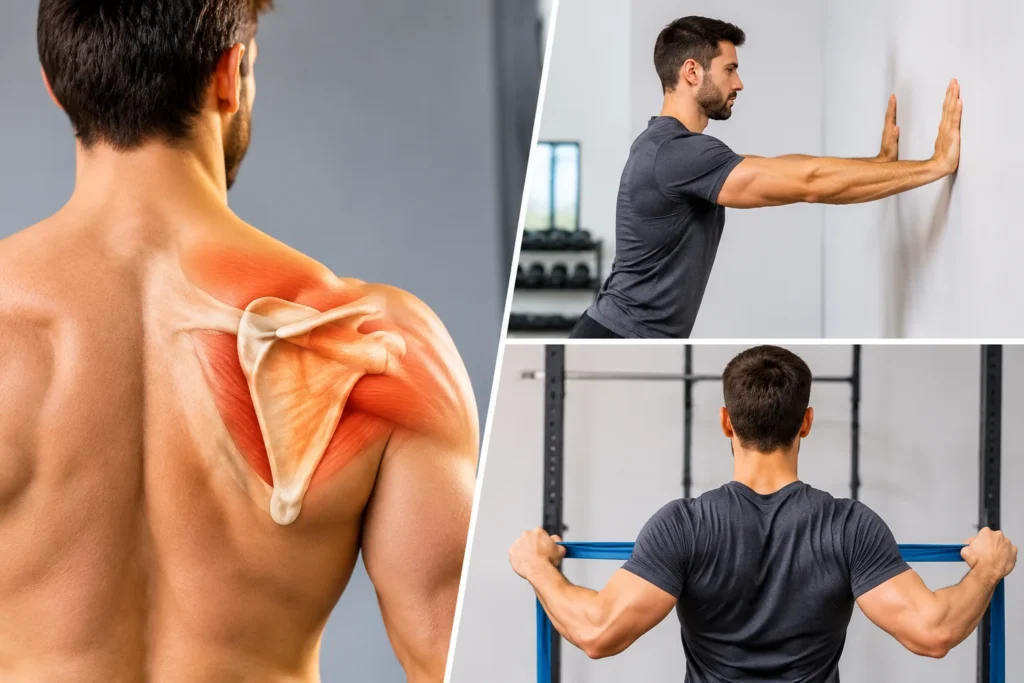
Why can the same dumbbell feel manageable in one position but extremely challenging in another? The answer often involves leverage in strength training. Leverage describes how forces act around joints and how the position of a resistance changes the mechanical demands placed on muscles.
A small adjustment in limb position, joint angle, or body posture can change the torque required to complete an exercise, even when the external weight stays the same. Understanding these principles helps athletes, bodybuilders, and coaches make better training decisions. At 5dfitness, applying biomechanics to exercise selection can help turn this knowledge into more effective training.
What Is Leverage in Strength Training and How Does It Work?
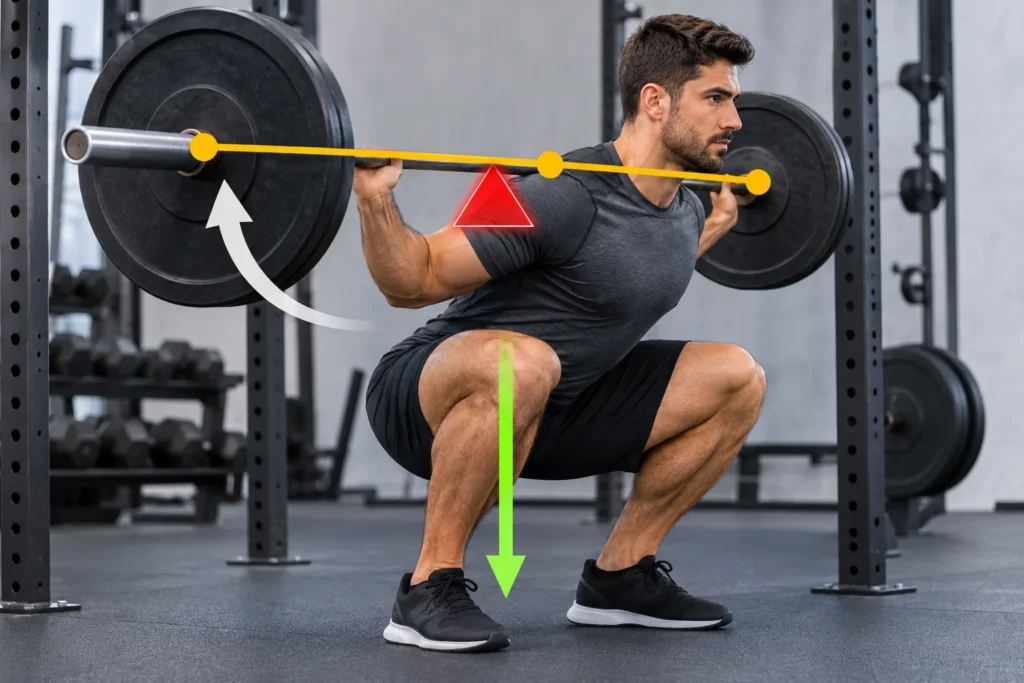
The human body uses a system of bones, joints, and muscles to produce movement. In this system, bones act as levers, joints provide axes of rotation, and muscles generate force. External resistance, including dumbbells, barbells, cables, and body weight, creates opposing forces. The arrangement of these elements determines the mechanical demands of a movement. Understanding the basic lever system makes it easier to see why changing body position can make an exercise easier or harder without changing the weight.
What Are the Three Classes of Levers in the Human Body?
A lever consists of three main components: a fulcrum, an effort force, and a resistance force. In the body, the fulcrum is usually a joint, the effort comes from muscle contraction, and resistance comes from external loads or body segments.
There are three lever classes:
- First-class lever: The fulcrum lies between the effort and resistance. The head and neck provide a common anatomical example.
- Second-class lever: The resistance lies between the fulcrum and effort. Raising the body onto the toes during a calf raise is a commonly used example.
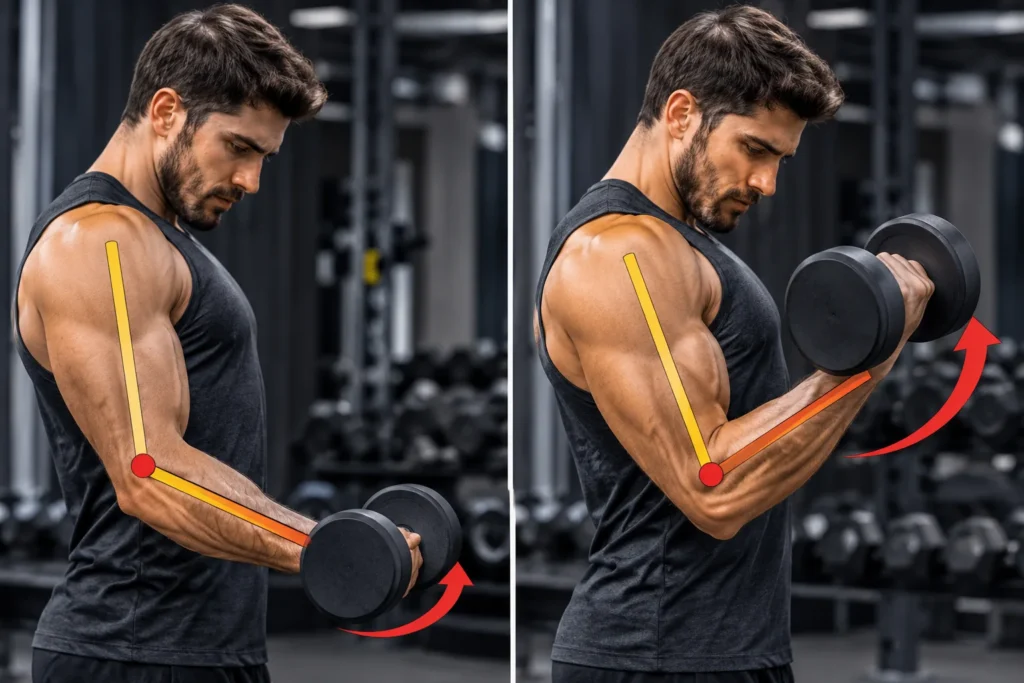
- Third-class lever: The effort lies between the fulcrum and resistance. Elbow flexion during a biceps curl is a typical example.
Most limb movements use third-class lever arrangements. These systems generally favor movement speed and range of motion rather than maximizing force advantage. As a result, muscles often need to produce substantial force to move relatively modest external loads.
What Is the Difference Between Mechanical Advantage and Disadvantage?
Mechanical advantage describes the relationship between the effort moment arm and the resistance moment arm. When the effort arm is relatively long compared with the resistance arm, less effort force may be required to balance a given resistance. This is a mechanical advantage.
When the resistance arm is longer than the effort arm, the system has a mechanical disadvantage for force production. The muscle must generate more force to balance the external resistance.
The human body often operates with this mechanical disadvantage because it allows limb segments to move quickly and through relatively large ranges. Therefore, a mechanical disadvantage does not automatically mean an exercise is poorly designed. It reflects a trade-off between force, speed, and movement range.
How Do Moment Arms and Torque Change Exercise Difficulty?
Torque is one of the most important concepts for understanding exercise leverage. It describes the turning effect of a force around a joint. The amount of torque depends not only on how much force is applied but also on the perpendicular distance between the joint axis and the force’s line of action. This distance is called the moment arm. When the resistance moment arm increases, the external torque generally increases if the applied force remains the same. Consequently, the muscles may need to produce more joint torque to control or move the resistance.
How Does a Longer Resistance Moment Arm Increase Exercise Difficulty?
A longer resistance moment arm can increase the torque acting around a joint. Consider a lateral raise with a dumbbell. When the arm is extended, the dumbbell is farther from the shoulder joint, creating a relatively long resistance moment arm. Bending the elbow brings the dumbbell closer to the shoulder and shortens that moment arm.
As a result, the shoulder muscles generally need to produce less torque to hold or lift the bent-arm position, assuming other conditions remain similar. This is why bending the elbows can make lateral raises feel easier without reducing the dumbbell’s weight.
The important point is that the distance must be considered perpendicular to the line of force. A longer-looking distance does not always mean a larger moment arm.
Why Do Joint Angles Change Torque During an Exercise?
The moment arm changes as a joint moves because the direction of resistance relative to the limb changes. During a dumbbell curl, gravity acts vertically downward. The external torque around the elbow depends on the forearm’s angle relative to that force.
When the forearm is approximately horizontal, the perpendicular distance from the elbow to the vertical line of gravity is relatively large. Near the bottom or top of the curl, that distance becomes smaller. Therefore, the external torque is not constant throughout the repetition.
This explains why a dumbbell curl often feels most challenging around the middle of the movement. It also shows why joint angle and resistance direction matter when evaluating exercise difficulty.
How Is Muscle Force Different From External Weight?
External weight describes the resistance being moved, but muscle force describes the effort required from the body to create or control movement. These values are not interchangeable.
For example, a 10 kg dumbbell produces a downward force due to gravity. However, the force required from the elbow flexors depends on the external moment arm, the muscles’ own moment arms, joint position, and the contribution of other muscles.
The NSCA’s Essentials of Personal Training defines torque through the relationship:
“The magnitude of torque (T) is calculated as the mathematical product of force (F) times moment arm (d).”
NSCA – Essentials of Personal Training,.
This relationship can be expressed as:
Torque = Force × Perpendicular Moment Arm
For example, a 20 N force acting at a perpendicular distance of 0.30 m produces 6 N·m of torque. If the distance increases to 0.45 m, the torque becomes 9 N·m. The force has not changed, but its turning effect has increased.
How Does Leverage Affect Common Strength Training Exercises?
Leverage becomes easier to understand when applied to familiar gym movements. Exercise difficulty can change because of arm position, body orientation, resistance direction, or the distance between a load and a joint. These changes influence external joint moments and the force muscles must produce. However, a movement may become more demanding at one joint while becoming less demanding at another. The following examples show how leverage affects common exercises and why technique matters when comparing different variations.
Why Is a Lateral Raise Harder With Straight Arms?
During a dumbbell lateral raise, the shoulder muscles must produce torque to lift the arms against gravity. Keeping the elbows relatively straight places the dumbbells farther from the shoulder joint than bending the elbows does.
This increases the resistance moment arm and generally raises the external shoulder torque. Bending the elbows shortens the lever and can reduce the mechanical demand.
A practical way to adjust the exercise is to begin with slightly bent elbows and a manageable load. As strength and control improve, the athlete can use a more extended arm position. The goal should be controlled movement rather than simply choosing the heaviest dumbbells available.
How Does Leverage Influence Squat and Deadlift Mechanics?
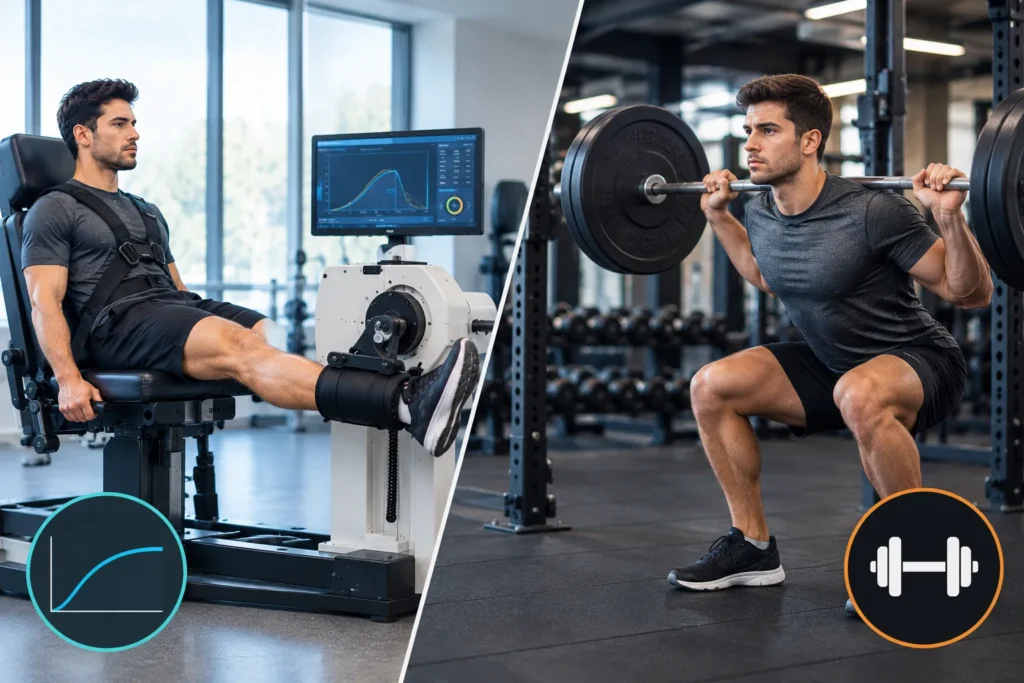
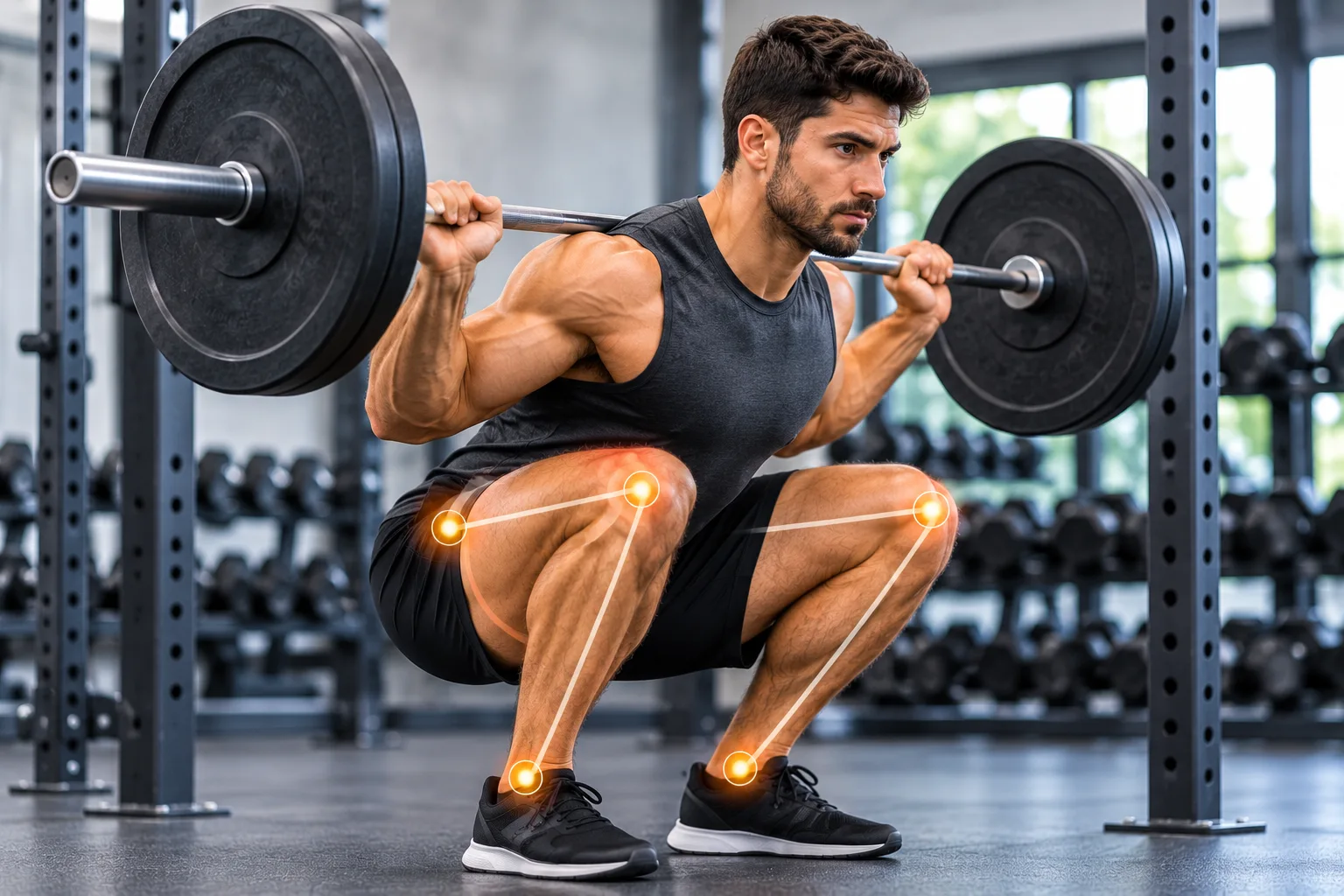
In squats and deadlifts, body proportions and technique influence the moment demands placed on different joints. A more forward trunk inclination can increase the external moment around the hip and may increase the demand on the hip extensors and trunk muscles. A more upright position can change the relative demands placed on the knees and hips.
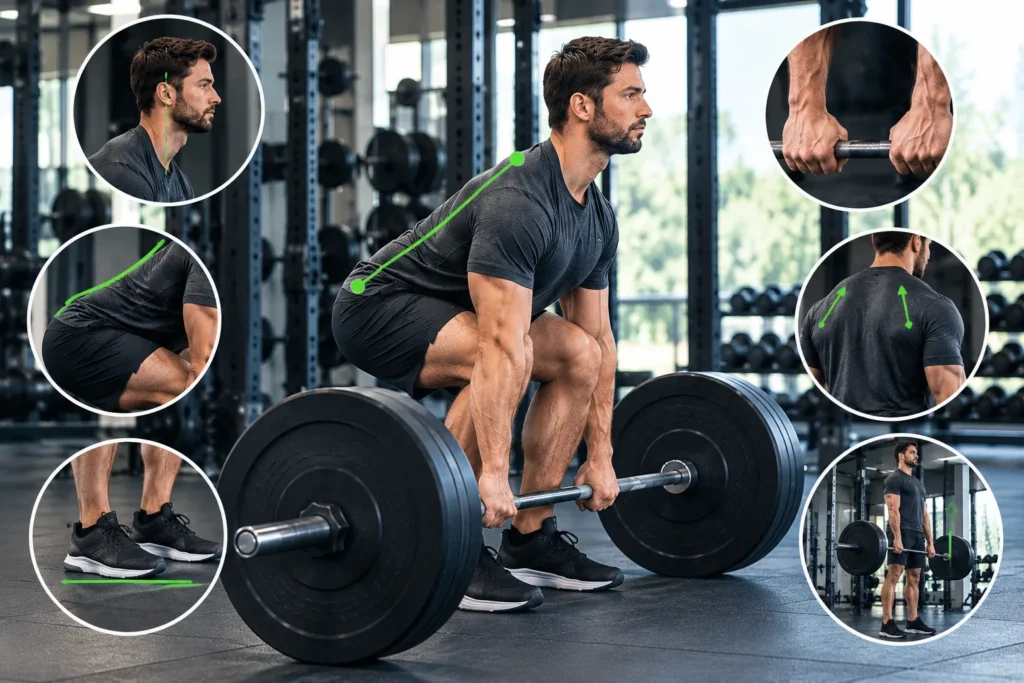
In a deadlift, the horizontal distance between the barbell and the hip or lower-back region is especially relevant. Keeping the bar close to the body generally reduces the external moment arm compared with allowing it to drift forward.
However, no single posture is ideal for every athlete. Femur length, torso proportions, mobility, bar position, and lifting style all influence the mechanics of a successful repetition.
How Does Body Position Change Push-Up and Plank Difficulty?
Push-ups and planks use body weight as resistance, so changing body position changes how that resistance is distributed. An incline push-up, performed with the hands on a stable elevated surface, usually reduces the proportion of body weight supported by the upper body compared with a floor push-up.
In a plank, extending the arms farther forward can increase the moment demands around the shoulders and trunk. This makes the position more challenging even though the athlete’s body weight has not changed.
These examples show how leverage can be used to modify bodyweight exercises. Small changes in hand placement, support height, and limb position can create meaningful differences in training difficulty.

Why Do Some People Find the Same Exercise More Difficult?
Two people can perform the same exercise with the same external load and experience different mechanical demands. Differences in limb length, joint structure, muscle attachment locations, mobility, and technique can change the relationship between resistance and joint axes. These variations help explain why a particular exercise may feel natural for one athlete but unusually difficult for another. They should not automatically be interpreted as differences in effort or motivation. Individual biomechanics should be considered when selecting exercise variations and evaluating performance.
How Do Limb Length and Body Proportions Affect Exercise Performance?
Limb length can influence the distance between a load and a joint during movement. For example, an athlete with relatively long forearms may experience a different external moment arm during certain pressing or curling exercises than someone with shorter forearms.
During squats, femur length and torso proportions can influence how much the athlete needs to incline the trunk to maintain balance. This may change the distribution of hip and knee joint moments.
However, longer limbs are not universally disadvantageous. They may create favorable mechanics in some exercises and less favorable mechanics in others. Strength, muscle size, mobility, technique, and training experience also influence performance.
Can Individual Joint Anatomy Change Mechanical Advantage?
Muscle attachment locations influence internal moment arms. If a muscle’s tendon attaches farther from a joint axis, its internal moment arm may be larger in a particular position. This can improve its ability to generate joint torque for a given muscle force.
However, anatomical differences are complex. Muscle moment arms can change with joint angle, and a larger moment arm may involve trade-offs in muscle shortening velocity and range of motion.
Therefore, individual anatomy can contribute to strength differences, but it should not be used alone to predict how much weight someone can lift. Training history, neural adaptation, muscle cross-sectional area, and coordination remain important factors.
How Can You Use Leverage to Adjust Exercise Difficulty?
Leverage is a practical tool for modifying resistance exercises. Coaches can use it to create easier variations for beginners, increase mechanical demands for experienced athletes, or adjust exercises when equipment is limited. The key is to understand which joint or muscle group is being challenged and how a change in body position affects the movement. A useful modification should preserve the exercise’s purpose, maintain control, and match the athlete’s current ability rather than simply making the movement look more difficult.
How Can You Make an Exercise Easier or Harder Without Changing Weight?
To make an exercise easier, you can often shorten the external resistance moment arm. For example, bending the elbows during lateral raises brings the dumbbells closer to the shoulder. Elevating the hands during push-ups reduces the load supported by the upper body.
To increase difficulty, you can lengthen the lever, change body position, or use a variation that increases the external moment around the target joint. Extending the arms during a plank is one example.
These adjustments should be introduced gradually. Increasing leverage demands too quickly may reduce technique quality or place excessive stress on a joint. The best variation is one that challenges the intended muscles while allowing controlled movement.
How Should Coaches Use Leverage to Progress or Regress Exercises?
Coaches can use leverage alongside load, repetitions, range of motion, and exercise selection to manage progression. A beginner might start with a bent-arm lateral raise or an incline push-up. As control and strength improve, the exercise can progress toward a longer lever or a less supported body position.
One strength-training textbook explains the principle directly:
“The moment arm of resistance can be manipulated many ways to alter exercise performance.”
ACSM’s Foundations of Strength Training and Conditioning
This approach is useful because progression does not always require adding weight. Coaches should monitor technique, range of motion, perceived effort, and the athlete’s response before increasing mechanical demands.
How to Apply Leverage Principles to Your Workout
- Identify the joint: Determine which joint or muscle group is the main focus of the exercise.
- Locate the resistance: Identify where the external force acts and the direction in which it acts.
- Assess the moment arm: Consider the perpendicular distance between the joint axis and the resistance line of action.
- Adjust the lever: Bend or extend the limbs, change body position, or modify support to alter the mechanical demand.
- Check movement quality: Maintain control, appropriate range of motion, and stable technique.
- Progress gradually: Increase leverage demands only when the current variation can be performed consistently.
Conclusion
Leverage is a major factor in determining how difficult a strength exercise feels. The position of a limb, the direction of resistance, and the distance between a joint and a force’s line of action all influence torque and muscular demands. This explains why the same weight can feel very different across exercise variations and why athletes with different body proportions may use different techniques.
Understanding leverage in strength training helps athletes and coaches adjust exercises more intelligently, improve movement control, and progress without relying exclusively on heavier weights. At 5dfitness, the goal is to connect biomechanics with practical training decisions so that exercise selection is based on more than appearance or load alone.
Frequently Asked Questions
Not always. A longer external moment arm can increase torque when the resistance force and direction remain comparable, but muscle strength, joint angle, and exercise mechanics also matter.
A moment arm is the perpendicular distance between a joint’s axis of rotation and the line of action of a force.
Bending the elbows brings the dumbbells closer to the shoulder, shortening the external resistance moment arm and generally reducing shoulder torque.
Yes. Limb proportions can change joint moments and movement mechanics, but their effects vary between exercises and individuals.
Yes. Changing body position, extending a limb, or adjusting support can increase mechanical demands without increasing external weight.
No. Many human joints operate with mechanical disadvantages that favor movement speed and range of motion rather than force advantage.