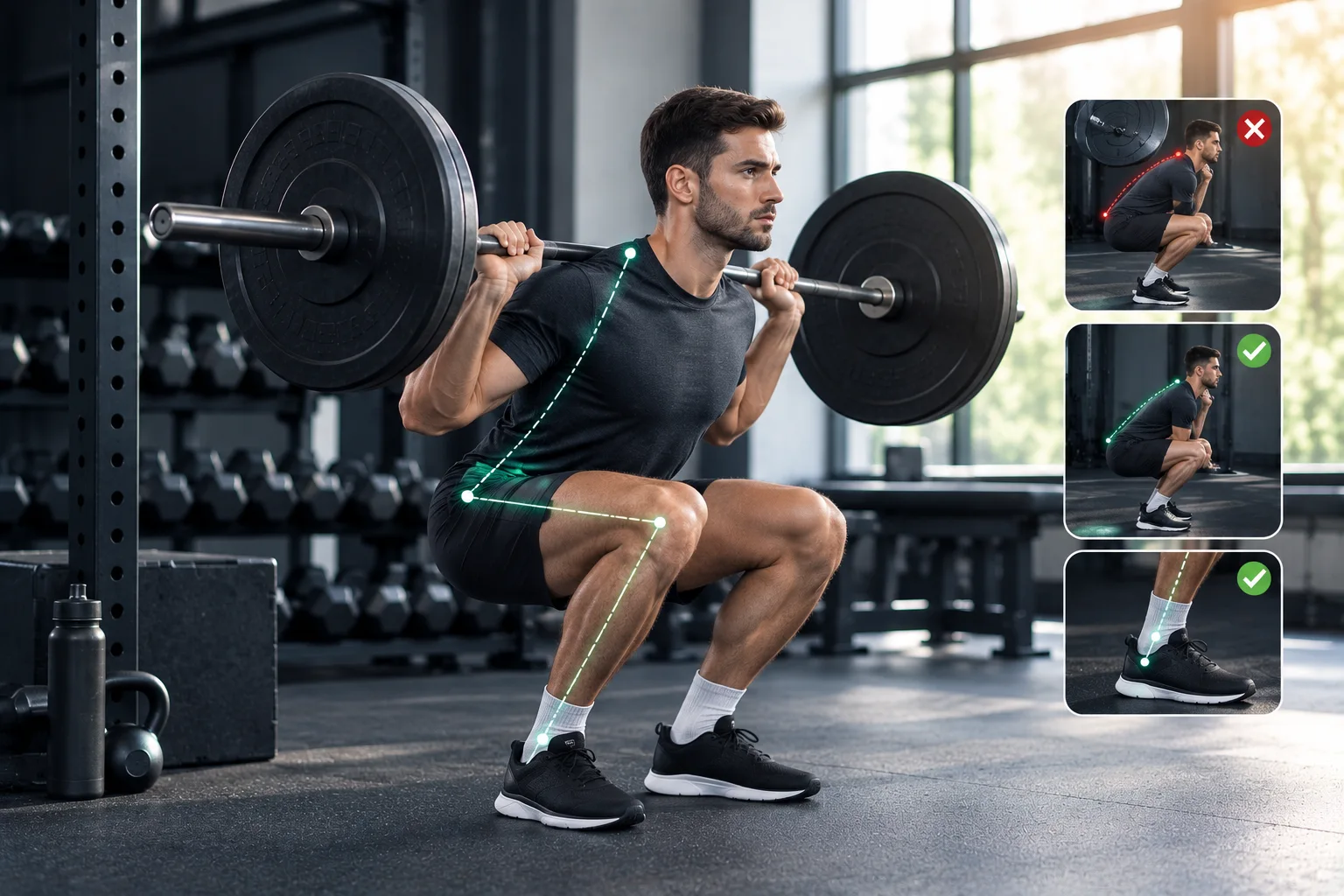
Improving exercise technique and form is one of the most important skills for athletes, fitness enthusiasts, bodybuilders, and beginners who want to train effectively and consistently. Good technique is not simply about making an exercise look correct. It involves controlling the movement, maintaining an appropriate body position, using a suitable range of motion, selecting a manageable load, and repeating the movement consistently.
For readers of 5dfitness, the practical goal is simple: learn the movement, control it, identify errors, correct them, and then progress gradually. Better technique can also make training more efficient because it helps you focus on the intended movement rather than simply moving more weight.
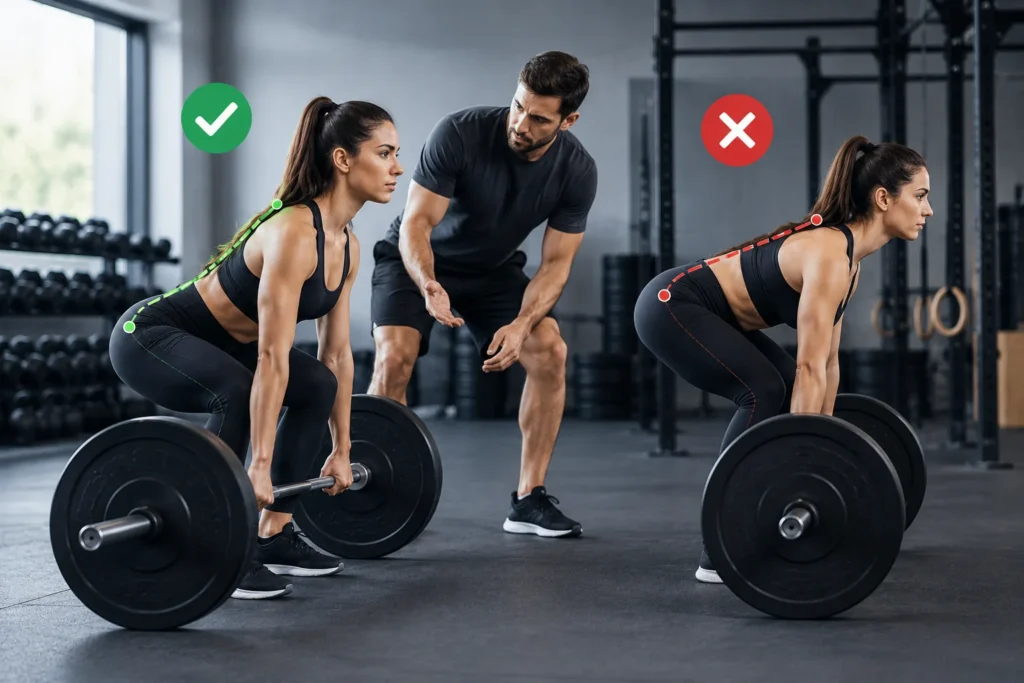
What Are Exercise Technique and Form, and Why Do They Matter?
Exercise technique and form are closely related, but they are not exactly the same. Technique describes how you execute a movement, including movement sequence, control, tempo, breathing, and coordination. Form generally refers to your body position and alignment during that movement. Both matter because resistance training places mechanical demands on muscles, joints, and connective tissues. Learning fundamental movement patterns before increasing complexity or load gives you a stronger foundation for progression. Proper form should therefore be viewed as a skill that develops through practice rather than as a fixed position that looks identical for every person.
What Is the Difference Between Exercise Technique and Form?
Exercise form mainly describes how your body is positioned and aligned during an exercise, while technique describes the broader process of performing the movement correctly.
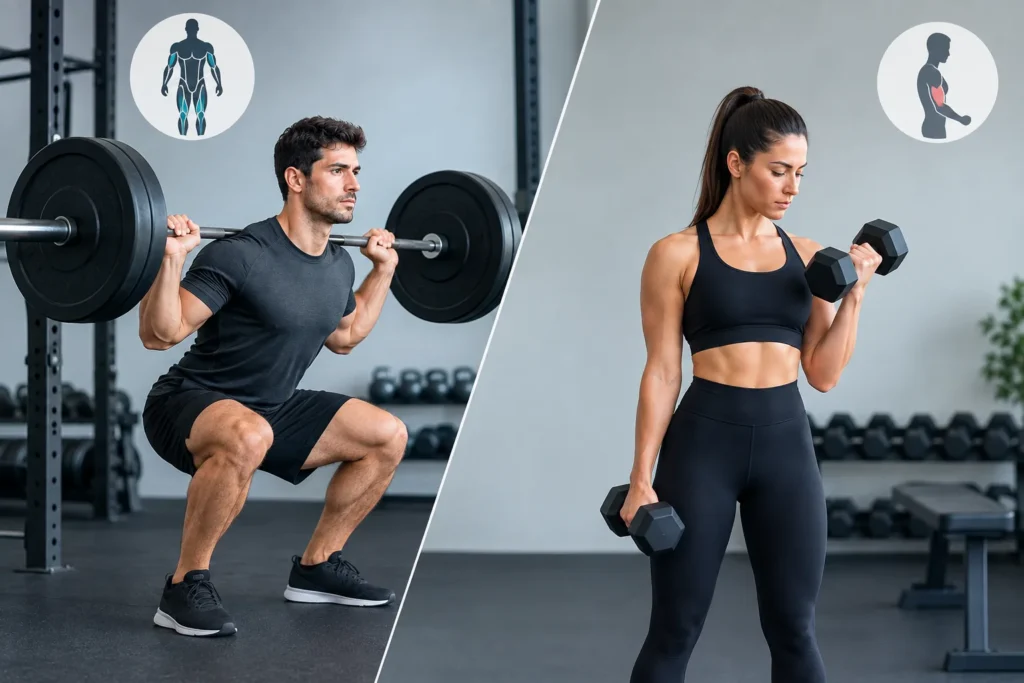
For example, during a squat, form can include your foot position, knee tracking, torso position, and depth. Technique also includes how you initiate the movement, control the descent, reverse the movement, and return to the starting position.
This distinction is useful because a person may have an acceptable starting position but still use poor movement technique. They may move too quickly, lose control at the bottom of a repetition, or change their body position as fatigue increases.
Instead of focusing only on whether an exercise “looks right,” evaluate the entire movement. Ask whether you can consistently control the exercise from beginning to end while maintaining a position appropriate for your body and training goal.
Why Is Proper Exercise Form Important?
Proper exercise form helps you perform movements in a controlled and repeatable way. It can also make it easier to identify when an exercise is becoming too difficult.
However, good form does not guarantee injury prevention. Resistance exercise involves many variables, including training load, fatigue, exercise selection, previous experience, recovery, and individual anatomy. Research on resistance-exercise technique shows that certain positions and ranges of motion can place greater demands on anatomical structures, which is why exercise execution should be considered alongside appropriate programming.
The practical goal is not to make every repetition look perfect. It is to maintain a technically appropriate movement that matches your experience, mobility, exercise selection, and training objective.
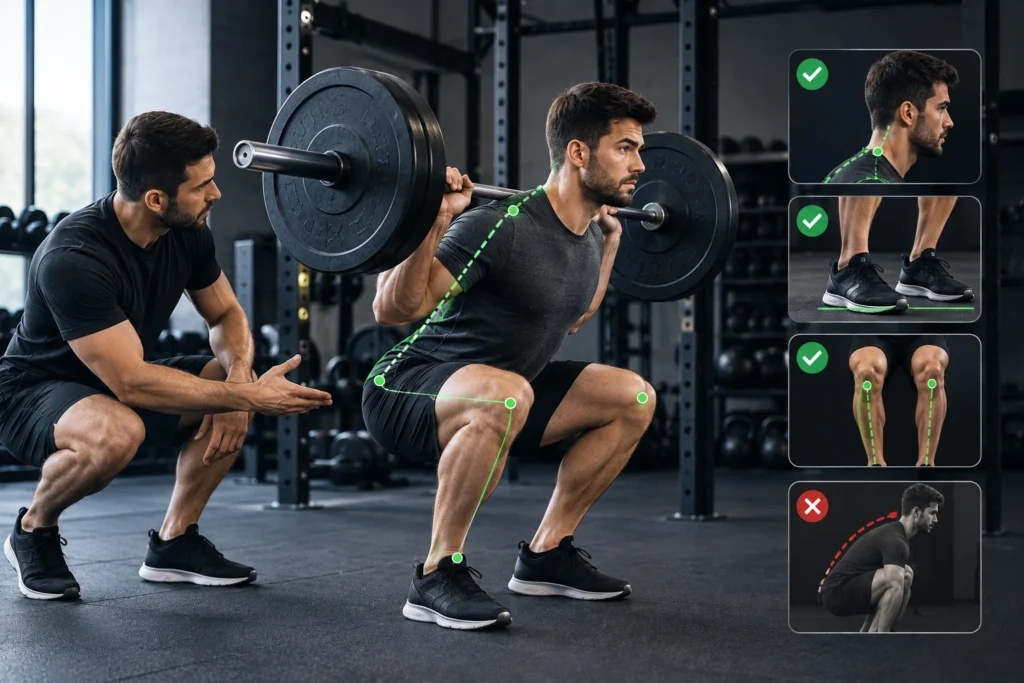
How Can You Improve Your Exercise Technique and Form?
Improving technique requires deliberate practice rather than simply performing more repetitions. Start with an exercise variation that you can control, learn the basic movement pattern, and then gradually introduce additional resistance or complexity. One of the most effective strategies is to separate learning the movement from testing your strength. If the weight is so heavy that you cannot maintain reasonable control, the exercise becomes a poor environment for technique development. Beginners can benefit particularly from lighter loads, simple variations, repeated practice, and clear feedback.
How Can You Learn the Correct Movement Pattern?
Start by learning the basic movement pattern before worrying about lifting heavy weights. Many resistance exercises are variations of fundamental patterns such as squat, hinge, push, pull, lunge, and carry.
Choose a manageable resistance and perform several controlled repetitions. Pay attention to the starting position, the direction of movement, the position of the major joints, and how you return to the starting position.
It can also help to learn an exercise in stages. For example, someone learning a squat could begin with a bodyweight squat, then progress to a goblet squat, and later use a barbell variation when the movement is sufficiently controlled.
The objective is not to master an exercise in one session. Technique improves when the correct movement is practiced consistently and feedback is used to correct errors.
How Can You Use Lighter Weights to Improve Exercise Form?
Reducing the weight is often one of the simplest ways to improve exercise form when resistance is interfering with movement quality.
When a load is too heavy, you may compensate by changing your posture, shortening your range of motion, increasing momentum, or using muscles that were not intended to dominate the movement. These changes can make it difficult to determine whether the exercise is actually being performed effectively.
A lighter load gives you an opportunity to practice the movement without constantly fighting the resistance. Once you can perform the exercise consistently with appropriate control, you can gradually increase the challenge.
The important point is that lighter weight is not a permanent solution. It is a technique-building tool. Your long-term goal should be to progressively increase resistance while maintaining a technically appropriate movement.
Merrick Lincoln, Kaitlyn Ill, and Matthew Ibrahim emphasize progressive teaching of fundamental resistance-training movement patterns, including exercise selection, monitoring performance, feedback, and progression toward more difficult variations.
NSCA guidance
How Can You Control Your Repetitions More Effectively?
Controlled repetitions make it easier to recognize what is happening during an exercise. Instead of rushing through each repetition, focus on the beginning, middle, and end of the movement.
For many exercises, controlling the lowering phase can help you become more aware of body position and movement quality. You should also avoid using unnecessary momentum simply to complete another repetition.
A useful strategy is to temporarily slow down your repetitions during technique practice. This does not mean every workout must use an extremely slow tempo. Rather, slower practice can help you identify weak points, balance problems, unstable positions, or loss of control.
Once the movement becomes familiar, your normal training tempo can be adjusted according to the exercise and goal. Technique should remain appropriate even when the movement becomes faster or the resistance increases.
How Can You Identify and Correct Common Exercise Form Mistakes?
Form problems are often easier to correct when you identify the reason behind them. A movement may deteriorate because the weight is too heavy, the exercise is too advanced, fatigue is excessive, mobility is limiting the movement, or the athlete has not yet learned the required coordination. Instead of immediately assuming that one body position is “wrong,” look at the entire movement. Compare your repetitions, identify when the error begins, and determine whether changing the load, exercise variation, range of motion, or tempo improves control.
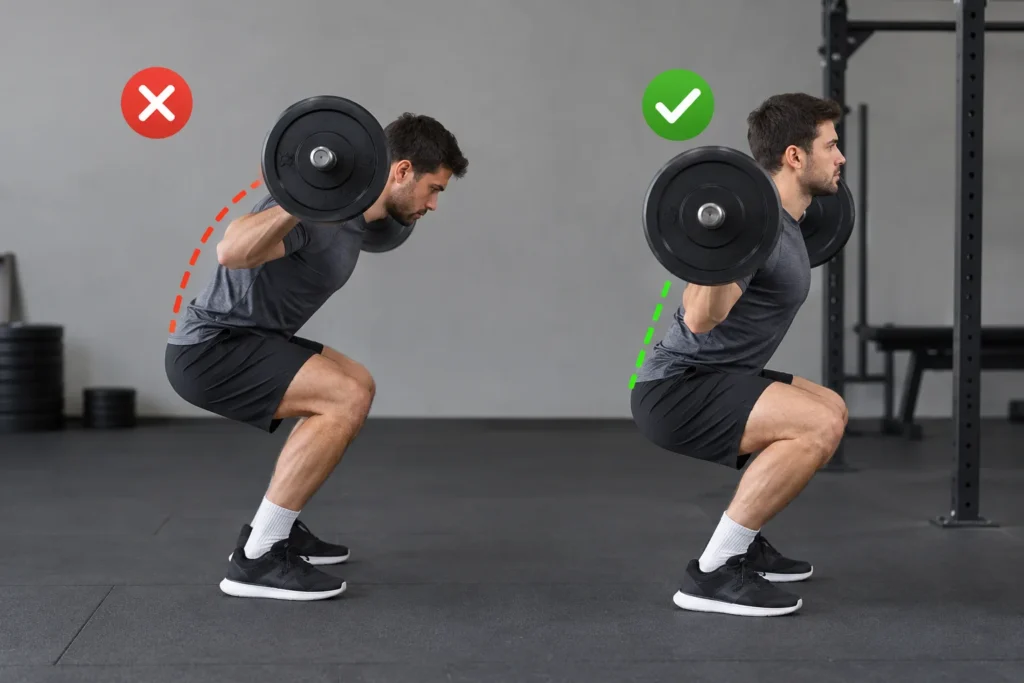
How Can Poor Exercise Form Affect Your Workout?
Poor technique can reduce movement efficiency and make it harder to target the intended muscles or movement pattern. It can also make it more difficult to progress consistently because you may be adding weight to a movement that you cannot yet control.
For example, if your squat depth becomes inconsistent as the load increases, simply adding more weight may not solve the problem. Similarly, if your back position changes significantly during a loaded hinge, increasing resistance could make the technical limitation more difficult to manage.
This does not mean every deviation from a textbook position is automatically dangerous. Human movement varies between individuals, and appropriate technique depends on the exercise, anatomy, training goal, and experience.
The practical solution is to identify the specific problem rather than labeling the entire exercise as unsafe.
How Can You Tell If You Are Using Too Much Weight?
One of the clearest signs that the load may be too heavy is a consistent breakdown in movement quality.
Watch for changes such as excessive momentum, shortened range of motion, loss of balance, inability to maintain the intended body position, or major differences between early and late repetitions.
If you planned controlled repetitions but need to swing, bounce, jerk, or dramatically change your posture to finish the set, the resistance may be exceeding your current technical capacity.
A useful approach is to reduce the load temporarily and determine whether the movement becomes more consistent. If it does, rebuild gradually from that point.
The goal is not to avoid challenging weights. Progressive overload remains important for strength and muscle development. The goal is to make sure that progression does not consistently come at the expense of movement quality.
How Can You Improve Your Range of Motion and Movement Control?
Range of motion should be appropriate for the exercise, your physical capabilities, and the training objective. More range is not automatically better if you cannot control it.
First, establish the range in which you can perform the movement consistently. Then work gradually toward a greater range when appropriate. Avoid forcing a deeper or larger movement simply because someone else can perform it.
Movement control is equally important. If you can reach a position but cannot control the movement into or out of it, you may need to reduce the load or use an easier variation while practicing.
A good technique strategy is therefore:
Control → consistency → appropriate range → gradual progression.
This approach allows you to improve movement quality without treating a single “perfect” range of motion as appropriate for every person.
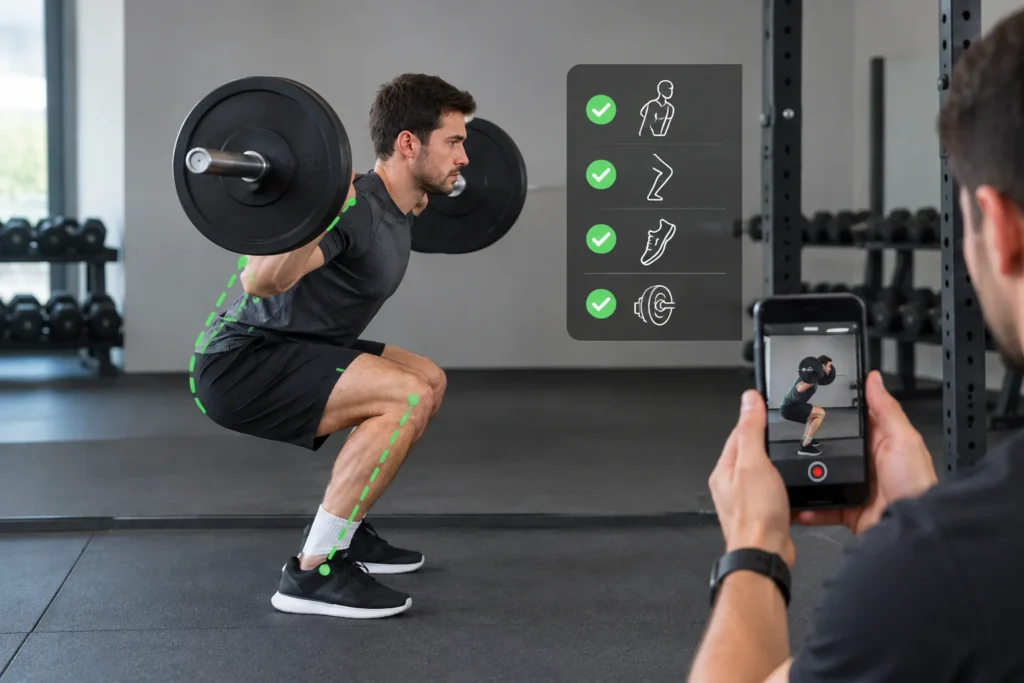
How Can You Check Your Exercise Technique During a Workout?
You do not always need a personal trainer to identify basic technique problems. Mirrors, video recordings, and simple self-assessment can provide useful feedback. However, visual feedback has limitations. You may not recognize technical problems from one angle, and some movements require knowledge of biomechanics or coaching experience. For difficult exercises, persistent problems, pain, or advanced athletic movements, professional feedback can be especially useful. The objective is to create a feedback loop: perform the exercise, observe the movement, identify one priority correction, practice it, and reassess.
Can Recording Yourself Help Improve Exercise Form?
Yes. Recording your exercise from an appropriate angle can be a practical way to review technique.
Instead of recording every set, choose one or two representative sets. Review the starting position, movement path, range of motion, tempo, and final repetitions. Pay particular attention to whether your technique changes as fatigue increases.
It can also be useful to compare your movement with a reliable demonstration of the same exercise. However, avoid trying to copy another person’s exact body position because differences in anatomy, mobility, limb proportions, and training experience can affect how an exercise looks.
Use video to identify trends rather than to search for microscopic imperfections. If you notice a consistent issue, adjust one variable at a time and record another set to see whether the change improves control.
When Should You Ask a Coach to Check Your Technique?
A qualified coach can be particularly useful when you are learning a technically demanding exercise, repeatedly experiencing the same movement problem, or preparing for performance-specific training.
A coach can observe the movement from different angles, provide specific cues, modify the exercise, and select an appropriate progression or regression. NSCA guidance on teaching resistance-training movement patterns emphasizes selecting appropriate exercises, monitoring performance, providing feedback, and progressively advancing the movement.
Professional feedback is also useful when you are unsure whether a limitation comes from technique, mobility, strength, coordination, or exercise selection.
If an exercise causes persistent or significant pain, technique coaching should not replace medical assessment. Pain that continues despite modifying the exercise deserves appropriate professional evaluation.
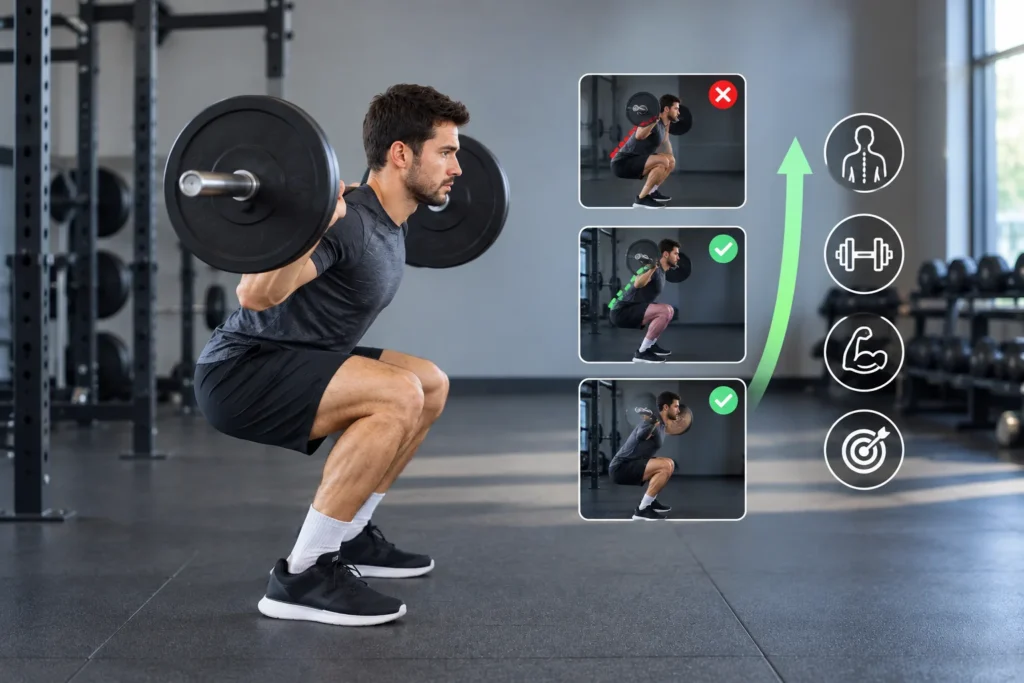
How Can You Maintain Proper Exercise Form as You Progress?
Technique should evolve with your training rather than being treated as something you “finish learning.” As resistance, repetitions, exercise complexity, or fatigue increases, the technical demands of the movement can also increase. This is why progression should be gradual and individualized. The latest ACSM resistance-training guidance emphasizes matching load and volume to the individual’s goal and capacity rather than relying on one universal prescription. Maintaining good technique therefore means progressing when you are ready, not simply because a particular weight or repetition target looks impressive.
Should You Reduce the Weight When Your Form Breaks Down?
If your form consistently deteriorates because the resistance is too challenging, reducing the weight is usually a practical adjustment.
For example, if your first repetitions are controlled but later repetitions involve substantial momentum or loss of position, reduce the resistance, stop the set, or use an appropriate modification depending on your goal.
This does not mean that every technically imperfect repetition is a failure. Fatigue naturally changes movement, especially during demanding training. The important question is whether the change remains within an acceptable range for the exercise and goal.
A useful progression model is:
Learn the movement → establish control → add repetitions or load → reassess technique → progress again.
This approach helps prevent strength progression from becoming disconnected from movement quality.
How Can You Maintain Good Form as Exercises Become Harder?
As an exercise becomes harder, keep one or two technical priorities in mind rather than trying to consciously control every part of your body.
For a squat, you might focus on maintaining a stable foot position and controlled movement. For a pressing exercise, you might focus on a stable setup and consistent movement path. For a hinge, you may focus on controlling the hip movement and maintaining an appropriate trunk position.
Use the simplest cue that produces the desired change.
You can also increase difficulty through several variables: resistance, repetitions, sets, range of motion, exercise complexity, or training density. You do not have to increase everything simultaneously.
If a progression causes a major deterioration in technique, return to the previous manageable level and build from there.
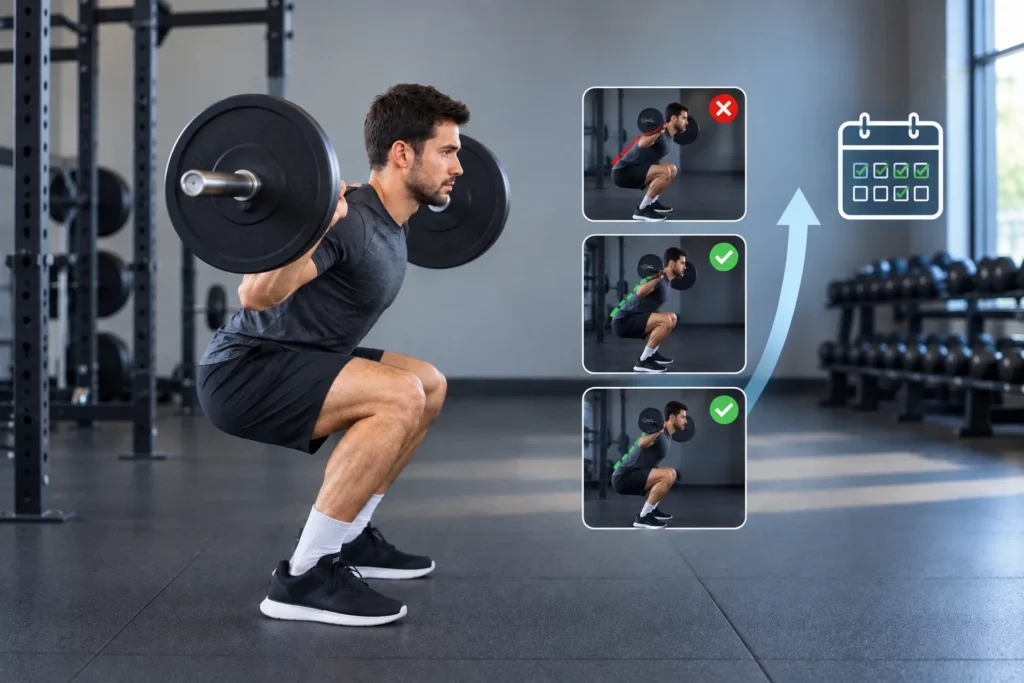
How Can You Build Better Technique Through Consistent Practice?
Technique improves through repeated exposure to a movement with appropriate feedback. Performing an exercise correctly once is not the same as developing a reliable movement skill.
Practice the same fundamental movements regularly enough to become familiar with them. Keep the early stages relatively simple, record selected sets when useful, and make one correction at a time.
Consistency also means avoiding unnecessary exercise changes. If you change exercises every session, it becomes harder to determine whether your technique is actually improving.
As your skill develops, you can introduce more resistance, complexity, or sport-specific variations. NSCA educational guidance emphasizes progressive teaching and movement-pattern proficiency before advancing to more challenging variations.
The long-term objective is not perfect form. It is repeatable, controlled, adaptable technique that remains appropriate as training demands increase.
Exercise Technique Problems and Practical Solutions
| Technique Problem | What It May Look Like | Practical Solution |
|---|---|---|
| Too much weight | Momentum or loss of position | Reduce resistance |
| Rushed repetitions | Poor control between phases | Slow the movement temporarily |
| Limited range | Repetitions become inconsistent | Use a manageable range and progress gradually |
| Technique changes with fatigue | Final repetitions look very different | Reduce load, volume, or stop the set |
| Unsure about form | Cannot identify the problem | Record a set or ask a qualified coach |
| Exercise is too advanced | Repeated technical breakdown | Use an easier progression |
| Trying to copy someone else | Uncomfortable or unstable position | Adapt technique to individual needs |
Conclusion
Improving exercise technique and form is a continuous process built around learning, controlled practice, feedback, and gradual progression. The most useful strategy is not simply to lift lighter weights or obsess over perfect positioning. Instead, learn the movement pattern, choose an appropriate load, control your repetitions, monitor your range of motion, review your technique, and progress only when you can maintain reasonable movement quality. For athletes and fitness enthusiasts using 5dfitness as a training resource, this approach can create a more consistent foundation for long-term strength, performance, and fitness development.
FAQ
Form refers mainly to body position and alignment, while technique includes the broader way you execute and control an exercise.
Good form helps you perform exercises consistently and control the movement. It may also help manage unnecessary mechanical stress, although it cannot eliminate injury risk.
Start with a manageable variation and load, practice consistently, control your repetitions, use feedback, and progress gradually.
If the weight repeatedly causes significant technique breakdown, reducing the load is a practical way to regain control before progressing again.
Yes. Mirrors and video recordings can provide useful feedback, although a qualified coach may be better suited to identify complex technical problems.
It can. Moving too quickly may reduce control and make technical errors harder to identify. During technique practice, a controlled tempo can make the movement easier to assess.
No. Human movement naturally varies, and technique depends on the individual and exercise. The goal is appropriate, controlled, and repeatable movement rather than visual perfection.
Consider professional feedback when learning complex exercises, repeatedly struggling with technique, or when you cannot identify why a movement is breaking down.