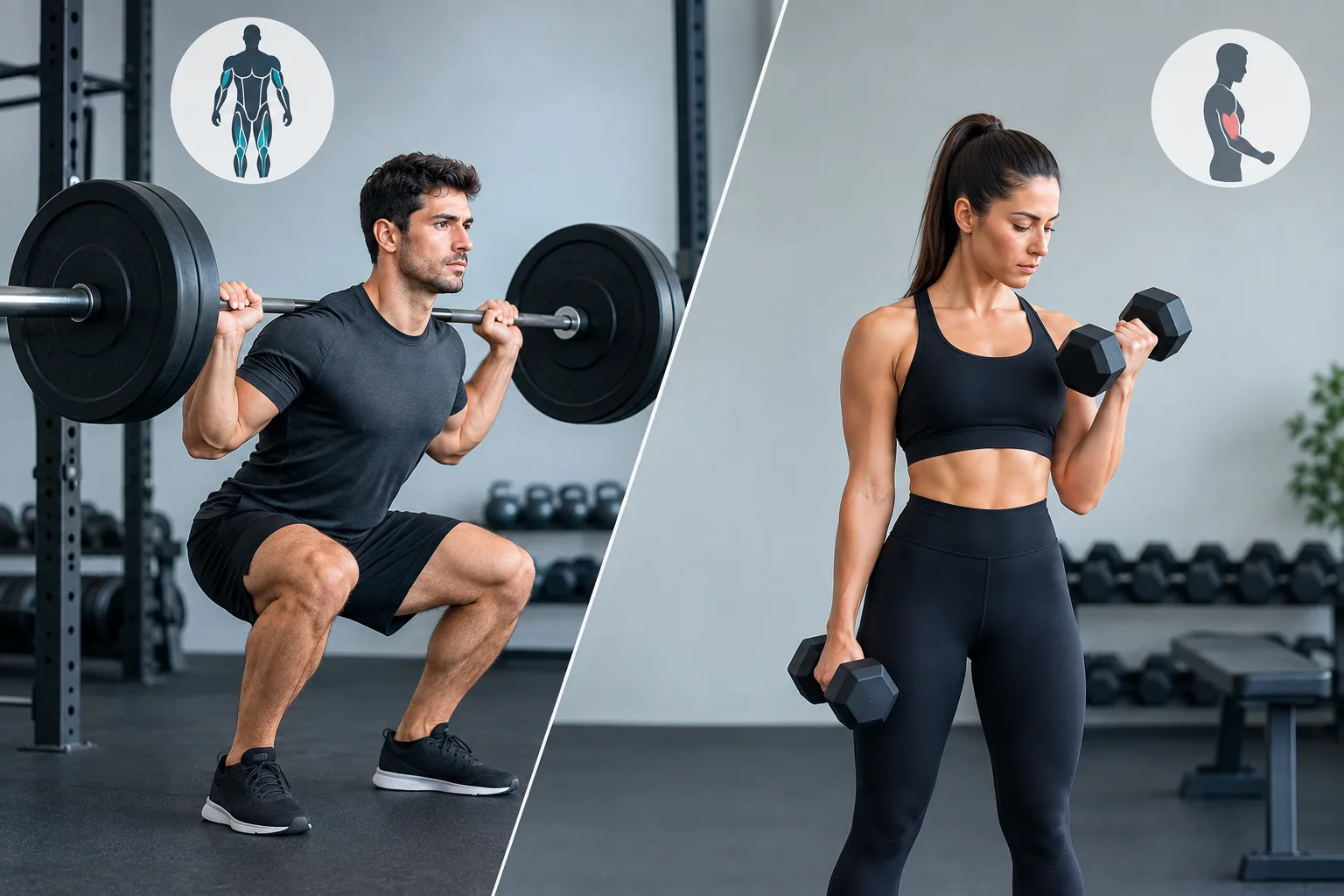
Compound vs isolation exercises is a common question among beginners, bodybuilders, and experienced athletes planning their workouts. Compound exercises involve movement at multiple joints, while isolation exercises primarily focus on movement at one joint and emphasize a specific muscle or muscle group. Both can contribute to a well-designed strength-training program, but they serve different purposes.
Understanding how these exercises differ can help you select movements based on your goals, experience, available time, and recovery needs. This guide explains their mechanics, benefits, limitations, role in muscle growth, and how to combine them in a practical workout—without assuming that one type is always superior.
Listen
What Is the Difference Between Compound and Isolation Exercises?
Compound and isolation exercises are two common categories of resistance training, distinguished mainly by how many joints move during the exercise. A compound movement typically involves two or more joints and coordinates several muscles, while an isolation movement generally centers on one joint to emphasize a more specific muscle action. These categories describe movement patterns, not a guarantee of how much muscle growth or strength a person will achieve. Both can be valuable, and the best selection depends on the exercise, the individual, and the training goal. Understanding the difference makes it easier to build a balanced program instead of relying on one category alone.
What Are Compound Exercises?
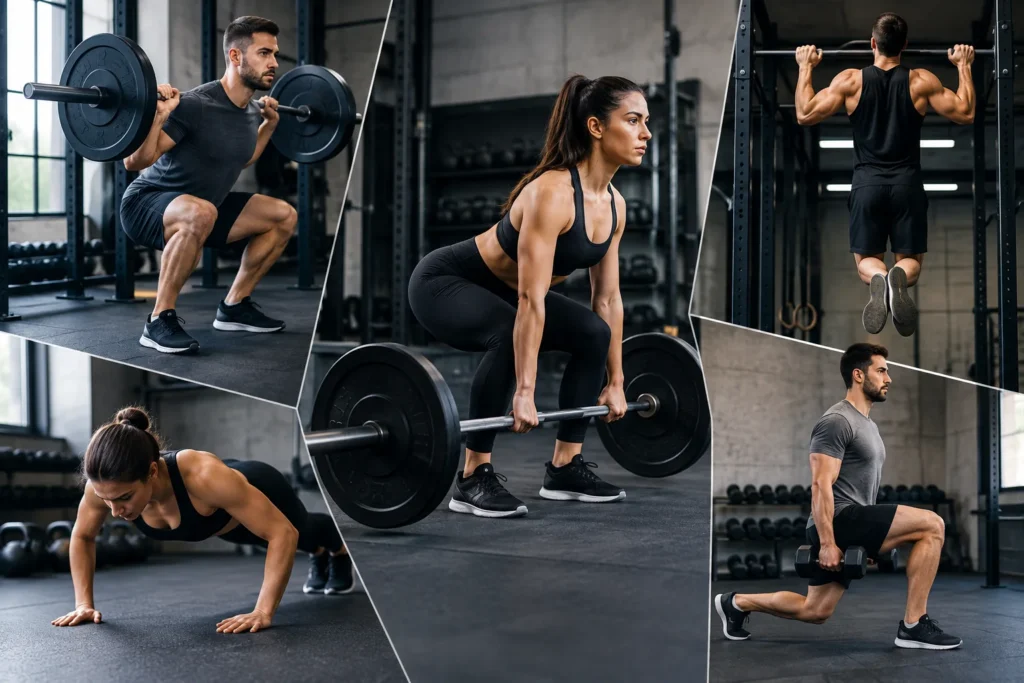
Compound exercises involve movement at multiple joints and typically recruit several muscle groups to complete a repetition. Common examples include squats, deadlifts, bench presses, rows, overhead presses, and pull-ups. During a squat, for example, the hips, knees, and ankles move while muscles across the legs and trunk contribute to the action and stabilization.
These exercises can be useful when a workout needs to train several muscle groups through coordinated movement. They also allow athletes to practice patterns relevant to many everyday and sporting tasks, although transfer depends on the specific movement and sport. Compound exercises often require more coordination and technique than simpler movements, especially when using free weights. Beginners should learn appropriate form, use manageable resistance, and progress gradually. A compound exercise is not automatically appropriate for everyone; equipment, mobility, experience, and individual limitations should guide selection.

What Are Isolation Exercises?
Isolation exercises generally involve movement at one main joint and focus on a particular muscle or muscle group. Examples include biceps curls, triceps pushdowns, leg extensions, leg curls, and lateral raises. In a biceps curl, the elbow is the primary moving joint, with the biceps contributing to elbow flexion.
These exercises can make it easier to direct training toward a specific muscle, add work without repeating a complex whole-body movement, or accommodate a program that needs more targeted volume. They may also be useful when a lifter wants to train a muscle that receives less direct emphasis in their compound movements. However, “isolation” does not mean only one muscle is active; supporting muscles still help stabilize the body and control the movement. Good technique, appropriate resistance, and controlled repetitions remain important. Isolation exercises are not merely optional “finishing moves”—their value depends on the needs of the training plan.
How Do Compound and Isolation Exercises Differ in Muscle Engagement?
The key distinction is the movement pattern: compound exercises coordinate movement across multiple joints, while isolation exercises focus primarily on one joint. This often means compound movements distribute the work across several muscles, whereas isolation movements can concentrate more of the intended action on a particular muscle.
| Feature | Compound Exercises | Isolation Exercises |
|---|---|---|
| Main movement | Multiple joints | Usually one main joint |
| Muscle involvement | Several muscle groups | More targeted emphasis |
| Examples | Squat, bench press, row | Curl, leg extension, lateral raise |
| Common role | Multi-muscle training, movement coordination | Targeted muscle work |
| Considerations | Coordination and technique demands | Specificity and controlled execution |
The distinction is useful, but it should not be oversimplified. Muscle activation, joint loading, and difficulty vary with technique, range of motion, equipment, and individual anatomy. A compound exercise may strongly train a target muscle, but it may not fully replace every targeted movement for every person. Likewise, isolation exercises can contribute meaningfully to strength and muscle development when programmed appropriately.
What Are the Benefits of Compound and Isolation Exercises?
Compound and isolation exercises offer different practical advantages. Compound movements can train multiple muscle groups in one exercise and provide opportunities to develop coordinated strength. Isolation movements can add targeted work where a program needs more emphasis on a particular muscle. Neither category guarantees better results on its own: outcomes depend on factors such as training effort, weekly volume, exercise execution, consistency, and recovery. A well-designed program considers what each exercise contributes and avoids adding movements simply to make a workout longer. The following sections explain how each category may fit into a training plan and what limitations to keep in mind.
How Can Compound Exercises Support Strength and Training Efficiency?
Compound exercises can be time-efficient because one movement may train several muscle groups. A squat, for example, involves the lower body and requires trunk stabilization; a bench press involves the chest, shoulders, and triceps. This makes compound movements useful when a person wants to cover major movement patterns within a limited training session.
They can also be particularly relevant when the goal is to improve performance in a specific multi-joint lift. A person seeking to increase their squat strength needs to practice squatting, rather than relying only on leg extensions and other isolated movements. A systematic review found that strength improvements tend to be greatest in exercises performed earlier in a session, supporting the practical idea of placing priority lifts when the athlete is relatively fresh. However, exercise order should reflect the main goal: if a particular isolation exercise is the priority, it may be placed earlier.
How Can Isolation Exercises Help Target Specific Muscles?
Isolation exercises can help address a specific training need that is not fully met by a person’s main compound movements. For example, a program may include rows and pull-ups but still use curls to provide direct elbow-flexor work. Similarly, compound pressing can train the triceps, while a pushdown may add more focused triceps training.
Targeted exercises can also allow training to continue for a particular muscle without requiring another demanding multi-joint movement. This can be useful when overall fatigue, equipment availability, or the structure of a workout limits additional compound work. Still, isolation exercises should be selected purposefully. Adding many movements for the same muscle can increase session length and fatigue without necessarily improving the overall plan. Choose them based on the muscle’s role in your goals, current training volume, and ability to perform the movement comfortably and consistently.
What Are the Limitations of Each Exercise Type?
Compound exercises may require more coordination, balance, and technical practice. A challenging squat or deadlift can also create substantial whole-body fatigue, potentially affecting later exercises. This does not make compound movements inherently unsafe, but it does mean that exercise selection, load, and technique should match the lifter’s ability.
Isolation exercises are more targeted, but they do not train the same multi-joint coordination as compound movements. A leg extension, for example, does not replicate the demands of a squat. They can also be overused if a program contains many exercises with overlapping purposes. The practical question is not which category has no drawbacks; both do. Instead, consider what the exercise trains, what it costs in time and fatigue, and whether it helps meet a clearly defined training objective.

Are Compound or Isolation Exercises Better for Muscle Growth?
For muscle growth, the question is not simply whether compound or isolation exercises are better. Both types can stimulate hypertrophy, and the available research does not establish that one category universally produces greater whole-muscle growth in every situation. Compound movements can train several muscles together, while isolation movements can add more targeted work or emphasize particular muscles. The more useful approach is to evaluate the full program: how much challenging work each muscle receives, whether exercises can be performed with good technique, and whether training can progress over time. Individual preferences and physical limitations also matter because a theoretically effective plan is less useful if it cannot be followed consistently.
How Do Compound Exercises Contribute to Muscle Growth?
Compound exercises can provide substantial training stimulus to several muscles within one movement. For example, a bench press trains the chest while also involving the triceps and front deltoids; a row involves the back and elbow flexors. This makes compound movements useful foundations for many hypertrophy programs, especially when training time is limited.
However, the involvement of a muscle does not mean it receives exactly the same stimulus as every other muscle in the exercise. The amount of work depends on technique, range of motion, individual structure, and how the exercise is performed. A lifter may make progress with compound movements alone, but some muscles may benefit from additional targeted work depending on their goals and the program’s overall design. The goal should be to use compound exercises for the training they provide—not to assume they fully cover every muscle for every person.
How Can Isolation Exercises Complement Muscle Development?
Isolation exercises can supplement compound training by giving a muscle additional direct work. For instance, a lifter may use a pressing movement for the chest, shoulders, and triceps, then add lateral raises for the side deltoids or pushdowns for the triceps. This allows the program to address specific priorities without requiring every additional set to be another complex compound lift.
A 2023 systematic review and meta-analysis comparing single-joint and multi-joint exercises reported broadly similar whole-muscle hypertrophy across the included comparisons. The authors also noted that single-joint work may offer a way to target particular muscle subdivisions, although this possibility needs more research. These findings support considering isolation exercises as useful options—not as mandatory additions for every muscle or every trainee.
Why Do Training Volume and Progressive Overload Matter?
Exercise category is only one part of an effective hypertrophy program. Training volume, effort, progression, exercise technique, and recovery also influence adaptation. The 2026 American College of Sports Medicine (ACSM) position stand synthesized 137 systematic reviews involving more than 30,000 participants and reported that resistance training improves muscle size and strength, while higher weekly training volume was associated with greater hypertrophy in the evidence reviewed.
Progressive overload means gradually increasing the challenge placed on the body as capacity improves. This may involve adding repetitions, increasing resistance, improving control, or progressing the exercise variation. It does not mean increasing weight every session regardless of technique. Track performance and recovery, and adjust the program when progress stalls or fatigue accumulates. Compound and isolation exercises can both be progressed; the appropriate method depends on the movement and the trainee.
Should Beginners Focus on Compound or Isolation Exercises?
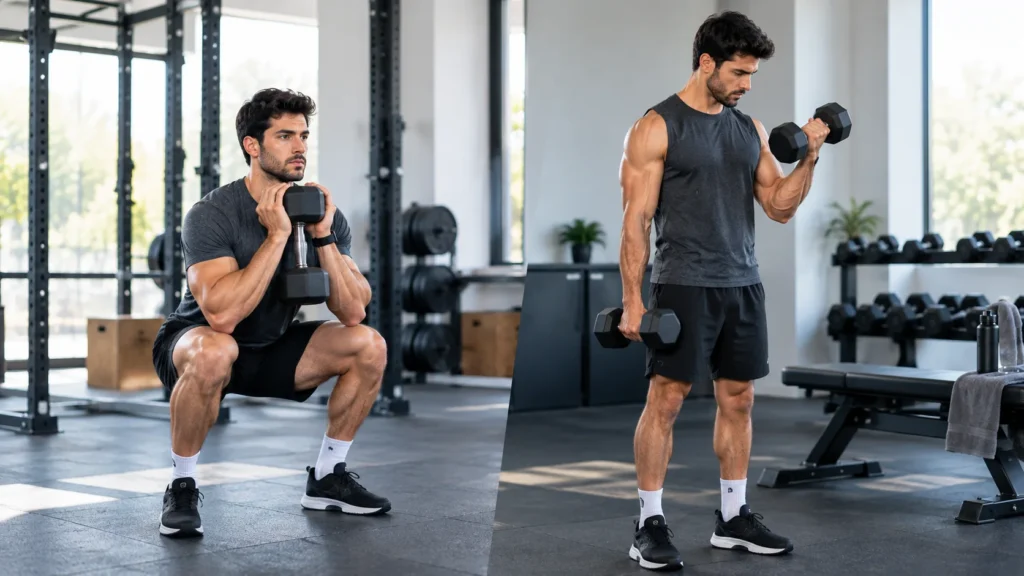
Beginners do not need to choose only one category. A balanced introductory program can include simple compound movements to practice broad movement patterns and selected isolation exercises to address specific needs. The priority should be learning technique, starting with manageable resistance, and building a repeatable routine rather than chasing complexity or exhaustion. The right exercise depends on the person’s experience, available equipment, comfort, and goals. A beginner who finds a particular compound lift difficult may use a machine or a simpler variation while learning, and a beginner who needs targeted work can include isolation exercises from the start. Progress should be gradual and based on how well the movement is performed.
Which Compound Exercises Can Beginners Learn First?
Beginners can start with accessible variations of common movement patterns, such as a bodyweight or goblet squat, a supported row, a machine chest press, or a hip-hinge variation taught by a qualified coach. These options can help a new lifter learn coordination without immediately handling heavy loads or complex setups.
The best starting exercise is not necessarily the most famous lift. A movement should fit the trainee’s mobility, comfort, equipment, and ability to maintain control. Begin with a resistance that allows consistent technique and stop a set if form deteriorates. As skill improves, the trainee can gradually increase resistance or move to a more challenging variation. If a movement causes pain or feels unsuitable, choose an alternative and seek qualified guidance when needed. The aim is to build competence and confidence while training the major muscle groups.
When Should Beginners Add Isolation Exercises?
Beginners can use isolation exercises when they serve a clear purpose. A new lifter might add a leg curl, calf raise, curl, or triceps extension to complement a simple full-body routine. These movements can be easier to understand because the main action is more focused, although they still require appropriate setup and control.
There is no universal waiting period before adding isolation work. It can be included early if the overall routine remains manageable and the trainee understands how to perform the exercise. The main caution is not to let a long list of small movements crowd out consistent practice of the major movement patterns. Start with a modest number of exercises, monitor soreness and performance, and add targeted work gradually. If time or recovery is limited, prioritize exercises that best match the person’s goals.
How Can Beginners Balance Exercise Selection and Recovery?
A beginner’s program should be simple enough to repeat and recover from. Instead of selecting many exercises for every muscle, begin with a manageable set of movements that cover the main areas of the body. Use a training log to record exercises, resistance, repetitions, and how the session felt. This helps identify whether the plan is progressing or becoming unnecessarily demanding.
Recovery is influenced by training volume, effort, sleep, nutrition, and individual circumstances. If soreness is persistent, performance is declining, or technique becomes less reliable from session to session, the trainee may need to reduce workload or allow more recovery. Beginners should avoid treating severe fatigue as proof of a successful workout. A qualified trainer can help tailor movement choices and technique, especially for people with previous injuries or other limitations.

How Can You Combine Compound and Isolation Exercises in a Workout?
A practical workout often uses compound exercises for broad movement patterns and isolation exercises for targeted work. The order should reflect the main training priority: a person focused on improving a squat or bench press will generally perform that lift while relatively fresh, whereas someone prioritizing a specific muscle may place its isolation exercise earlier. There is no requirement to include both categories in every session, and exercise selection should fit the available time and recovery capacity. The following approach offers a flexible framework rather than a fixed prescription. Adjust the exercises, sets, and resistance to your experience and goals.
Should Compound Exercises Come Before Isolation Exercises?
For many strength-focused workouts, placing the main compound lift early can help preserve technique and performance while the trainee is fresh. Research on exercise order indicates that strength gains tend to be greater for exercises performed earlier in the session, while hypertrophy outcomes may be similar across different exercise orders.
This does not mean compound exercises must always come first. If the primary goal is to improve a specific muscle or lift that is usually trained through isolation work, placing that exercise earlier may make sense. Warm-ups and preparation should also be considered before the main work. A useful rule is to prioritize the exercise most closely connected to the main goal, then arrange the remaining movements around fatigue, equipment, and time. Consistency matters more than following a rigid order that does not fit the individual.
How Can You Build a Balanced Workout?
A balanced session can include one or more compound movements followed by a small number of targeted exercises. For example, a general upper-body workout might include a press and a row, followed by a curl or triceps exercise based on the trainee’s goals. A lower-body session might include a squat or hinge pattern, with a leg curl or calf raise added if useful.
The exact number of exercises and sets should depend on training experience, weekly schedule, and recovery. The sample below is an illustration of exercise selection—not a personalized prescription:
| Training focus | Compound example | Isolation example |
|---|---|---|
| Chest and triceps | Bench press | Triceps pushdown |
| Back and biceps | Row or pulldown | Biceps curl |
| Quadriceps | Squat variation | Leg extension |
| Hamstrings | Hip hinge | Leg curl |
| Shoulders | Overhead press | Lateral raise |
Avoid adding every listed movement into one workout. Select the exercises that match the goal and allow enough time for warm-up, good execution, and recovery between sessions.
How Should You Adjust Exercise Selection for Your Fitness Goals?
For strength, prioritize practicing the specific lifts or movement patterns you want to improve. Compound exercises often have a central role because they closely match multi-joint strength tasks, while isolation exercises can support additional muscle work where appropriate.
For hypertrophy, combine movements that train the target muscles effectively and allow enough manageable weekly volume. Isolation exercises may be useful for adding targeted work, but they are not automatically required for every muscle. For general fitness or time-limited sessions, a smaller selection of compound movements may cover several muscle groups efficiently, with isolation work added only when it provides a clear benefit.
For beginners, comfort, technique, and consistency should guide exercise selection. For experienced athletes, training history, sport demands, and specific muscle priorities may justify a more individualized mix. Review the program periodically and change exercises when there is a reason—not simply because variety itself guarantees better results.
Conclusion: How Can You Make the Most of Both Exercise Types?
The difference between compound and isolation exercises comes down mainly to joint movement and the way muscles contribute to an exercise. Compound movements coordinate several joints and muscle groups, while isolation movements emphasize a more specific action. Both can support strength and muscle development when selected and programmed appropriately.
For many lifters, a practical strategy is to build a routine around movements that match their main goals, then add targeted exercises where they provide value. There is no need to treat the two categories as competitors: the most useful program is one that fits your goals, ability, schedule, and recovery.
At 5dfitness, our aim is to help athletes and fitness enthusiasts make informed training decisions. Review your current routine, identify what each exercise contributes, and build a balanced plan that you can perform consistently. Start with a clear goal, progress gradually, and make every exercise count.
FAQ
Compound exercises involve movement at multiple joints and usually train several muscle groups. Isolation exercises primarily involve one main joint and emphasize a specific muscle or muscle group.
Not universally. Compound exercises can train several muscles in one movement, but research suggests single-joint and multi-joint exercises can produce similar whole-muscle hypertrophy. The best choice depends on the overall program and individual goals.
Yes. Isolation exercises can provide targeted resistance training for specific muscles and contribute to muscle growth when performed with appropriate effort, volume, and progression.
Beginners can benefit from learning accessible compound movements, but they do not need to avoid isolation exercises. Start with manageable resistance, prioritize technique, and choose exercises that fit your ability.
Often, if strength in a compound lift is your priority. Exercises performed earlier in a session tend to receive a strength-performance advantage, but the order can be adjusted to prioritize a specific muscle or movement.
Yes. Many workouts use compound movements for broad training and isolation exercises for targeted work. You do not need to include both categories in every session.