Staying active does not always require a gym, expensive equipment, or a long workout session. Exercises You Can Do Anywhere can help you maintain strength, muscular endurance, mobility, and cardiovascular fitness using your own body weight. For athletes, fitness enthusiasts, and beginners, bodyweight training is a practical way to stay consistent when access to a gym is limited.
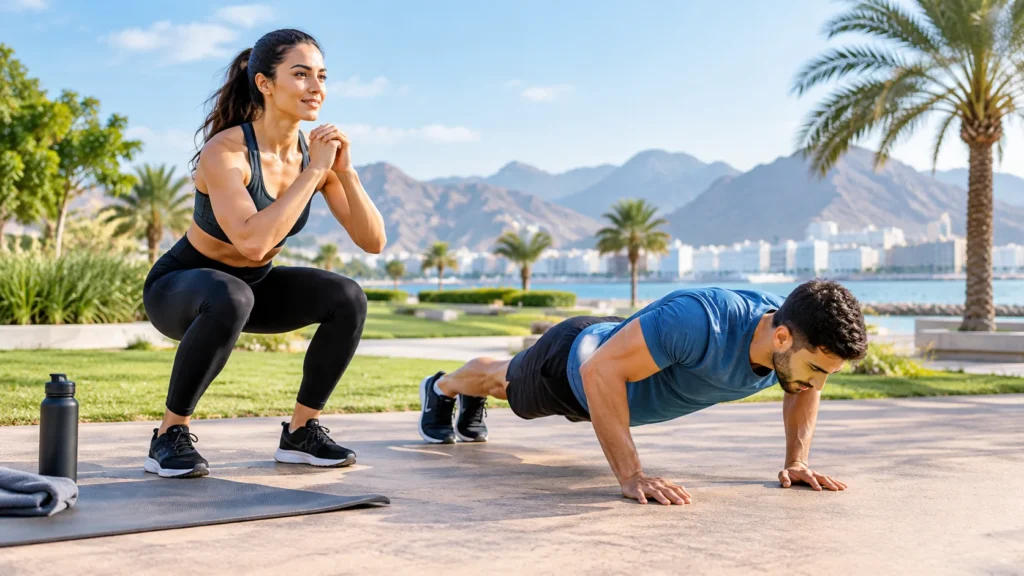
At 5dfitness, the focus is on simple, evidence-based fitness strategies that can be adapted to different goals and fitness levels. The five exercises in this guide target major muscle groups and can be combined into a short full-body workout.
Listen
Why Are Exercises You Can Do Anywhere Useful for Fitness?
Exercises that require little or no equipment remove some of the most common barriers to regular training. You can perform them at home, in a hotel room, outdoors, or during travel with minimal space. Bodyweight movements can also be modified by changing repetitions, tempo, range of motion, or exercise variation. This makes them useful for both beginners and experienced exercisers. Regular physical activity is associated with important health benefits, while muscle-strengthening activities are recommended as part of a balanced weekly exercise routine.
Why Are Bodyweight Exercises Easy to Perform Anywhere?
Bodyweight exercises are convenient because the resistance comes primarily from your own body rather than external equipment. This means you can perform many movements without needing access to dumbbells, machines, resistance bands, or a gym.
The main advantage is flexibility. A person traveling for work can complete a short workout in a hotel room, while someone working from home can use a few minutes between tasks to stay active. Athletes can also use bodyweight exercises as supplementary training when they cannot access their normal equipment.
However, convenience does not mean that every bodyweight exercise is automatically easy. Exercises such as push-ups, lunges, and mountain climbers can become demanding when performed with controlled technique and appropriate intensity. The key is to choose a variation that matches your current ability.
Can No-Equipment Exercises Improve Overall Fitness?
Yes. A well-designed bodyweight routine can contribute to several components of fitness, including muscular endurance, strength development, core stability, coordination, and cardiovascular conditioning.
The effectiveness depends on exercise selection and progression. Performing the same easy movement indefinitely may provide limited additional challenge. Instead, you can gradually increase repetitions, sets, movement tempo, range of motion, or exercise difficulty.
Research has also shown that simple calisthenics can improve neuromuscular function, while bodyweight training programs can produce improvements in cardiorespiratory fitness. Therefore, equipment-free training should not be viewed simply as a temporary substitute for gym workouts. It can be a useful training method when programmed appropriately.
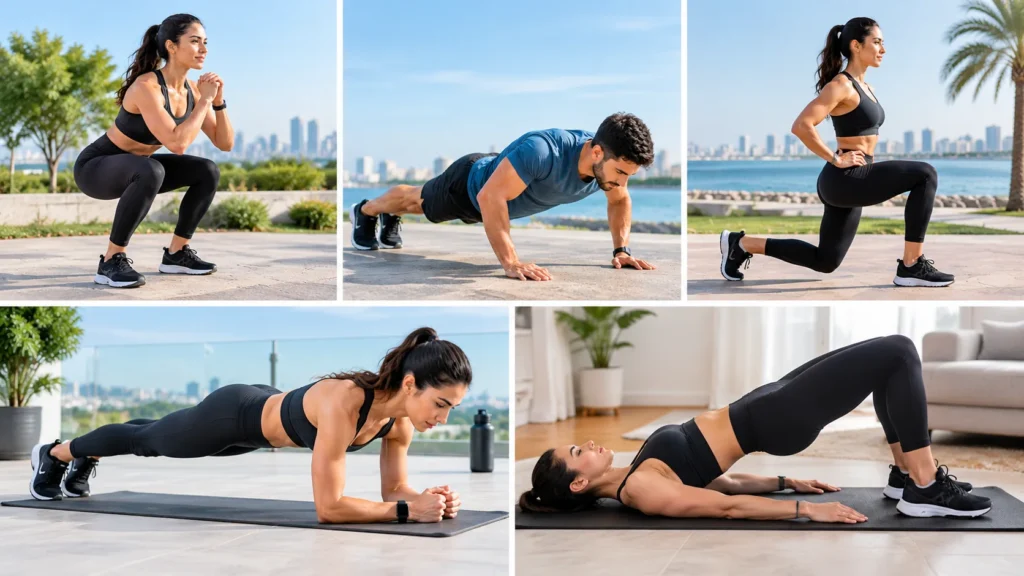
Which 5 Simple Exercises Can You Do Anywhere?
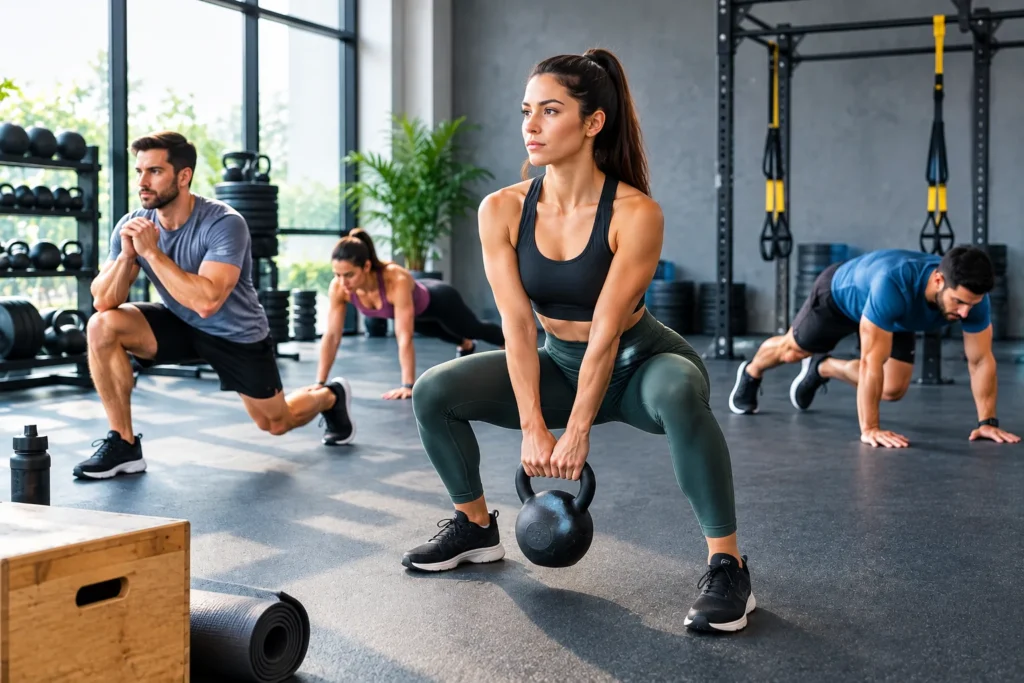
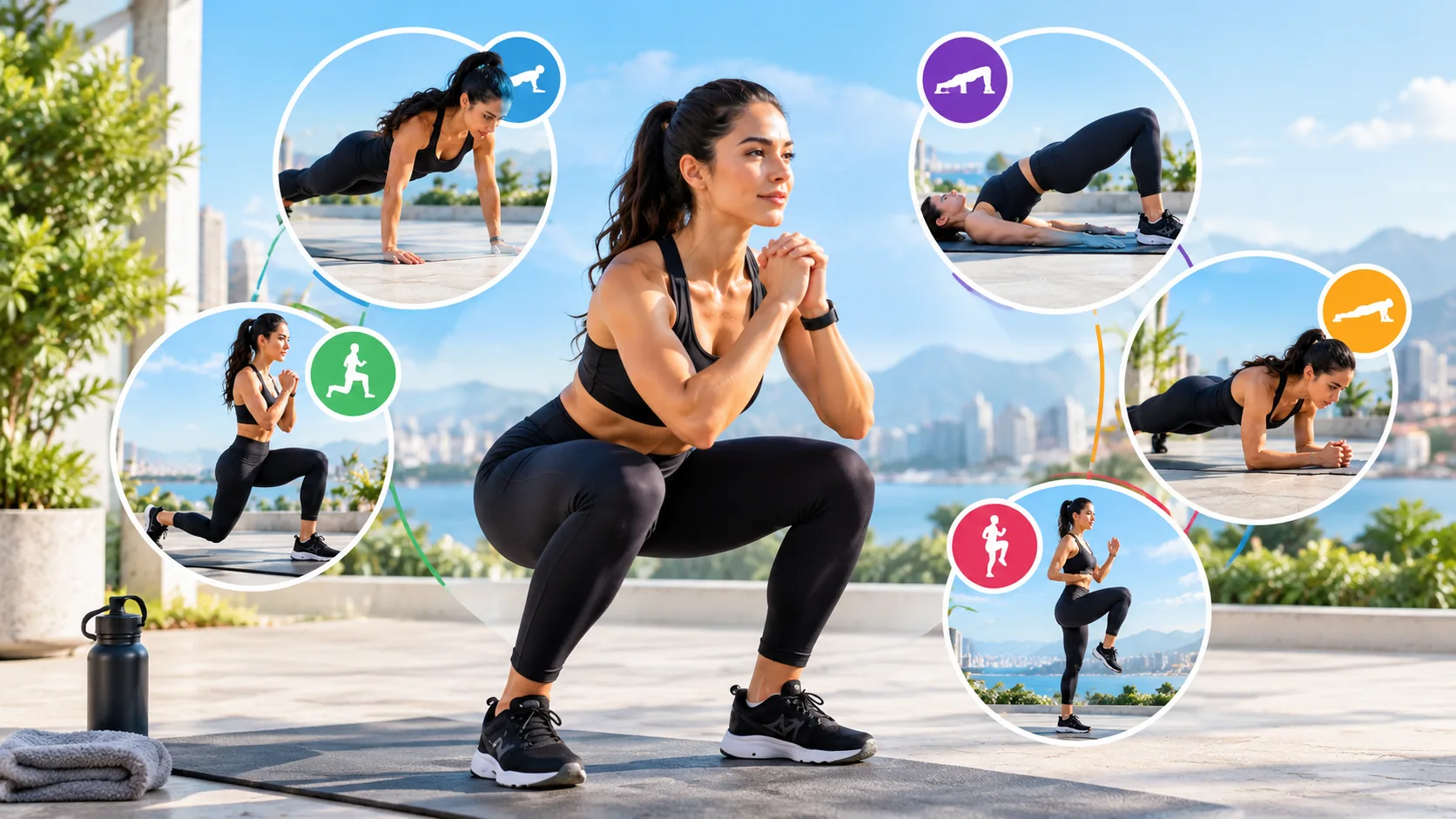
The most practical exercises are movements that require little space and target several major muscle groups. A simple combination of squats, push-ups, lunges, planks, and mountain climbers creates a balanced routine involving the legs, upper body, core, and cardiovascular system.
These exercises can also be adjusted for different fitness levels. Beginners can use easier variations and fewer repetitions, while experienced athletes can increase volume, tempo, or movement difficulty. The goal is not simply to complete as many repetitions as possible, but to maintain controlled technique and gradually increase the training stimulus.
How Do You Perform Bodyweight Squats Correctly?
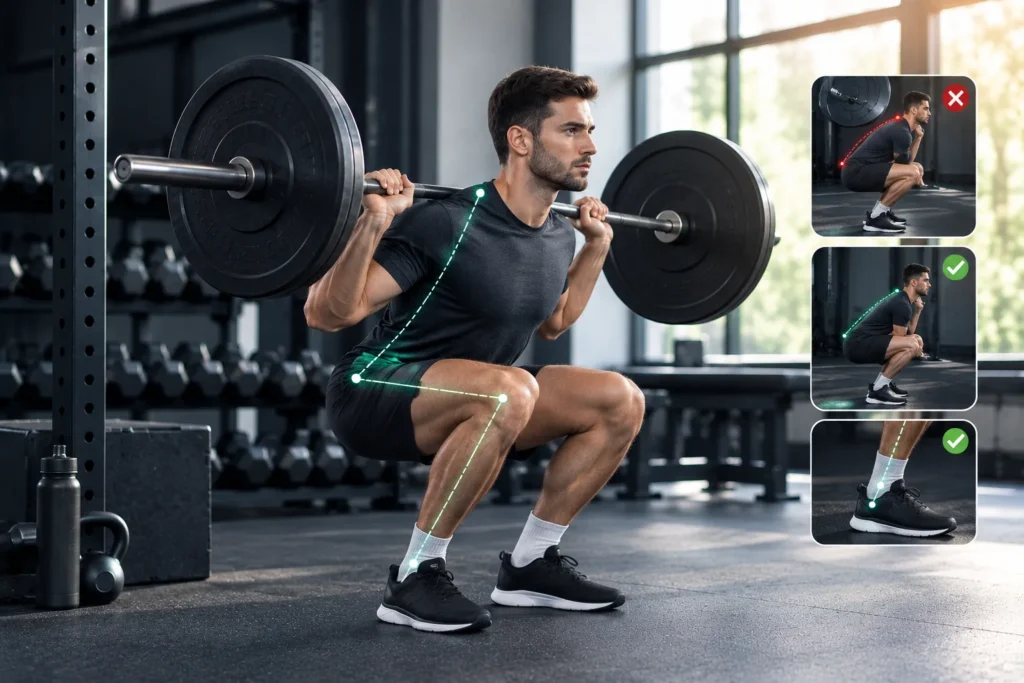
Bodyweight squats are one of the simplest lower-body exercises and primarily involve the quadriceps, glutes, and other muscles responsible for controlling the hips and knees.
Stand with your feet approximately shoulder-width apart. Keep your chest relatively upright, brace your core, and bend your knees and hips while lowering your body. Descend only as far as you can maintain good control, then push through your feet to return to the starting position.
Beginners can start with 8–12 controlled repetitions. If the movement becomes easy, you can increase repetitions, slow the lowering phase, add a pause at the bottom, or progress to more demanding squat variations.
The most important point is quality. Avoid rushing through repetitions simply to increase the number. Controlled movement and a comfortable range of motion should come first.
How Do You Perform Push-Ups Without Equipment?
Push-ups are an effective upper-body bodyweight exercise that mainly challenges the chest, shoulders, triceps, and core. They are also highly adaptable because changing the position of the hands or body can alter the difficulty.
Start in a plank position with your hands positioned slightly wider than your shoulders. Keep your body relatively straight from your head to your heels. Bend your elbows and lower your chest toward the floor while keeping your core engaged. Then press the floor away to return to the starting position.
If a standard push-up is too difficult, perform the movement with your hands elevated on a stable surface or use a modified variation. More experienced exercisers can increase difficulty through slower repetitions or harder variations.
Good technique should always take priority over completing more repetitions.
How Can Lunges Strengthen Your Lower Body?
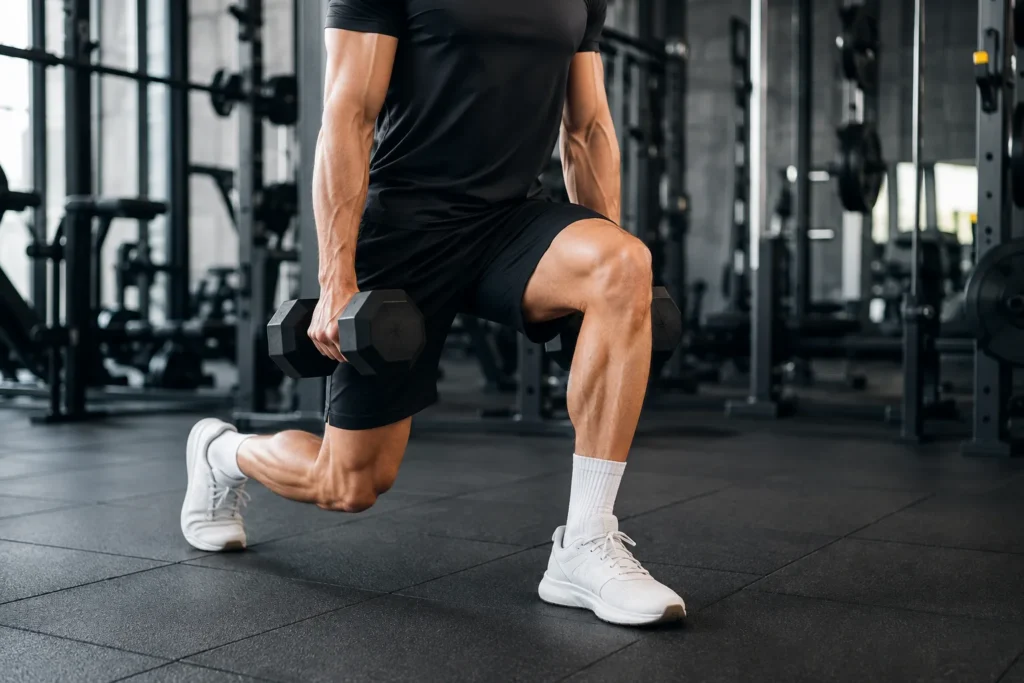
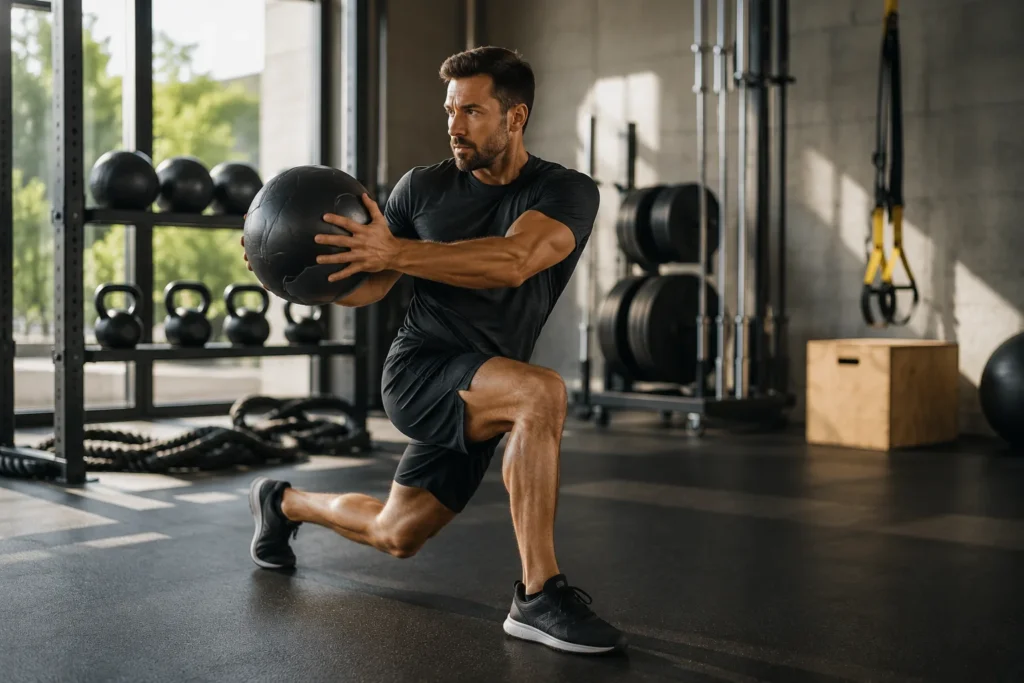
Lunges are a unilateral lower-body exercise that can challenge the quadriceps, glutes, and other muscles involved in hip and knee control. Because each leg works more independently, lunges can also introduce a balance and coordination component.
Start by standing tall with your feet comfortable apart. Step forward with one leg and lower your body under control by bending both knees. Keep your torso stable and avoid allowing the front knee to collapse inward. Push through the front foot to return to the starting position.
Beginners can perform stationary reverse lunges, which may feel easier to control. More experienced exercisers can use forward, reverse, or walking lunges.
Start with approximately 6–10 repetitions per leg and increase the volume gradually. If balance becomes difficult, reduce the range of motion or use a stable support until technique improves.
How Does the Plank Strengthen Your Core?
The plank is a simple isometric exercise that challenges the muscles responsible for maintaining trunk stability. Unlike dynamic exercises, the goal is to maintain a controlled position rather than repeatedly moving through a large range of motion.
Begin with your forearms or hands supporting your upper body and your legs extended behind you. Keep your body aligned without allowing your hips to drop excessively or rise too high. Brace your abdominal muscles and breathe normally while maintaining the position.
Beginners can start with short holds, such as 15–30 seconds, followed by adequate rest. Over time, the duration can gradually increase.
The goal is not to hold a plank for as long as possible at the expense of technique. Once your hips begin to sag or your body position becomes difficult to control, the set should end.
How Do Mountain Climbers Improve Full-Body Fitness?
Mountain climbers combine a plank position with alternating leg movement, creating a more dynamic exercise that can challenge the core, shoulders, hips, and cardiovascular system.
Start in a strong high-plank position. Bring one knee toward your chest while keeping the supporting leg extended. Return that leg and alternate sides. Beginners should prioritize controlled movement rather than immediately trying to move as fast as possible.
Because the exercise can become intense quickly, it is useful to begin with short intervals. For example, you could perform mountain climbers for 20–30 seconds before resting.
As fitness improves, you can increase the work interval or perform the movement at a faster controlled pace. If maintaining a stable plank position becomes difficult, slow down rather than sacrificing technique.
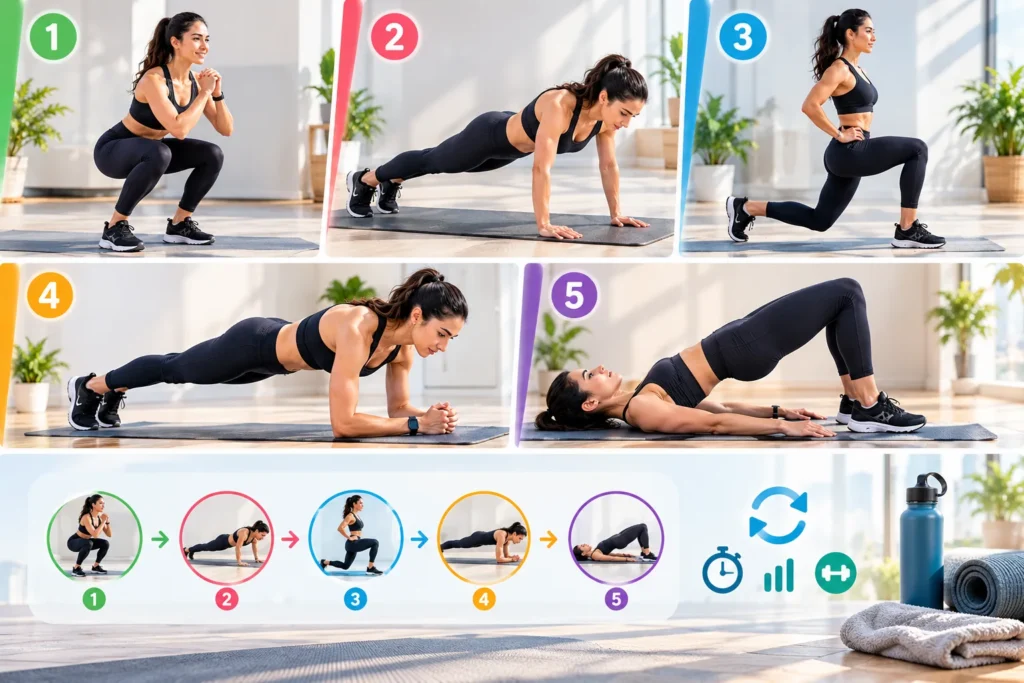
How Can Beginners Turn These Exercises Into a Simple Full-Body Workout?
The five exercises can be combined into a short circuit that trains different areas of the body without requiring equipment. A practical beginner workout does not need to be extremely long or exhausting. The priority should be consistent training, appropriate intensity, and progressive improvement.
For a simple routine, perform squats, push-ups, lunges, planks, and mountain climbers consecutively. Rest between movements when necessary, and take a longer recovery period between rounds. Beginners can start with one or two rounds and gradually increase the workload as their fitness improves.
How Many Repetitions and Sets Should You Perform?
There is no single repetition target that works perfectly for everyone. Training volume should match your fitness level, exercise difficulty, and overall goal.
A practical starting point is:
| Exercise | Beginner Starting Point | Main Focus |
|---|---|---|
| Bodyweight Squats | 8–12 reps | Legs and glutes |
| Push-Ups | 5–10 reps | Chest, shoulders and triceps |
| Lunges | 6–10 reps per leg | Legs and balance |
| Plank | 15–30 seconds | Core stability |
| Mountain Climbers | 20–30 seconds | Core and conditioning |
Complete one or two rounds initially. As the exercises become easier, you can add another round, increase repetitions, extend plank duration, or choose a more challenging variation.
The correct workload is one that provides a meaningful challenge while allowing you to maintain good form.
How Can You Increase Workout Intensity Over Time?
Progressive overload does not always require heavier weights. With bodyweight training, you can increase difficulty in several ways.
First, increase repetitions gradually. Second, add another set or circuit round. Third, slow down the eccentric phase of movements such as squats and push-ups. Fourth, introduce a more challenging variation. Finally, reduce rest periods slightly when the goal is to increase conditioning.
Progression should be gradual rather than aggressive. If you suddenly increase training volume, intensity, and frequency at the same time, fatigue can rise quickly.
A useful approach is to change one variable at a time. For example, once you can comfortably complete two rounds, add a few repetitions or introduce a third round rather than dramatically increasing everything at once.
How Can You Exercise Anywhere Safely and Stay Consistent?
The biggest advantage of equipment-free training is accessibility, but accessibility should not replace good exercise habits. Proper technique, suitable progression, recovery, and consistency are essential.
Adults are generally encouraged to accumulate at least 150 minutes of moderate-intensity aerobic activity each week or an equivalent amount of vigorous activity, along with muscle-strengthening activity on at least two days per week. These recommendations do not mean every workout must be long. Activity can be divided into smaller sessions throughout the week.
Why Is Proper Exercise Form Important?
Exercise technique determines how effectively you perform a movement and can influence unnecessary stress on joints and muscles. This is particularly important when exercising without supervision.
Start with a variation that you can perform comfortably. Keep your movements controlled and avoid using momentum simply to increase repetitions. If pain occurs, stop the movement rather than trying to push through it.
A useful principle is to progress only when you can consistently perform the current variation with good control. For example, if standard push-ups cause your hips to sag, use an easier variation until you develop sufficient strength.
If you have an injury, chronic health condition, or significant limitations, consider discussing your exercise plan with an appropriate healthcare or exercise professional before increasing intensity.
Should You Warm Up Before a Bodyweight Workout?
A short warm-up can prepare your body for movement and allow you to gradually increase exercise intensity. It does not need to be complicated.
Before this workout, spend approximately 5 minutes performing low-intensity movements such as walking in place, arm circles, controlled bodyweight squats, and gentle mobility exercises.
The purpose is to increase movement gradually rather than exhaust yourself before the main workout. You can then perform the first set of each exercise at a lower intensity before moving into your normal working level.
Consistency also matters. A short workout that you can perform regularly is generally more practical than an extremely demanding workout that you repeatedly skip.
Conclusion
You do not need a gym to maintain an effective exercise routine. Exercises You Can Do Anywhere such as squats, push-ups, lunges, planks, and mountain climbers can provide a practical combination of strength, muscular endurance, core stability, and conditioning. The most important factors are choosing appropriate exercise variations, maintaining good technique, progressing gradually, and staying consistent.
For athletes and fitness enthusiasts, these movements can also work as supplementary training when equipment is unavailable. For beginners, they provide a simple starting point for building an active routine.
5dfitness aims to make practical fitness information easier to apply in real-world situations, whether you train at home, travel frequently, or simply want a workout that does not depend on gym access.
Start with one or two rounds, focus on quality movement, and gradually build your capacity over time.
FAQ
Squats, push-ups, lunges, planks, and mountain climbers are practical choices because they require little or no equipment and can be modified for different fitness levels.
Yes. Bodyweight exercises use your body as resistance and can provide strength, muscular endurance, core, and conditioning benefits when programmed appropriately.
They can contribute to muscle development, particularly for beginners and intermediate exercisers. Progress becomes increasingly important as your body adapts, so more difficult variations or additional resistance may eventually be useful.
Yes, provided the exercises are modified appropriately. Beginners should start with manageable repetitions, shorter intervals, and easier variations before increasing difficulty.
Yes. This is one of the main advantages of equipment-free training. A small amount of floor space is enough for most of these movements, making them practical for hotel rooms, outdoor spaces, or travel.
It depends on your fitness level and goals. A short 10–20-minute session can be useful, particularly when performed consistently. Longer workouts can be used as fitness and recovery capacity improve.
They can contribute to energy expenditure and support an active lifestyle. However, weight management depends on overall physical activity, nutrition, energy balance, sleep, and other lifestyle factors rather than one specific exercise.