Functional training focuses on movements that resemble the physical demands of everyday life, rather than isolating muscles only for appearance or maximum strength. The best functional exercises can help improve strength, balance, coordination, mobility, and the ability to perform daily movements such as squatting, lifting, carrying, pushing, pulling, and climbing stairs.
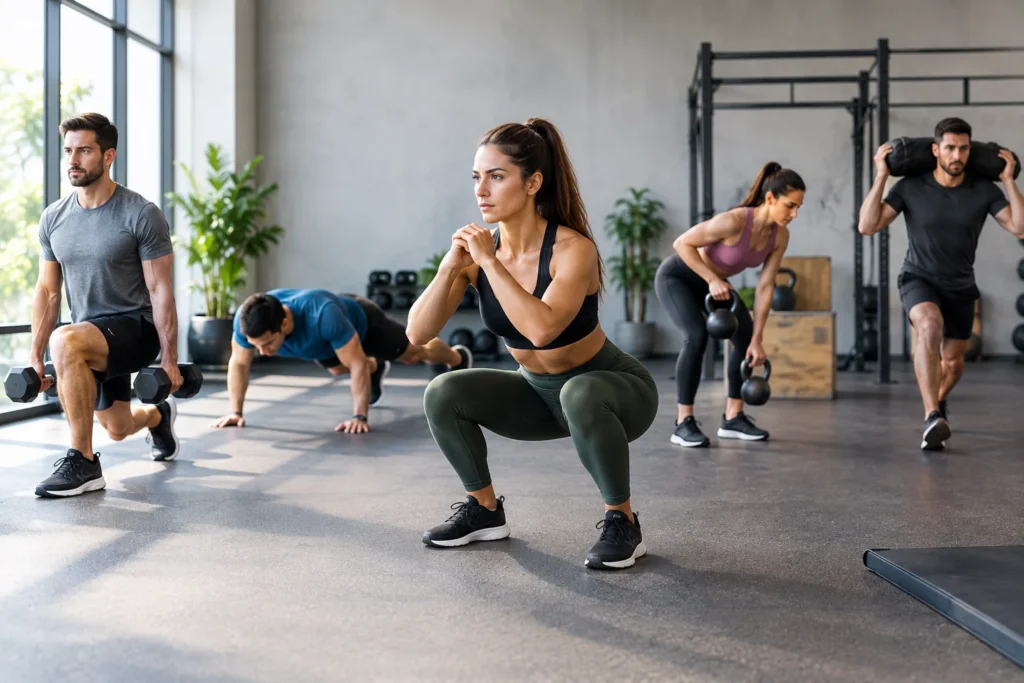
For athletes, fitness enthusiasts, bodybuilders, and people who simply want to move better, functional training can complement traditional resistance training and cardiovascular exercise. 5dfitness approaches functional fitness from a practical, evidence-based perspective, focusing on how exercise can improve physical performance both inside and outside the gym.
Listen
What Are the Best Functional Exercises for Everyday Fitness?
Functional exercises are movements designed to develop physical qualities that transfer to real-life activities and sport. Instead of focusing exclusively on a single muscle, many functional movements involve several joints and muscle groups working together. Squats, lunges, push-ups, rows, deadlifts, carries, step-ups, and rotational movements are common examples.
The best functional exercises are not necessarily the most complicated ones. A well-designed program should include fundamental movement patterns and gradually increase resistance, repetitions, range of motion, balance demands, or movement complexity. This approach can make functional training useful for beginners as well as experienced athletes.
Which Functional Exercises Should You Include in a Full-Body Routine?
A balanced functional workout can include exercises such as squats, lunges, push-ups, rows, deadlifts, step-ups, planks, and loaded carries.
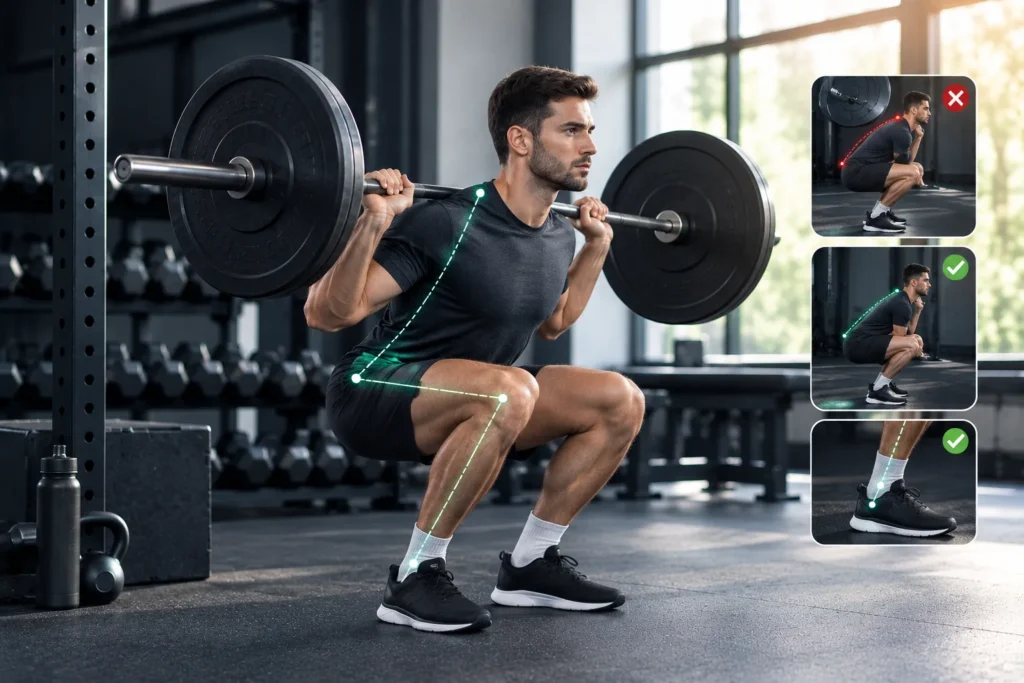
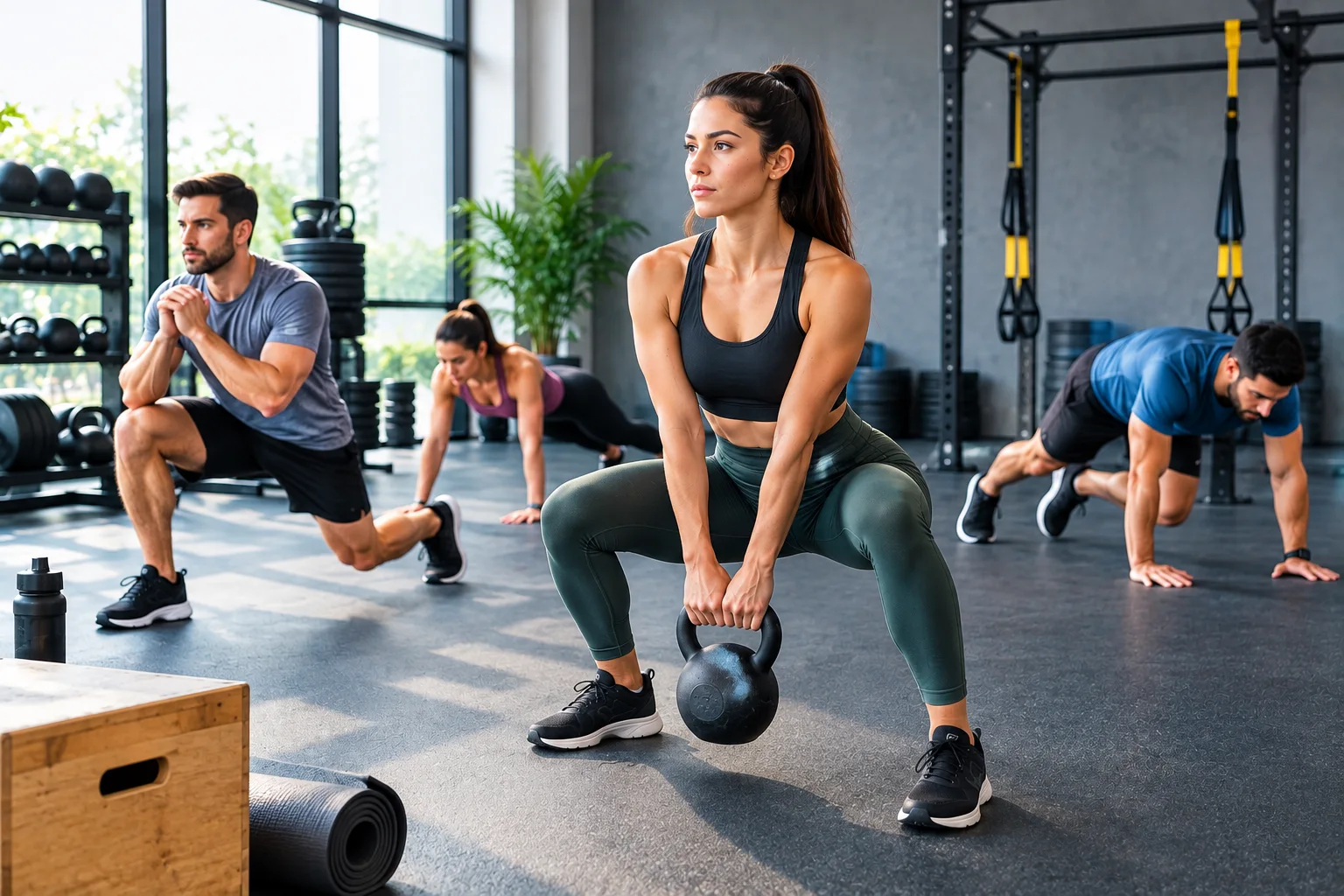
Squats train the hips, knees, and trunk and resemble movements such as sitting down and standing up.
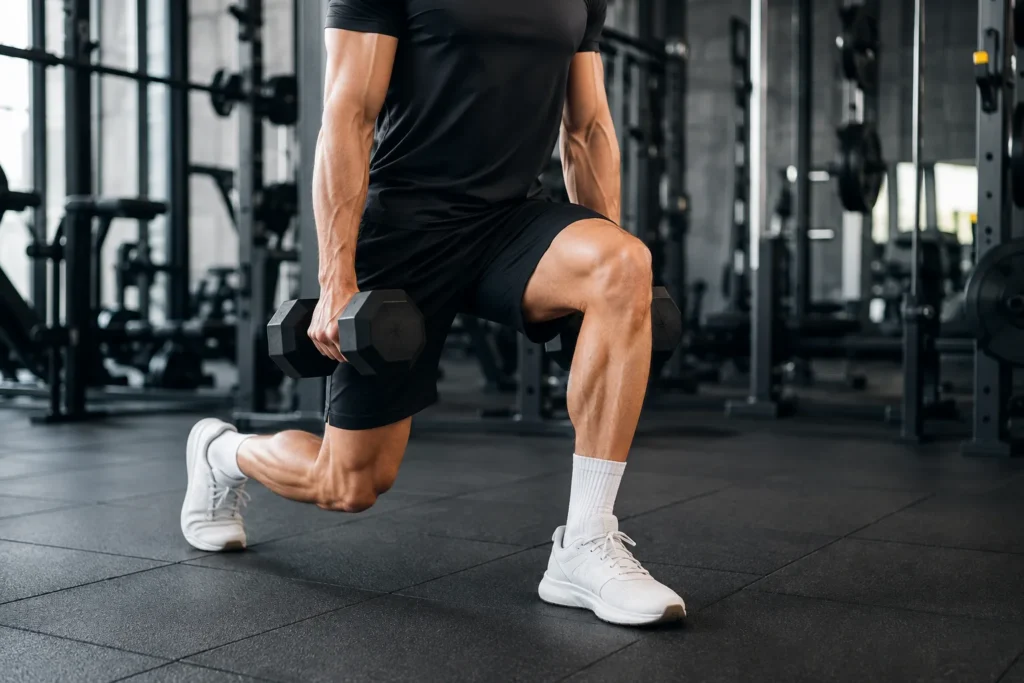
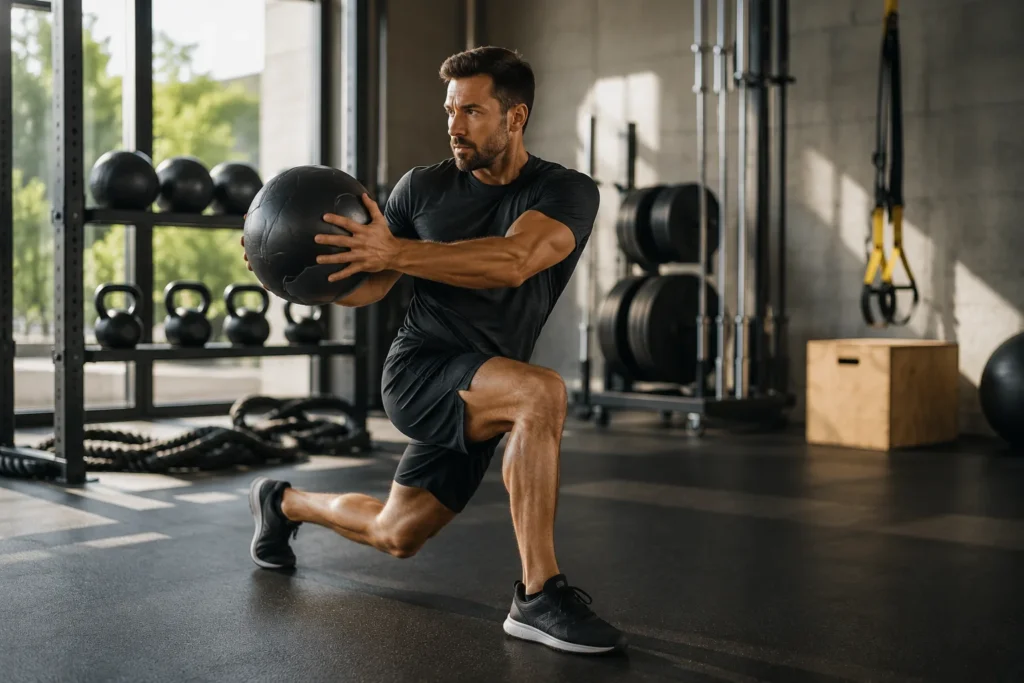
Lunges challenge unilateral leg strength, coordination, and stability while requiring one side of the body to work differently from the other.
Push-ups develop upper-body pushing strength while requiring trunk stability.
Rows strengthen the muscles involved in pulling and can support better upper-body control.
Deadlift variations train the hips and posterior chain while teaching an important lifting pattern.
Step-ups combine single-leg strength, balance, and coordination.
Loaded carries, such as farmer’s carries, challenge grip strength, posture, trunk stability, and the ability to control the body while moving under load.
Together, these exercises cover several fundamental movement patterns and can create a practical full-body training session.
How Can Squats and Lunges Improve Everyday Movement?
Squatting and lunging are fundamental lower-body movement patterns that appear in many daily activities. Sitting down, standing up, picking objects from a low position, climbing stairs, and getting up from the floor all require some combination of hip, knee, and ankle movement.
Squats primarily train bilateral lower-body strength, while lunges introduce a unilateral component that can challenge balance and coordination. This distinction makes lunges particularly useful when training the ability to control each leg independently.
Functional training should not mean performing random movements simply because they look athletic. The goal is to progressively improve strength, control, range of motion, and coordination in movement patterns that have practical relevance.
For beginners, bodyweight squats and supported lunges can provide an accessible starting point. As strength improves, resistance can be added through dumbbells, kettlebells, or other appropriate equipment.
Why Are Push, Pull, Hinge, and Carry Movements Important?
A complete functional program should not focus only on the legs. Everyday life requires pushing, pulling, lifting, carrying, and stabilizing the body.
Push-ups and pressing movements develop pushing strength, while rows and pull-ups train pulling patterns. Hip-hinge movements such as deadlifts teach the body to produce force through the hips while maintaining control of the trunk.
Carries add another practical dimension because the body must stabilize itself while moving with an external load. Farmer’s carries, for example, require grip strength and coordination while challenging the trunk and postural muscles.
Rather than treating these movements as isolated exercises, a functional program can organize them around fundamental patterns. This creates a more balanced training approach and helps prevent the program from becoming excessively focused on a single muscle group.
What Health Benefits Can Functional Training Provide?
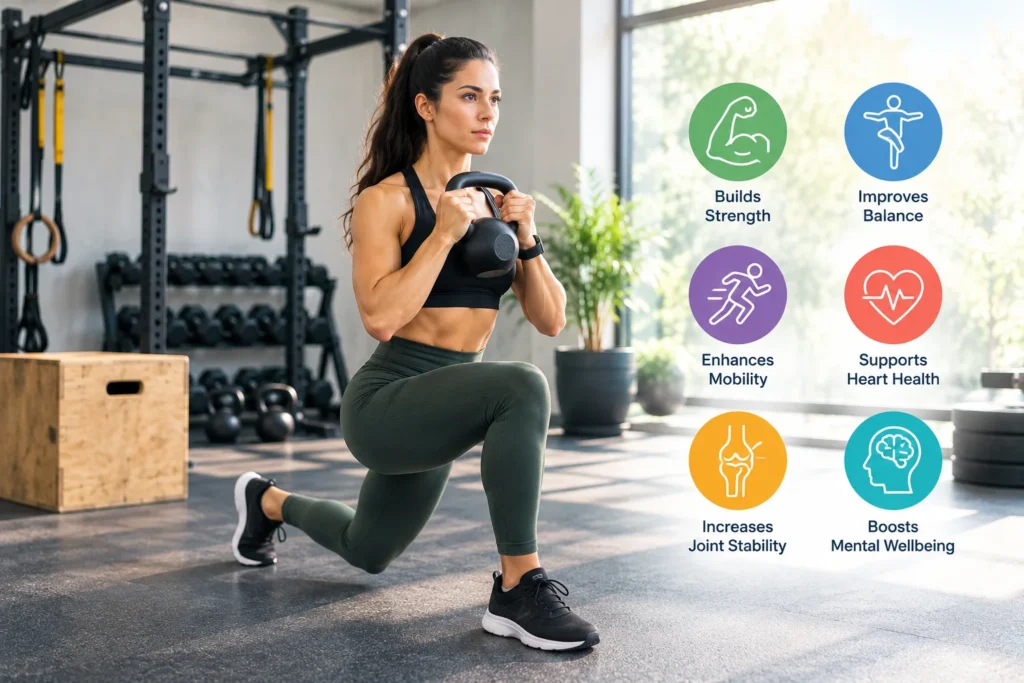
Functional training can contribute to several components of physical fitness, including muscular strength, balance, coordination, mobility, and physical function. However, it is important not to present functional training as a universal replacement for every other type of exercise.
The health benefits depend on exercise selection, training volume, intensity, individual fitness level, and consistency. Current physical-activity guidance recommends that adults combine aerobic activity with muscle-strengthening activities, while older adults should also include balance-focused activity.
Functional exercise can fit naturally into this broader framework because many functional movements can develop strength while also challenging coordination and stability.
Can Functional Exercises Improve Strength and Physical Performance?
Yes. Functional exercises can improve strength when they provide an appropriate training stimulus and are progressed over time.
Strength development does not require every exercise to resemble a daily activity perfectly. What matters is whether the movement provides sufficient resistance and whether the program progressively challenges the muscles.
For example, a beginner may start with bodyweight squats before progressing to goblet squats and eventually heavier loaded squats. Similarly, a basic carry can progress by increasing the load, distance, duration, or complexity.
Current resistance-training evidence emphasizes that training variables should be appropriately prescribed according to the desired outcome, including muscle function and physical performance. The American College of Sports Medicine highlighted this principle in its 2026 position stand on resistance-training prescription.
Functional training can therefore contribute to strength development when it is structured rather than treated as an unplanned collection of exercises.
Can Functional Training Help Improve Balance and Coordination?
Functional training can incorporate balance and coordination challenges, particularly through unilateral movements, controlled changes in position, carries, step-ups, and movements that require the body to stabilize itself.
Balance is not simply the ability to stand on one leg. It involves the interaction of muscular strength, sensory information, coordination, postural control, and the ability to respond to changes in the body’s position.
Research on functional and balance training has found benefits for physical function, particularly in older adults. A systematic review and overview of systematic reviews reported improvements in physical functioning and reductions in falls among adults aged 65 and older participating in balance and functional training.
Importantly, evidence does not mean every functional exercise automatically improves balance. Exercise selection and progression matter. A program should gradually introduce appropriate stability challenges rather than sacrificing technique simply to make an exercise look more difficult.
Can Functional Exercises Support Better Daily Physical Function?
One of the strongest arguments for functional exercise is its potential relationship with everyday physical function.
Daily activities such as climbing stairs, getting out of a chair, carrying groceries, lifting objects, walking, and changing direction require combinations of strength, coordination, balance, and mobility.
Recent research supports the relevance of task-oriented functional exercise. A 2026 systematic review and meta-analysis found that functional task exercise improved activities of daily living and mobility compared with control interventions in community-dwelling older adults, although results compared with conventional strength training were more mixed for mobility.
This distinction is important: functional training may be particularly valuable when the goal is improving practical physical performance, but it should not be presented as inherently superior to strength training for every fitness outcome.
functional task exercise improved activities of daily living and mobility compared with control interventions, while results versus conventional strength training were more mixed.
PubMed — 2026 Systematic Review & Meta-analysis
Are Functional Exercises Better Than Traditional Bodybuilding?
Functional training and traditional bodybuilding are not necessarily competing systems. They emphasize different outcomes.
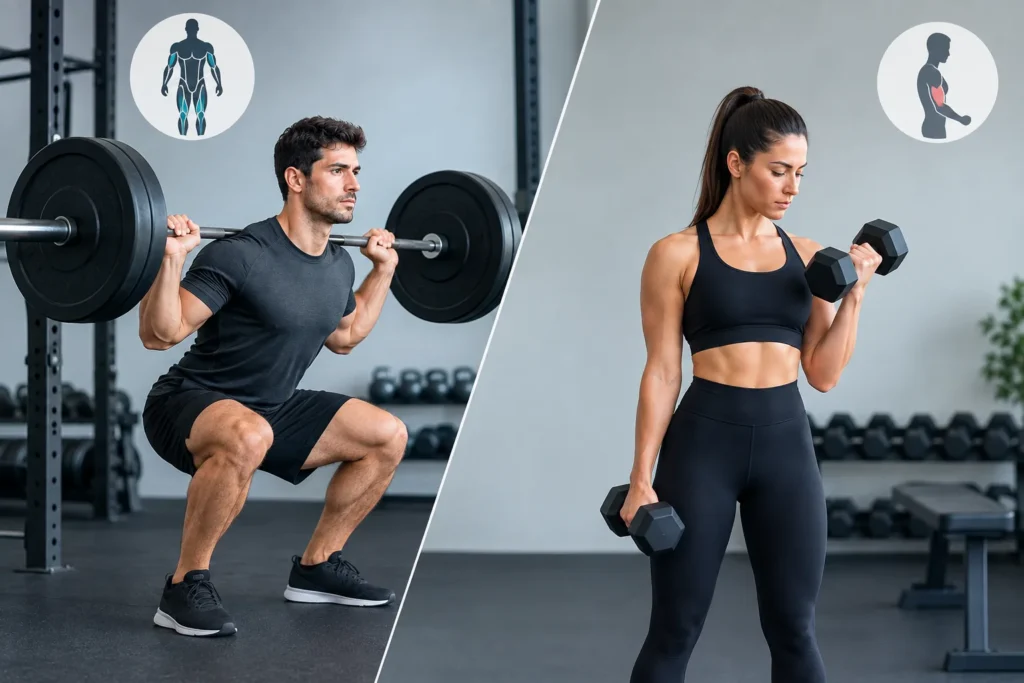
Traditional bodybuilding generally places greater emphasis on muscle hypertrophy, muscle development, exercise selection, training volume, and physique-focused goals. Functional training places greater emphasis on movement patterns, coordination, stability, strength transfer, and physical tasks.
For someone primarily interested in maximizing muscle size, a bodybuilding-oriented program may be more appropriate. For someone who wants to improve movement quality, athletic performance, balance, and practical strength, functional training may be more relevant.
For many people, combining both approaches can provide a more complete fitness strategy.
What Is the Main Difference Between Functional Training and Traditional Bodybuilding?
The main difference is the primary training objective.
Bodybuilding typically organizes training around individual muscles or muscle groups. Exercises such as biceps curls, leg extensions, lateral raises, and machine-based movements can be highly effective for increasing muscular size when programmed appropriately.
Functional training more often organizes exercise around movement patterns. A squat, deadlift, lunge, push, pull, carry, or rotation may involve multiple muscles working together.
This does not mean bodybuilding exercises are “non-functional.” Strong muscles can contribute to better physical function, and traditional resistance training can improve strength, muscle mass, and physical performance.
Similarly, functional exercises can also stimulate muscle growth. The difference is primarily one of emphasis rather than a strict separation between the two training styles.
Which Training Style Is Better for Athletes and Fitness Enthusiasts?
The answer depends on the athlete’s goals.
A bodybuilder who wants maximum hypertrophy may benefit from a program with substantial exercise-specific volume and controlled resistance training. An athlete participating in field or court sports may need strength, acceleration, deceleration, balance, coordination, and movement-specific conditioning.
A general fitness enthusiast may benefit from combining approaches. For example, a weekly program could include traditional resistance exercises for progressive strength and hypertrophy alongside functional movements such as carries, step-ups, lunges, and rotational exercises.
The key is to match the training method with the desired adaptation rather than labeling one system universally superior.
Can Functional Training Also Build Muscle?
Yes. Functional exercises can build muscle when they provide sufficient mechanical tension, training volume, and progressive overload.
Exercises such as squats, deadlifts, rows, pull-ups, presses, lunges, and loaded carries can place significant demands on multiple muscle groups.
However, if maximum hypertrophy is the primary objective, highly complex functional movements are not automatically superior to stable, controlled resistance exercises. Isolation exercises and machine-based movements can sometimes make it easier to target a specific muscle and accumulate training volume.
A practical program can therefore combine compound functional movements with more targeted exercises. This allows the individual to develop useful movement capacity while also addressing specific muscular weaknesses or hypertrophy goals.
What Functional Exercises Can You Do at Home?
Functional training does not require a commercial gym. Many fundamental movement patterns can be trained using bodyweight, household space, resistance bands, or a small amount of portable equipment.
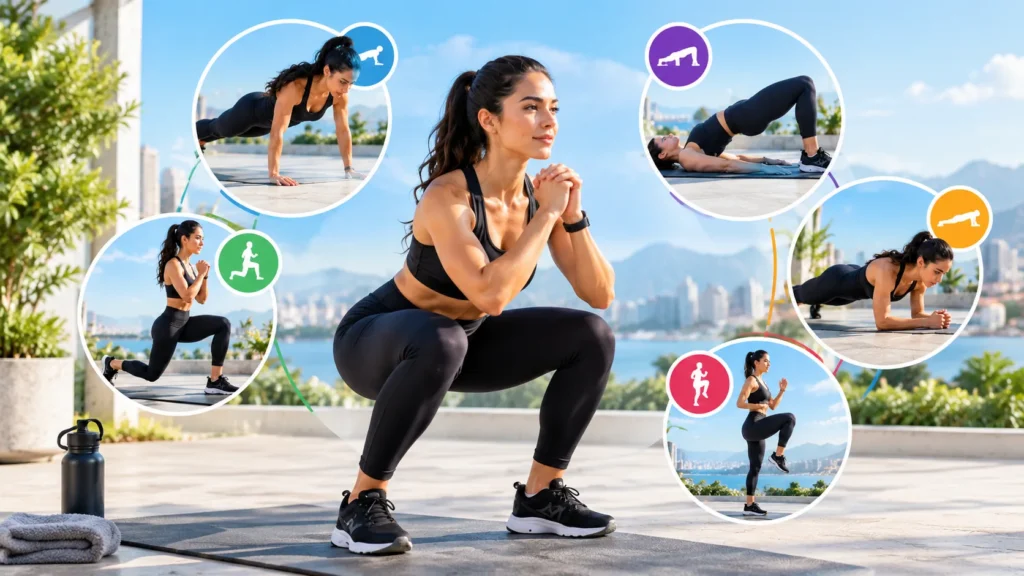
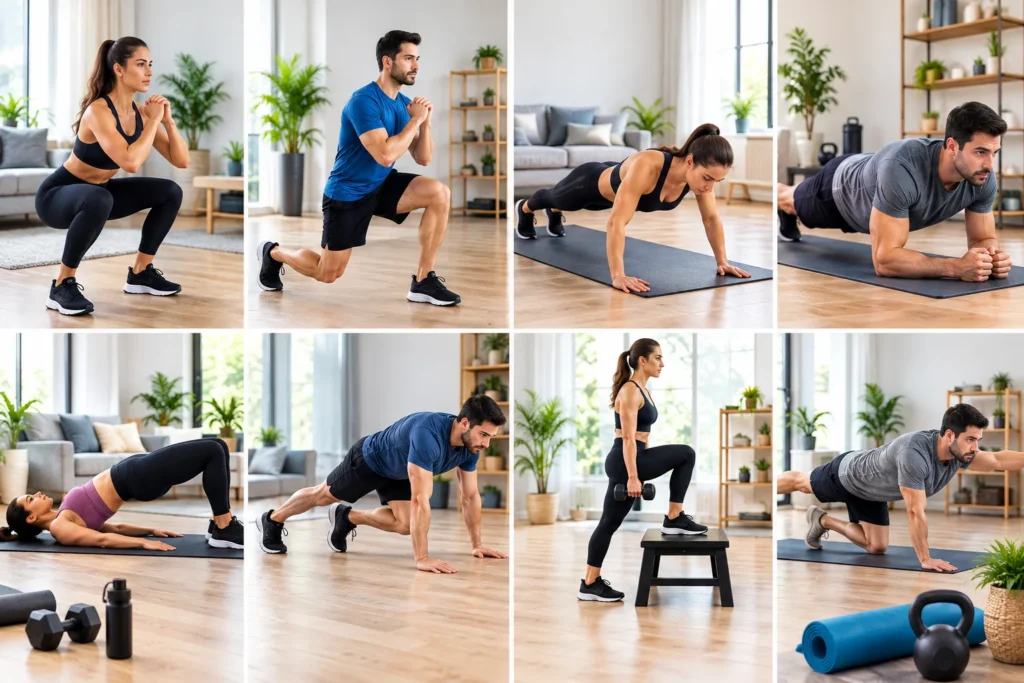
Bodyweight squats, reverse lunges, push-ups, glute bridges, planks, step-ups, mountain climbers, and controlled single-leg exercises can all be performed at home.
The most important consideration is not how expensive the equipment is but whether the exercise provides an appropriate stimulus and can be performed safely with good technique.
Which Functional Exercises Can You Do Without Equipment?
A simple no-equipment routine could include:
- Bodyweight squats
- Reverse lunges
- Push-ups
- Glute bridges
- Planks
- Side planks
- Mountain climbers
- Bird dogs
- Single-leg balance exercises
These movements can train several important patterns without requiring weights.
For example, squats and lunges challenge the lower body, push-ups train pushing strength, planks and bird dogs develop trunk control, and single-leg exercises introduce balance demands.
The routine can become progressively harder by increasing repetitions, adding pauses, increasing range of motion, reducing rest periods where appropriate, or moving toward more challenging variations.
However, progression should not come at the expense of movement quality. A technically sound exercise performed consistently is generally more useful than a complicated variation performed poorly.
What Equipment Is Useful for Functional Training at Home?
Although functional training can be performed without equipment, a few simple tools can increase exercise variety and progression options.
Useful equipment includes:
- Resistance bands
- Adjustable dumbbells
- Kettlebells
- A stable step or platform
- Suspension trainers
- A training mat
Resistance bands can provide portable resistance for pulling and pressing movements. Dumbbells and kettlebells allow progressive loading for squats, deadlifts, carries, presses, and rows.
A stable step can be useful for step-ups and controlled unilateral movements.
The equipment should support the training goal rather than become the goal itself. CDC guidance recognizes resistance bands, weights, and bodyweight exercises as legitimate forms of muscle-strengthening activity.
How Should You Build a Functional Training Routine for Everyday Fitness?
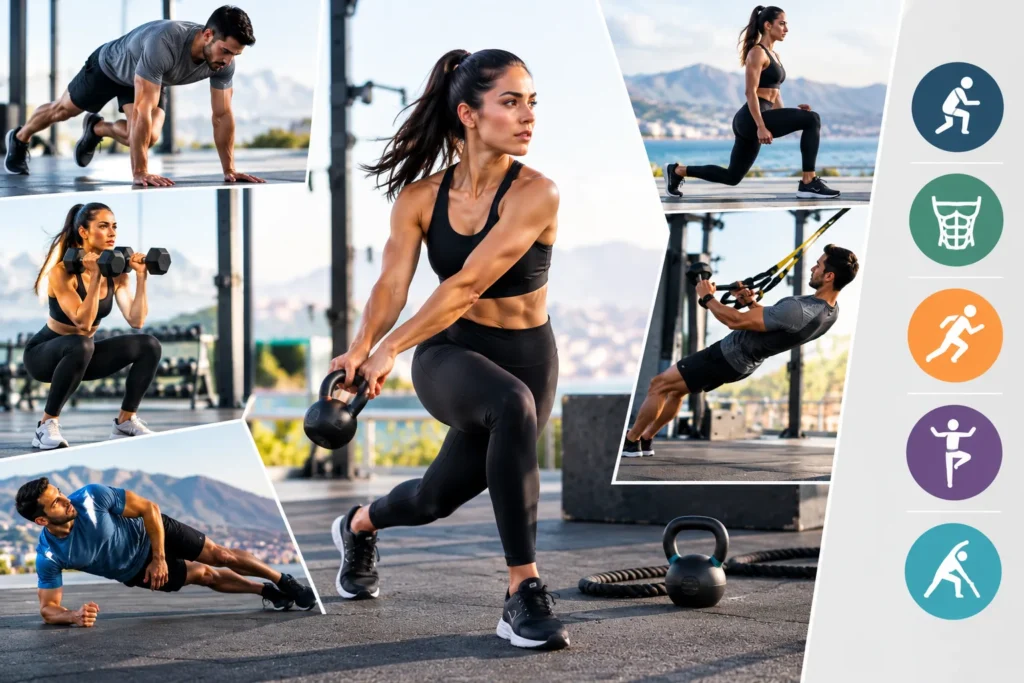
An effective functional routine should combine fundamental movement patterns with appropriate progression and recovery. Instead of choosing exercises randomly, start by identifying the physical qualities you want to develop.
A balanced session could include a lower-body movement, hip-hinge movement, upper-body push, upper-body pull, trunk-stability exercise, and loaded carry or balance exercise.
The exact number of exercises, sets, repetitions, and training days should depend on fitness level and goals.
For general health, adults are advised to accumulate at least 150 minutes of moderate-intensity aerobic activity or 75 minutes of vigorous activity each week, along with muscle-strengthening activity on at least two days.
How Can Beginners Start Functional Training Safely?
Beginners should start with movement quality rather than maximum intensity.
A practical starting session might include:
- Bodyweight squat — 8–12 repetitions
- Reverse lunge — 6–10 repetitions per side
- Incline push-up — 8–12 repetitions
- Resistance-band row — 8–12 repetitions
- Glute bridge — 10–15 repetitions
- Plank — 20–30 seconds
- Farmer’s carry — 20–40 seconds
The routine can be performed with controlled technique and appropriate rest between exercises.
As the beginner adapts, resistance or repetitions can gradually increase. More advanced movements should be introduced only when the basic pattern can be performed consistently.
People with injuries, medical conditions, or significant limitations should seek individualized advice from an appropriate healthcare or exercise professional before starting or substantially changing a training program.
How Many Days per Week Should You Do Functional Training?
There is no single number that works for everyone. Training frequency should account for experience, intensity, recovery, other sports, work demands, and personal goals.
For a beginner, two full-body functional-strength sessions per week can be a practical starting point. More experienced individuals may train three or more times per week, depending on how the sessions are structured.
Functional training can also be combined with aerobic exercise. For example, someone might perform strength-focused functional sessions on Monday and Thursday while using walking, cycling, swimming, or other aerobic activities on additional days.
The goal is not to maximize the number of workouts. The goal is to create a sustainable routine that provides enough training stimulus while allowing adequate recovery.
How Can You Build a Functional Training Workout Step by Step?
A simple functional workout can be built by combining different movement patterns rather than repeatedly training the same exercise.
- Step 1 — Choose a squat or lunge pattern:
Select squats, split squats, reverse lunges, or step-ups.
- Step 2 — Add a hip-hinge movement:
Use a hip hinge, Romanian deadlift, or kettlebell deadlift.
- Step 3 — Add pushing and pulling:
Combine push-ups or presses with rows or pull-down variations.
- Step 4 — Train trunk stability:
Use planks, side planks, dead bugs, or bird dogs.
- Step 5 — Add carrying or balance work:
Finish with farmer’s carries, suitcase carries, or controlled single-leg exercises.
- Step 6 — Progress gradually:
Increase resistance, repetitions, range of motion, duration, or movement complexity according to your ability.
This structure provides a practical framework without requiring a complicated workout.
What Do Experts and Research Say About Functional Fitness?
Functional training is best understood as one component of a broader exercise strategy rather than a magic training method. Current evidence supports regular physical activity, muscle strengthening, and balance-focused exercise as important components of physical health.
The CDC notes that physical activity can improve physical function and that older adults benefit from combining aerobic, muscle-strengthening, and balance activities.
Research also suggests that functional task training can improve activities of daily living and mobility, particularly in older populations. However, systematic reviews indicate that functional training is not automatically superior to other forms of exercise for every outcome.
What Does the CDC Recommend for Physical Function?
The CDC’s guidance is clear that adults should combine aerobic activity with muscle-strengthening activity. For adults, the general target is at least 150 minutes of moderate-intensity aerobic activity each week plus muscle-strengthening activity on at least two days.
For older adults, balance activities are also specifically recommended. Examples include activities that challenge stability while improving strength and coordination.
This supports a broader view of functional fitness: good physical function is not produced by one exercise. It develops through a combination of strength, cardiovascular fitness, balance, coordination, mobility, and regular movement.
What Does Recent Research Say About Functional Task Training?
A 2026 systematic review and meta-analysis examined functional task exercise in community-dwelling older adults. Compared with control interventions, functional task exercise produced meaningful improvements in activities of daily living and mobility. However, when compared directly with conventional strength training, the advantages were less consistent for mobility.
Another recent systematic review examining functional training found positive effects on activities of daily living in community-dwelling older adults, while noting that functional training was not consistently superior to other exercise programs for balance and mobility.
The practical takeaway is important: functional training can be highly useful, but its effectiveness depends on the goal, population, exercise selection, and program design.
How to Build a Functional Training Routine for Everyday Fitness
| Training Component | Example Exercises | Main Benefit |
|---|---|---|
| Squat | Bodyweight Squat, Goblet Squat | Lower-body strength |
| Lunge | Reverse Lunge, Split Squat | Unilateral strength and balance |
| Hinge | Deadlift, Romanian Deadlift | Hip and posterior-chain strength |
| Push | Push-up, Dumbbell Press | Upper-body pushing strength |
| Pull | Row, Pull-up | Back and pulling strength |
| Carry | Farmer’s Carry | Grip, posture, and core stability |
| Core Stability | Plank, Dead Bug | Trunk control |
| Balance | Single-leg Stand, Step-up | Balance and coordination |
Conclusion
The best functional exercises are not necessarily the most complicated or athletic-looking movements. Effective functional training is built around fundamental patterns such as squatting, lunging, hinging, pushing, pulling, carrying, stabilizing, and maintaining balance.
Functional training can support strength, coordination, balance, mobility, and practical physical performance. At the same time, it should not be treated as a replacement for every other form of exercise. Traditional resistance training and aerobic activity remain important components of a complete fitness program.
For most people, the most effective approach is to combine different training methods according to their goals, experience, and lifestyle. A well-designed functional program can make strength training more practical and help build physical capabilities that matter beyond the gym.
5dfitness can be a useful starting point for building a more structured approach to everyday fitness, especially when functional movements are combined with appropriate strength, cardiovascular training, recovery, and progression.
FAQ
Functional exercises are movements that train strength, coordination, balance, stability, mobility, or other physical qualities that can contribute to practical movement and everyday activities.
Yes. Beginners can start with simple bodyweight movements such as squats, lunges, push-ups, glute bridges, and planks before gradually increasing resistance and complexity.
Yes. Many functional exercises require little or no equipment. Resistance bands, dumbbells, kettlebells, or a stable step can provide additional progression options.
Not universally. Functional training emphasizes movement and physical function, while bodybuilding places greater emphasis on muscular development and hypertrophy. Many people can benefit from combining both approaches.
It can. Exercises that challenge unilateral strength, stability, coordination, and controlled movement can contribute to balance. Evidence particularly supports balance and functional training for improving physical function in older adults.
Yes. Functional exercises can stimulate muscle growth when they provide sufficient resistance, training volume, and progressive overload. However, people whose primary goal is maximum hypertrophy may benefit from combining functional movements with more targeted resistance exercises.
For many beginners, two full-body sessions per week can be a reasonable starting point. More experienced individuals may train more frequently depending on their overall program and recovery.