
You finish a demanding session in Muscat, reach for your phone, and see conflicting advice: drink a shake within 30 minutes, avoid carbohydrates, replace every drop of sweat, or eat nothing because you trained for fat loss. Good Post Workout Nutrition in Oman is much simpler. Your next meal should help repair muscle, restore the fuel your training used, replace appropriate fluid losses, and fit your total daily energy and protein needs.
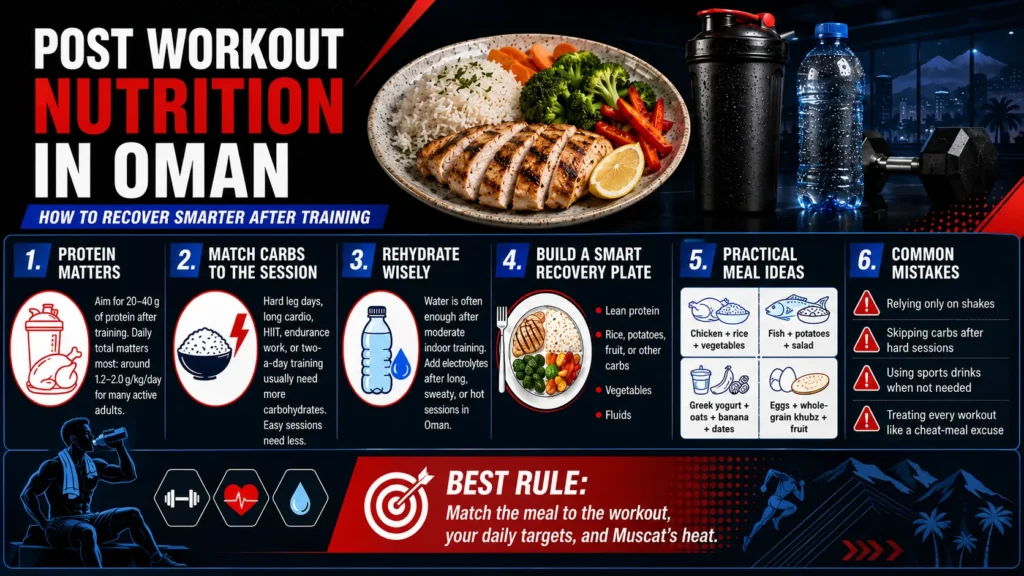
The details depend on the session. A moderate upper-body workout does not create the same recovery demand as a long run, a hard leg session, two-a-day training, or an outdoor sport in hot conditions. The goal is not to copy an athlete’s recovery protocol. It is to match food and fluids to your actual training load and next workout.
Listen
Post Workout Nutrition in Oman Changes With the Session
Post-workout eating matters, but the “anabolic window” is not a trapdoor that closes exactly 30 minutes after your final set. A practical recovery meal within a few hours works well for most recreational trainees, especially when they ate protein before training. The urgency rises when you trained fasted, completed a long session, or need to perform again later the same day.
“The performance of, and recovery from, sporting activities are enhanced by well-chosen nutrition strategies.”
D. Travis Thomas, lead author — ACSM Joint Position Statement
That principle is broader than timing. Recovery depends on the full day: enough energy, appropriate protein, useful carbohydrate, hydration, sleep, and a training plan you can recover from. The wider guide to post-workout recovery habits explains how nutrition fits beside cooldowns, sleep, soreness management, and workload.
Protein After Gym: Daily Total Comes First
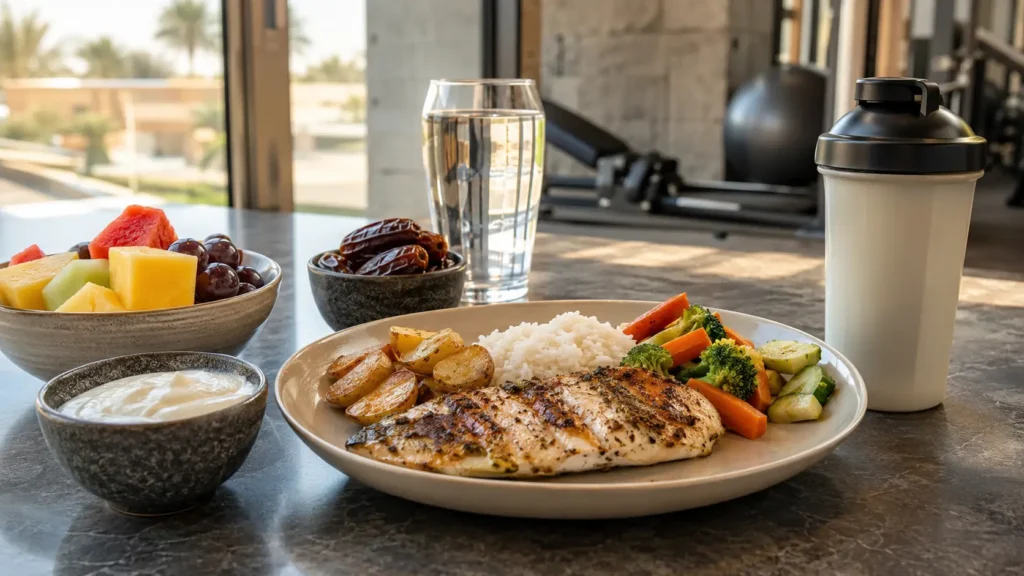
Protein after gym training supplies amino acids that support muscle repair and remodeling. For most healthy exercising adults, a useful general range is 1.4–2.0 grams of protein per kilogram of body weight per day. The exact target depends on body size, training volume, energy intake, age, food preferences, and whether the goal is muscle gain, maintenance, or fat loss.
“An overall daily protein intake in the range of 1.4–2.0 g protein/kg body weight/day is sufficient for most exercising individuals.”
Ralf Jäger, lead author — International Society of Sports Nutrition
A practical serving after training is often about 20–40 grams of high-quality protein, or roughly 0.25–0.40 grams per kilogram. Larger adults, older trainees, and people relying mainly on lower-leucine plant proteins may choose the upper end. Spread useful servings across the day rather than saving nearly all protein for dinner.
Protein supports adaptation only when training provides a reason to adapt. Combine your nutrition with a progressive strength-training plan, and remember that protein also has to fit your total calorie intake. The guide to a realistic metabolism and fat-loss system explains why preserving muscle, daily movement, and energy balance matter more than one “perfect” shake.
Carbohydrates Depend on the Workout and What Comes Next
Carbohydrate helps restore muscle glycogen, the stored fuel used heavily during longer or higher-intensity exercise. It becomes more important after hard leg training, HIIT, running, cycling, swimming, squash, football, or a demanding full-body workout. It is less urgent after a short, easy session when the next demanding workout is a day or two away.
| Training situation | Post-workout priority | Practical meal direction |
|---|---|---|
| Moderate strength session | Protein plus a normal carbohydrate serving | Chicken, rice, vegetables, and water |
| Long cardio or field sport | Carbohydrate, fluid, sodium, and protein | Rice or potatoes, fish or chicken, fruit, and fluids |
| Two sessions in one day | Faster carbohydrate replacement plus protein | Easy-to-digest meal or shake, then a full meal |
| Light mobility or easy recovery work | Normal daily nutrition | No special recovery product required |
| Fat-loss phase | Protein and portion control without under-fuelling | Lean protein, vegetables, measured carbohydrate |
If you train once daily, a balanced meal is usually enough. If you must perform again within several hours, carbohydrate timing becomes more important and low-fiber, familiar foods may feel easier to digest. Avoid using a hard workout as permission for an uncontrolled “reward meal”; recovery requires enough fuel, not an automatic calorie surplus.
Use Your Daily Targets to Size the Recovery Meal
A post-workout meal cannot be judged in isolation. Someone maintaining body weight, an athlete adding muscle, and a person reducing body fat may eat different portions even after the same workout. Estimate your daily protein, carbohydrate, and fat targets first, then decide how much of that daily plan belongs in the meal after training.
Splits your daily calories into protein, carbs, and fat targets based on your goal and diet style.
Used to adjust the metabolic formula for hormonal differences.
Metabolic rate and max heart rate both change with age.
Your standing height without shoes.
Your current body weight, not the weight you lift.
How active you are on a typical week, including exercise and daily movement.
Your primary objective — adjusts the daily calorie target up or down.
Determines how your calories are split between protein, carbs, and fat.
Treat the calculator result as a planning estimate, not a clinical prescription. Use it to create consistent meal portions and review your energy, gym performance, hunger, and body-composition trend over several weeks. Medical conditions, pregnancy, digestive disorders, kidney disease, diabetes, or a history of disordered eating require individualized advice from an appropriately qualified healthcare or nutrition professional.
Hydration in Muscat: Replace Losses Without Overdrinking
Post Workout Nutrition in Oman must account for sweat, but more fluid is not always better. A short air-conditioned gym session may need water and a normal meal. A long outdoor session, heavy sweating, or repeated training in warm conditions may justify extra fluid and sodium. Your body size, sweat rate, session duration, clothing, heat exposure, and food intake all change the answer.

"Develop fluid-replacement practices that promote sufficient but not excessive hydration before, during, and after physical activity."
Brendon P. McDermott, PhD, ATC, FACSM, et al. — NATA Position Statement
For a repeatable estimate, weigh yourself before and after a typical session under similar conditions. Each kilogram of body mass lost represents roughly one litre of net fluid loss, adjusted for anything you drank and any urine produced during training. Use several sessions to find a pattern; do not chase a single reading. Pair this with planned rest and recovery days, especially when heat exposure and hard training accumulate.
A Food-First Recovery Plate Works for Most People
The most reliable post-workout meal contains a clear protein source, carbohydrate matched to training demand, fruit or vegetables, and fluid. Fat does not need to be eliminated; very high-fat meals may simply digest more slowly. A shake is useful when convenience, appetite, or timing makes solid food difficult, but it is not inherently more anabolic than an appropriate meal.
- Grilled chicken, rice, salad, and laban
- Fish, potatoes, vegetables, and fruit
- Greek yogurt, oats, banana, dates, and nuts
- Eggs, whole-grain khubz, fruit, and water
- Lentils or beans with rice, vegetables, and a suitable plant protein
- Protein shake with milk or soy drink and a banana when a full meal must wait
Common errors include drinking a high-calorie shake after every light session, avoiding all carbohydrate because the goal is fat loss, using sports drinks without meaningful sweat loss, or eating too little all day and then overeating late at night. These patterns are part of the broader gym mistakes that block progress. Persistent fatigue, falling performance, poor sleep, and loss of appetite may also indicate that the problem extends beyond one meal; review the signs of excessive training stress.
Make the Next Meal Support the Next Session

The strongest approach to Post Workout Nutrition in Oman is not a rigid food list. It is a decision system: assess the workout, meet daily protein needs, add carbohydrate according to fuel demand, replace appropriate fluid losses, and keep the meal consistent with your wider goal. This fits the shift toward a more sustainable fitness lifestyle in Oman, where training, food, sleep, and recovery work together.
If your meals, portions, and training schedule still feel disconnected, professional coaching can help you turn estimates into a practical weekly structure. Contact 5D Fitness to discuss structured training and nutrition guidance built around your experience, schedule, and goal in Muscat.
FAQ
Choose protein, carbohydrate matched to the session, fruit or vegetables, and fluids. A normal balanced meal works for most people.
A common practical serving is 20–40 grams, while total daily protein and meal distribution matter more than one exact post-workout number.
Usually no. Eating protein within a few hours is practical, especially if you had a protein-containing meal before training.
No. Shakes are convenient, but suitable whole foods can provide protein, carbohydrate, fluids, and micronutrients just as effectively.
Use lean protein, vegetables, a measured carbohydrate portion, and fluids while keeping the meal within your daily calorie target.
Electrolytes may help after long, sweaty, or hot sessions. Water and a normal meal are often enough after moderate indoor training.
Yes. Dates provide carbohydrate and pair well with yogurt, milk, eggs, or another protein source after demanding training.