
You trained hard, finished the final set, and left the gym feeling accomplished. Then the next morning one thought takes over: if I rest today, am I losing progress?
That fear pushes gym members through heavy legs, poor sleep, aching joints, and falling performance. Often, the problem is misunderstanding Rest Day Importance in Oman and training adaptation.
A workout is a stimulus. Your body then needs time, nutrition, sleep, and lower stress to respond. Recovery and rest after fitness are not passive habits for lazy people; they are part of serious programming.
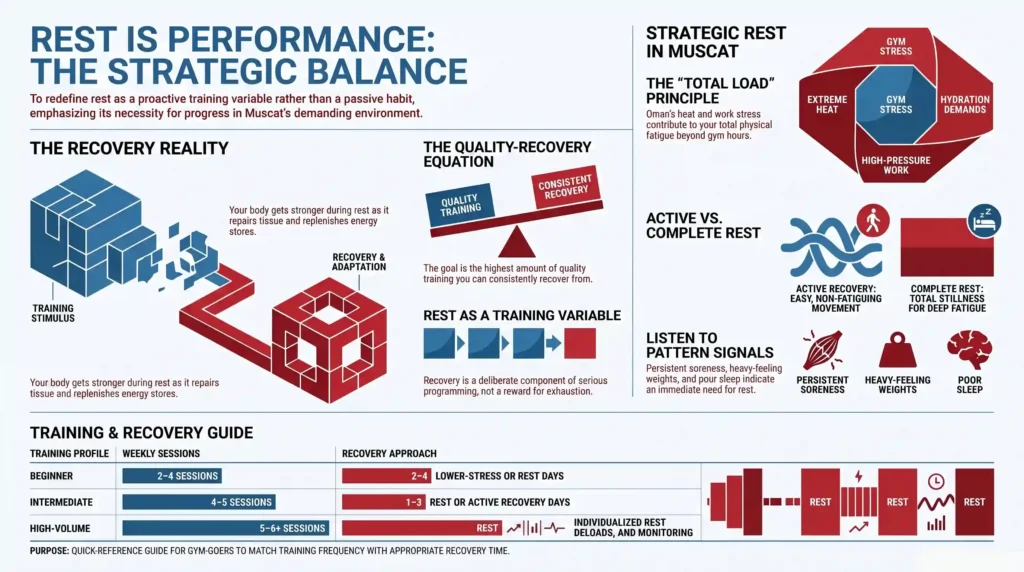
For people training in Muscat, gym sessions may sit on top of work pressure, hot weather, dehydration, late nights, and family commitments. The smarter question is not, “How many days can I force myself to train?” It is, “How much quality training can I recover from?”
Recovery reality: The goal is not to train as often as physically possible. The goal is to complete the highest amount of quality training your body can consistently recover from.
Listen
Why Are Rest Days Important for Fitness Results in Oman?

Rest days matter because results depend on the balance between training stress and recovery capacity. A hard session can create a productive challenge, but repeating high stress without enough recovery may reduce workout quality instead of improving it.
Does Your Body Get Stronger During the Workout or After It?
During strength training, sprint work, HIIT, or demanding sport, you create fatigue and challenge performance systems. The session tells your body to prepare for similar stress. Improvement continues after you leave the gym.
This is where Rest Day Importance in Oman becomes practical. Muscle tissue needs recovery resources, energy stores need replenishing, and hard sessions need enough separation to preserve quality.
“Successful training not only must involve overload but also must avoid the combination of excessive overload plus inadequate recovery.”
Romain Meeusen, PhD — Professor Emeritus and Exercise Physiologist
The goal is enough productive training stimulus, followed by enough recovery to express that adaptation clearly and return physically ready for the next truly meaningful training challenge ahead. Learn the warning signs in our guide to overtraining symptoms in Oman.
What Are the Signs That You May Need a Rest Day?
One tired workout does not automatically mean you are under-recovered. Normal fatigue happens. The useful skill is identifying a pattern when several warning signs appear together.
Common signals include:
- Your usual weights feel unusually heavy and performance drops across several sessions.
- Soreness lasts longer than expected, movement feels stiff, or minor aches keep returning.
- Sleep, mood, motivation, or daily energy worsens while training volume stays high.
Imagine a gym member in Muscat training six intense days weekly, sleeping five hours, working long shifts, and adding cardio because fat loss slowed. The problem may not be weak motivation. Total stress may exceed recovery capacity.
A rest day can interrupt that cycle and create space to review. Are hard days grouped intelligently? or Are you progressing? Or maybe you are eating and sleeping enough for the workload?
Rest is not a reward earned after breaking yourself. It is a training variable that makes progressive exercise more sustainable.
What Actually Happens During Recovery and Rest After Fitness?
Recovery is not one single event. Muscular, metabolic, neurological, and psychological processes do not always recover at exactly the same speed. That is why a person can feel mentally ready to train while a specific muscle group is still heavily fatigued.

How Does Recovery Help Muscle Repair, Energy, and Performance?
After demanding exercise, the body begins restoring what the workout disrupted. Resistance training creates muscular stress. Conditioning can reduce fuel and produce wider fatigue. High-intensity work may feel harder when recovery is poor.
A planned rest day creates better conditions for the next productive session. It gives the weekly program space for recovery to catch up with accumulated stress.
“An adequate balance between stress and recovery is essential for athletes to achieve continuous high-level performance.”
Michael Kellmann, PhD — Professor of Sport Psychology
The principle applies to recreational lifters. A beginner doing three full-body sessions has different needs from a high-volume athlete or regular padel player managing matches, strength work, and conditioning together in the same demanding week. Read our guide to muscle recovery in Oman.
How Many Rest Days Do You Need Each Week?
There is no universal number that works for every body and every program. Rest-day frequency should reflect training experience, exercise intensity, total weekly volume, sport participation, sleep, nutrition, and life stress.
Is One Rest Day a Week Enough for Everyone?
No. One rest day may work for an experienced athlete whose program rotates muscle groups and controls intensity. The same schedule could overwhelm a beginner or someone training through poor sleep and heavy work stress.
Match recovery with the plan instead of copying an influencer. Our Push Pull Legs training guide in Oman shows how muscle groups rotate, but split routines still create whole-body fatigue.
| Training Profile | Typical Weekly Training | Practical Recovery Approach |
|---|---|---|
| Beginner | 2–4 structured sessions | 2–4 lower-stress or rest days |
| Intermediate lifter | 4–5 sessions | 1–3 rest or active recovery days |
| High-volume athlete | 5–6+ sessions | Individualized rest, deloads, and load monitoring |
| Gym + padel/squash | Mixed weekly workload | Count sport as training stress |
| Poor sleep/high life stress | Any level | Reduce intensity or add recovery before volume |
This is a coaching framework, not a medical prescription. The strongest program produces measurable progress while recovery remains consistent.
How Should Beginners Plan Rest Days?
Beginners often feel excited and want to train every day. That enthusiasm is valuable, but movement skill and work capacity need time to adapt.
For many beginners, three or four structured gym sessions create plenty of stimulus. Days between sessions can include walking, mobility, or complete rest depending on soreness and energy. Our beginner gym workout guide for Oman explains why technique and consistency should come before aggressive volume.
A useful beginner rest-day check is:
- Can you perform normal daily movements without significant pain or unusual heaviness?
- Is your sleep reasonably stable and are you waking with usable energy?
- Are your gym numbers, technique, or confidence gradually improving rather than declining?
If the answers are repeatedly no, adding sessions is rarely the first solution. Review load, sleep, nutrition, hydration, and stress. Rest Day Importance in Oman matters for beginners because early progress can tempt them to accelerate faster than recovery capacity develops.
Should a Rest Day Mean Doing Absolutely Nothing?
Not always. Rest can be complete or active. The correct choice depends on why you are resting and how your body feels.
What Is the Difference Between Complete Rest and Active Recovery?
Complete rest removes planned training stress for the day. You still live normally, but there is no structured workout. It can help after demanding sessions or during significant fatigue.
Active recovery uses easy movement that feels restorative, not competitive. The intensity stays low enough that the activity does not become another hidden workout.

Examples include:
- An easy walk, relaxed swim, or very light cycle at conversational effort.
- Gentle mobility through comfortable ranges rather than forced deep stretching.
- Light technique or breathing-focused movement that leaves you fresher afterward.
Many athletes sabotage rest days by turning “easy cardio” into a hard session. Use a simple test: if the activity creates significant fatigue, demands serious recovery, or reduces tomorrow’s performance, it was probably training.
The active recovery test: If your “recovery session” creates significant fatigue or hurts tomorrow’s performance, it was probably another workout.
At 5D Fitness, recovery should support the next meaningful session. The choice may be complete rest, active movement, or a planned low-load day. The target is appropriate stress management.
How Do Sleep and Oman’s Climate Change Your Recovery Needs?
A workout does not happen in isolation from your environment. Daily heat exposure, hydration habits, sleep timing, work schedules, and late-evening routines can influence how prepared you feel to train.
Why Does Sleep Matter So Much on Rest Days?
Sleep is a major recovery opportunity because it occurs every day. A single rest day cannot rescue a routine built around chronically short sleep.
“Sleep is an essential component for athlete recovery due to its physiological and psychological restorative effects.”
Michele Lastella, PhD — Senior Lecturer and Sleep Researcher
For gym members, do not judge recovery only by soreness. Poor sleep can influence effort, concentration, mood, and willingness to train. If you repeatedly arrive exhausted, another maximum-effort session may produce lower-quality work.
This is why recovery and rest after fitness should include a realistic sleep routine, not just supplements or massage. Protect a consistent sleep opportunity and consider when and how late you train. Read our guide to sleep scheduling for muscle growth in Oman for more context.

Why Can Training in Muscat Make Recovery Planning More Important?
Muscat’s hot conditions can add recovery challenges when someone spends time outdoors, sweats heavily, or enters a workout behind on fluids. Indoor training removes direct sun exposure, but not the rest of the day’s stress.
A smarter rest-day routine in Oman should prioritize basics. Rehydrate consistently and consider individual sweat losses during hard training. Eat balanced meals with enough protein and carbohydrate for your goal and workload. Protect sleep timing and avoid “making up” missed workouts with double intensity.
The goal is not to fear Oman’s climate. It is to program around reality. A person training after a long, hot day may need a different session from someone who slept well and trained early.
Muscat recovery rule: Judge training readiness from the entire day. Heat exposure, hydration, sleep, work stress, and previous exercise all contribute to total load.
This local context is one reason Rest Day Importance in Oman deserves attention. Recovery decisions should consider the entire day, not only the 60 minutes spent in the gym. Good programming adjusts to the person rather than treating every training day as equal.
How Can Smart Coaching Turn Rest Days Into Better Progress?
A good coach does not only write exercises. Effective programming manages the relationship between workload, performance, and recovery over time.
What Should a Coach Monitor Before Adding More Training?
Attendance is easy to celebrate, but attendance alone does not prove a program is working. Coaches should watch trends in strength, technique, conditioning, motivation, soreness, and the ability to complete planned sessions.
When progress slows, the answer may be more overload, a deload, an extra rest day, a better split, or improved sleep. Context decides.

This is where Rest Day Importance in Oman becomes a performance strategy. A member who lifts four days, plays squash twice, and sleeps poorly is not experiencing a simple “four-day training plan.” Their body is handling at least six athletic stress exposures plus life demands.
At 5D Fitness in Muscat, structured coaching can create a plan that challenges you without turning every week into a survival test. If you are constantly sore or losing strength, a fitness assessment can clarify the next step.
Your weekly training plan should know when to push, when to reduce load, and when recovery will create a better next session.
Conclusion: Rest Is Part of the Training Plan
The lesson behind Rest Day Importance in Oman is simple: recovery is not the opposite of training. It is part of the process.
Hard sessions create the challenge. Recovery helps you return ready for quality work. Rest days, sleep, hydration, nutrition, active recovery, and intelligent programming should all support sustainable performance.
You do not need less ambition. You need to direct it more intelligently. When every session has purpose and each recovery day protects the next step, progress becomes easier to sustain.
For gym members in Muscat who are tired of guessing, 5D Fitness offers structured coaching built around individual goals and training load.
FAQ
Rest days manage training fatigue and support recovery between workouts, helping you return with better readiness and higher-quality performance in future sessions.
Many people use one to three recovery days weekly, but training volume, experience, sleep, sports, and total life stress should guide frequency.
No. Two planned rest days do not normally cause meaningful muscle loss. Consistent training, adequate protein, nutrition, and long-term progression matter more.
Yes. Easy walking can support active recovery when it feels comfortable and creates no meaningful fatigue. Keep the effort low and relaxed.
Often, yes. Beginners may need more recovery while movement skills and training tolerance develop. Three or four structured weekly sessions can be effective.
Persistent soreness may signal a recovery need, especially with declining performance. Mild soreness alone does not automatically mean every planned workout should stop.
Yes. Repeated poor sleep can reduce readiness, concentration, and energy. Lowering training intensity or adding recovery may be smarter than forcing hard sessions.
Eat balanced meals with adequate protein, carbohydrate, fluids, and total energy for your goal. A rest day still requires appropriate recovery nutrition.
Neither is always better. Active recovery can suit mild fatigue, while complete rest may be more appropriate when you feel deeply under-recovered.
Heat exposure, hydration demands, and busy routines can add training stress. Gym members in Oman should plan recovery around total workload, not frequency.