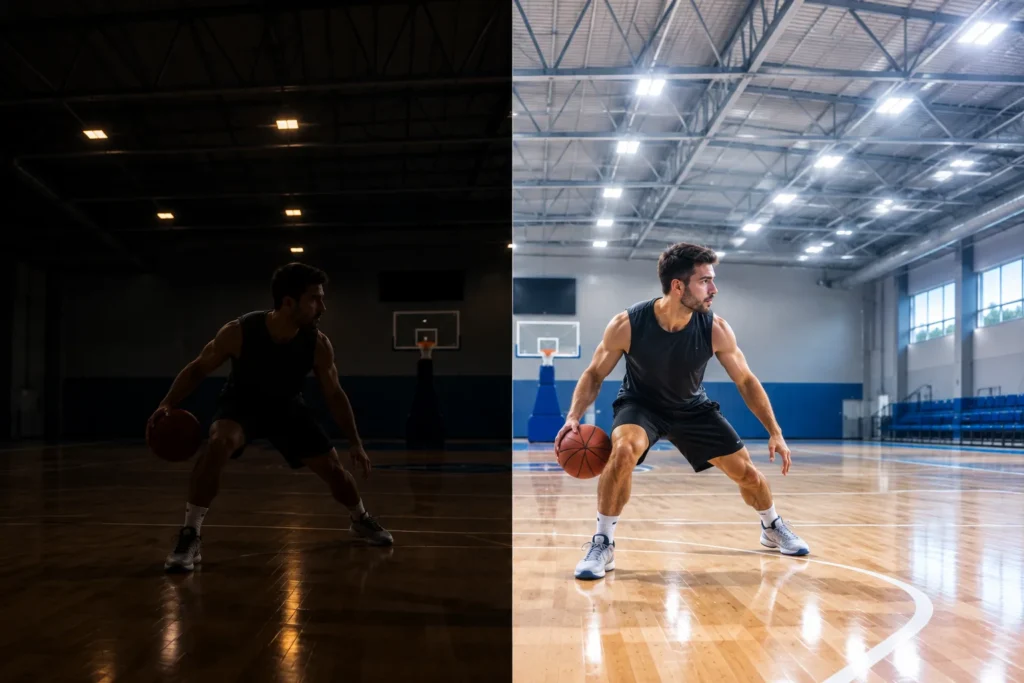
A safe sports facility is more than a building with good equipment. Sports facility safety depends on how well the facility manages physical hazards, emergency situations, equipment maintenance, hygiene, lighting, ventilation, and staff preparedness. For athletes, fitness enthusiasts, bodybuilders, and recreational users, these features can reduce avoidable risks and create a more reliable training environment.
A well-designed facility should also have clear safety procedures rather than relying only on users to identify hazards themselves. At 5dfitness, understanding these safety principles can help athletes make better decisions when choosing where to train and help facility operators identify areas that require improvement.
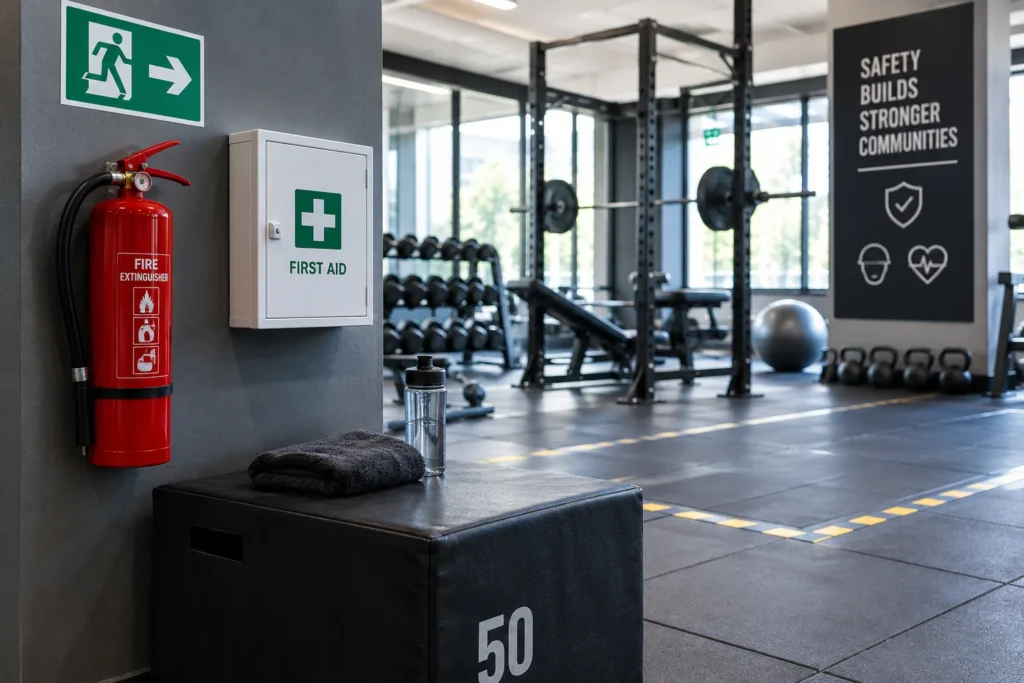
What Are the Most Important Safety Features in a Sports Facility?
The most important safety features should address the hazards that users are most likely to encounter during training or competition. These include stable and well-maintained equipment, suitable flooring, clear walkways, adequate lighting, visible safety signage, accessible emergency equipment, and appropriate supervision.
Safety also depends on the type of facility: a gym, swimming pool, football field, indoor court, and combat-sports facility have different risks. Therefore, there is no single checklist that fits every venue. The best approach is to combine general safety principles with sport-specific requirements, manufacturer instructions, building regulations, and applicable local standards.
What Should Safe Sports Facility Flooring Provide?
Sports flooring should provide a stable, appropriate surface for the activities performed on it. Damaged flooring, loose sections, unexpected level changes, wet areas, or debris can increase the risk of slips, trips, and falls. For indoor sports, flooring performance is also relevant to movement and athletic activity. ASTM’s current F2772-24 specification addresses performance properties of multipurpose indoor sports floor systems, demonstrating that sports surfaces can be evaluated using specific performance criteria rather than appearance alone.
Facility operators should routinely look for cracks, raised edges, damaged surfaces, excessive moisture, and other hazards. The appropriate surface also depends on the sport and activity. A basketball court, weight-training area, running track, and swimming-pool deck should not necessarily use the same type of flooring.
Why Are Clear Walkways and Safety Signage Important?
Clear walkways help users move between training areas without unnecessary obstacles. Equipment should not block exits, corridors, emergency access routes, or areas needed for medical response. Storage should be organized so that weights, accessories, cables, and other equipment do not create unnecessary trip hazards.
Safety signage is another important layer. The current ASTM F1749-15(2026) specification addresses safety signs and labels for fitness equipment and facilities and distinguishes warning levels using terms such as danger, warning, and caution.
Signs should be visible, understandable, and positioned close to the hazard they describe. Clear instructions can be especially useful for unfamiliar equipment or areas with specific risks.
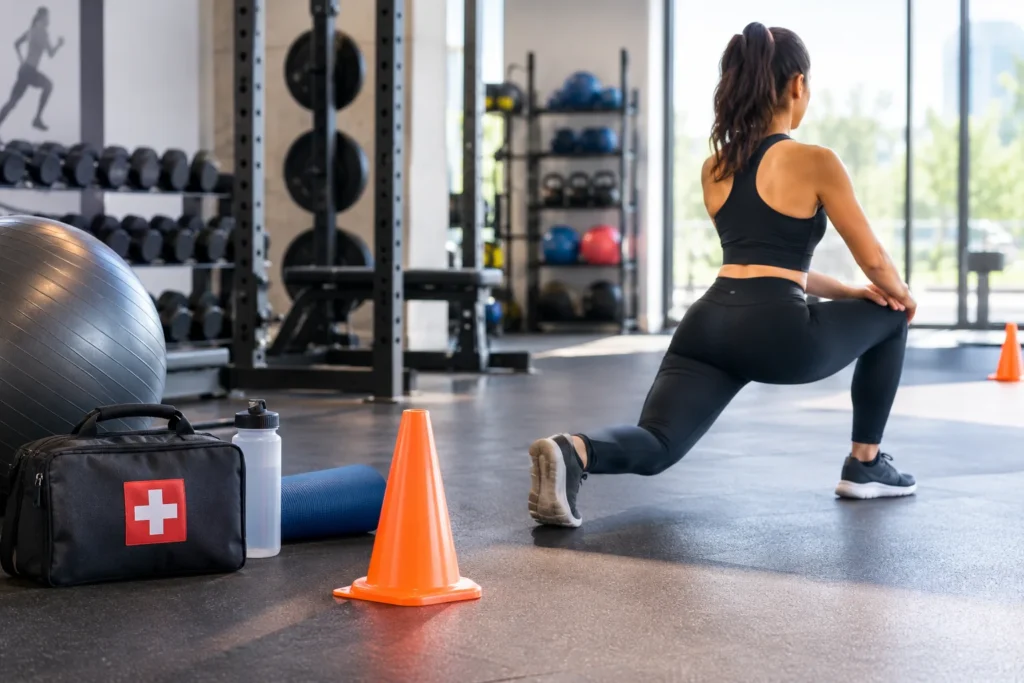
How Can Sports Facilities Prevent Injuries and Accidents?
Injury prevention requires more than placing warning signs around a facility. Equipment must be maintained, hazards must be identified before they cause an incident, and users should receive appropriate instructions and supervision. Staff also need to know how to respond when an injury occurs.
A strong safety system therefore combines prevention, monitoring, education, and emergency readiness. Facility operators should consider both common everyday hazards and less frequent but potentially serious events. Regular inspections are particularly important because equipment and surfaces deteriorate with use, while changes in layout or user behavior can introduce new risks.
How Can Proper Equipment Maintenance Reduce Injury Risks?
Sports equipment can become unsafe through wear, loose components, mechanical failure, improper installation, or inadequate maintenance. This applies to gym machines as well as permanently installed equipment such as basketball backstops, volleyball systems, divider curtains, and other gymnasium structures.
ASTM F3783-26 specifically provides guidance for inspection, maintenance, and service of permanently installed indoor gymnasium equipment. The standard notes that such equipment can become worn or fall into disrepair through normal use and requires periodic attention to support safe operation.
A practical maintenance system should include scheduled inspections, documentation of defects, prompt removal of unsafe equipment from service, and maintenance according to manufacturer instructions. Equipment should never remain available simply because a problem has not yet caused an injury.
Why Is Supervision Important for Sports Facility Safety?
Supervision can help identify unsafe behavior, incorrect equipment use, overcrowding, and developing hazards. The level of supervision should match the activity and user population. A beginner strength-training area may require different supervision from an experienced athlete-only facility, while swimming pools and youth sports often require specialized supervision.
Staff should know the facility layout, emergency exits, first-aid resources, communication systems, and emergency procedures. They should also understand when an incident requires escalation to medical professionals or emergency services.
Safety supervision is not about monitoring every movement. Its purpose is to create a system in which risks can be recognized early and appropriate action can be taken before a minor problem becomes a serious incident.
How Can Sports Facilities Identify Common Hazards?
Facilities can use routine risk assessments to identify hazards before opening, during operating hours, and after maintenance or layout changes. Common issues include wet surfaces, damaged flooring, unstable equipment, blocked exits, exposed cables, inadequate lighting, poor storage, excessive heat, and insufficient ventilation.
A useful approach is to inspect each area from the perspective of the person using it. Ask: What could cause a slip, trip, collision, equipment failure, or delayed emergency response here?
Hazards should then be documented, assigned to a responsible person, and corrected within an appropriate timeframe. This creates a preventive safety culture rather than relying on complaints or accidents to reveal problems.
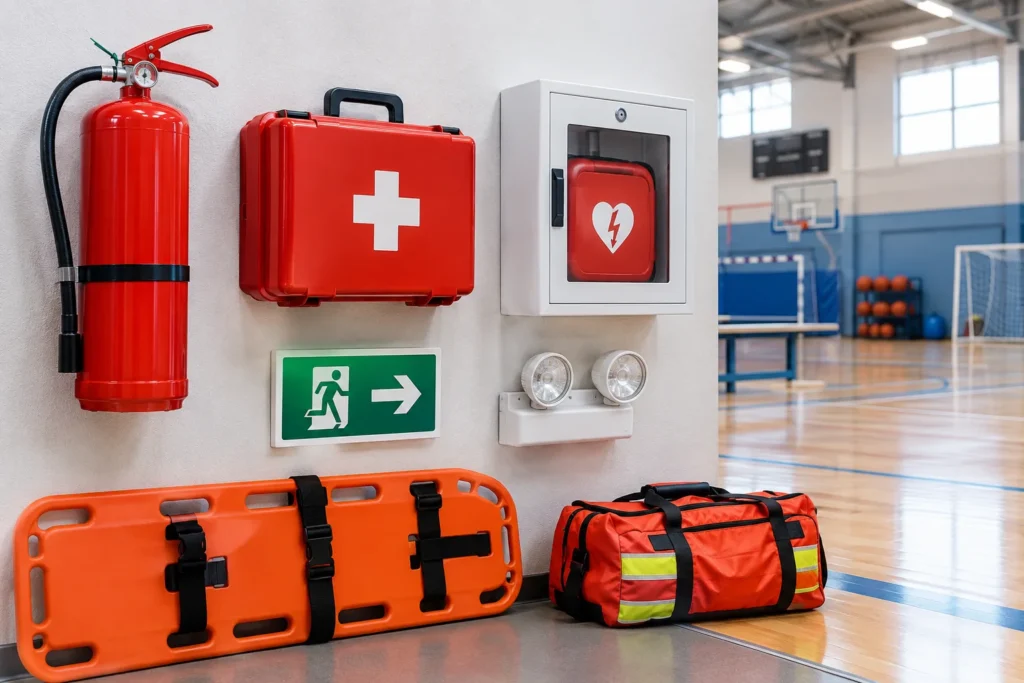
What Emergency Safety Equipment Should a Sports Facility Have?
A sports facility needs an emergency system that goes beyond simply keeping a first-aid kit somewhere in the building. Emergency planning should define who responds, how emergency services are contacted, where equipment is located, how responders access the facility, and how staff practice the procedure. The National Athletic Trainers’ Association emphasizes that emergency plans should be venue-specific and rehearsed, with emergency equipment quickly accessible.
The American Heart Association similarly recommends a written Cardiac Emergency Response Plan for sports facilities, including AED placement, staff CPR/AED training, drills, and regular review.
What First-Aid Equipment Should Be Available?
A first-aid area should contain appropriate supplies for the activities and risks associated with the facility. Depending on the setting, this can include gloves, wound-care materials, dressings, cold packs, basic protective equipment, and other supplies appropriate to the facility’s emergency procedures.
The exact contents should be determined by qualified personnel and applicable local requirements rather than using one universal list. Supplies should also be checked regularly for expiration, damage, or missing items.
Accessibility is critical. A first-aid kit that is technically present but difficult to locate does not provide the same practical value as clearly identified equipment that staff can reach immediately.
Why Should Sports Facilities Have an AED?
An automated external defibrillator (AED) can be an important component of emergency preparedness because sudden cardiac arrest requires rapid action. The American Heart Association recommends AEDs at athletic facilities and emphasizes clear identification, accessibility, routine maintenance, and integration into a broader cardiac emergency response plan.
The AHA’s sports-facility guidance recommends that AED placement should allow rapid retrieval and delivery to the location of a suspected cardiac emergency.
An AED should therefore not be hidden in a locked or difficult-to-access location. Staff should know where it is, how to activate the emergency response system, and how to use the device according to their training and local procedures.
How Should Emergency Exits and Fire Safety Be Managed?
Emergency exits should remain visible, accessible, and free from unnecessary obstruction. Staff should know evacuation routes, assembly procedures, communication responsibilities, and how to assist users who may need additional support.
Emergency plans should also consider how responders will enter the facility. The National Athletic Trainers’ Association recommends venue-specific emergency plans that address communication, equipment, transportation, and access for emergency personnel.
These procedures should be practiced rather than simply written down. Regular drills can reveal practical problems such as blocked routes, unclear responsibilities, or communication failures.
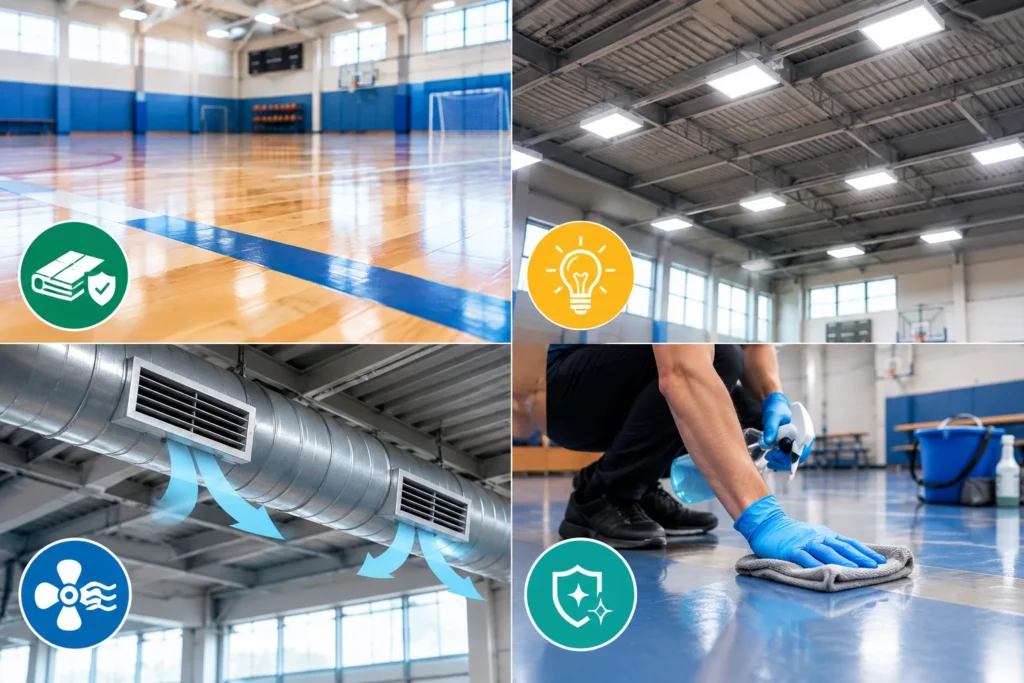
How Do Flooring, Lighting, Ventilation, and Hygiene Affect Sports Facility Safety?
Environmental conditions can influence both safety and user comfort. Poor lighting can make hazards harder to see, inadequate ventilation can contribute to an uncomfortable training environment, and poor hygiene can increase health risks in shared spaces. Flooring also requires regular maintenance because even a suitable surface can become hazardous when damaged or contaminated. Safety should therefore be considered as an ongoing environmental-management process rather than a one-time construction decision. Facilities should establish inspection schedules for surfaces, lighting, ventilation, showers, changing rooms, and other high-use areas.
Why Is Proper Lighting Important for Sports Safety?
Adequate lighting allows athletes to see equipment, boundaries, obstacles, other participants, and changes in the playing surface. Insufficient or uneven lighting can make it more difficult to recognize hazards, particularly during fast-moving sports.
Lighting should be appropriate for the activity and should avoid unnecessary glare or significant dark areas. Facility operators should also inspect damaged or failed lights promptly.
For competitive environments, lighting requirements can be more specific because visibility affects both performance and safety. For general fitness facilities, the priority is consistent visibility throughout training zones, walkways, entrances, stairs, and emergency routes.
How Does Ventilation Affect Athlete Safety and Comfort?
Ventilation helps manage indoor air quality, temperature, humidity, and odors. This becomes particularly important in facilities with high exercise intensity or high occupancy, where users generate additional heat and moisture.
A well-managed environment can support comfort and reduce conditions that make exercise unnecessarily difficult. Ventilation systems should therefore be maintained rather than treated as background infrastructure.
The appropriate environmental conditions depend on the facility, activity, climate, building design, and applicable regulations. Operators should monitor problems such as excessive heat, condensation, persistent odors, or inadequate air movement and address the underlying cause.
Why Do Clean and Well-Maintained Facilities Matter?
Cleanliness is an important part of facility safety because many sports environments involve shared equipment and frequently touched surfaces. Locker rooms, showers, changing areas, training equipment, and other shared spaces should have appropriate cleaning procedures.
Maintenance should also include removing water, debris, damaged materials, and other hazards as soon as they are identified. NATA guidance for sports settings highlights the importance of checking equipment and regularly cleaning areas such as locker rooms, gyms, and shower surfaces.
The objective is not simply to make a facility look clean. The goal is to reduce preventable environmental and equipment-related risks.
How Can Sports Facilities Maintain and Improve Safety Standards?
Safety standards need continuous monitoring because equipment wears out, facilities change, and emergency procedures can become outdated. A strong system combines routine inspections, staff training, documented maintenance, incident reporting, and regular review of emergency plans. Facility operators should also consider sport-specific risks rather than applying a generic checklist to every area. ASTM’s sports-facility standards illustrate this principle by covering specific areas such as indoor sports floors, facility signage, and permanently installed gymnasium equipment.
How Often Should a Sports Facility Be Inspected?
Inspection frequency should depend on the type of equipment, intensity of use, manufacturer recommendations, applicable regulations, and the consequences of failure. High-use equipment and areas exposed to moisture or heavy impact may require more frequent checks.
A practical system can combine daily visual checks, scheduled maintenance inspections, and more detailed periodic assessments. Any serious defect should trigger immediate action rather than waiting for the next scheduled inspection.
Documentation is also important. A record of inspections, repairs, equipment removal, and follow-up actions helps facility managers identify recurring problems and demonstrate that safety is being actively managed.
What Safety Training Should Sports Facility Staff Receive?
Staff training should match the risks present in the facility. Depending on the setting, this can include first aid, CPR, AED use, emergency communication, evacuation procedures, equipment operation, incident reporting, and hazard recognition.
The AHA recommends ongoing First Aid, CPR, and AED training for sports-facility personnel as part of cardiac emergency preparedness.
Training should not be treated as a one-time event. Staff changes, equipment changes, and lessons from previous incidents can all require updates. Regular drills can also test whether employees understand their roles when an emergency occurs.
How Can a Sports Facility Use a Safety Checklist?
A checklist can turn general safety principles into repeatable actions. A useful checklist should cover:
- Flooring and playing surfaces
- Equipment condition
- Walkways and storage
- Lighting and visibility
- Ventilation and environmental conditions
- First-aid supplies
- AED availability and readiness
- Emergency exits
- Fire-safety equipment
- Hygiene and cleaning
- Staff training
- Emergency procedures
The checklist should identify not only whether a feature exists, but whether it is accessible, functional, maintained, and appropriate for the activity.
Sports Facility Safety Checklist: Key Features and Their Purpose
| Safety Feature | Main Purpose | Example |
|---|---|---|
| Safe flooring | Reduce slip and trip risks | Maintained sports surface |
| Equipment maintenance | Reduce equipment-related hazards | Routine inspections |
| Safety signage | Communicate hazards and instructions | Warning labels |
| First aid | Provide immediate basic care | Accessible first-aid kit |
| AED | Support cardiac emergency response | Clearly marked AED |
| Emergency exits | Support rapid evacuation | Unobstructed exits |
| Lighting | Improve visibility | Adequately lit areas |
| Ventilation | Support environmental comfort | Maintained ventilation system |
| Hygiene | Reduce environmental health risks | Cleaning procedures |
| Staff training | Improve emergency response | CPR/AED training |
| Safety inspections | Identify hazards early | Documented inspections |
How to Check the Safety of a Sports Facility?
- Step 1:
Inspect floors, playing surfaces, stairs, and walkways.
- Step 2:
Check equipment for damage, instability, or missing safety components.
- Step 3:
Confirm that emergency exits are visible and accessible.
- Step 4:
Locate first-aid equipment and verify that essential supplies are available.
- Step 5:
Confirm that the AED is accessible, clearly marked, and maintained.
- Step 6:
Evaluate lighting, ventilation, cleanliness, and environmental conditions.
- Step 7:
Ask whether staff know their emergency responsibilities.
- Step 8:
Review the emergency plan and confirm that it is practiced and updated.
- Step 9:
Document hazards and assign corrective actions.
- Step 10:
Repeat the assessment regularly.
Practical Conclusion
Effective sports facility safety is a system rather than a single feature. Safe surfaces, reliable equipment, emergency resources, clear exits, appropriate lighting, ventilation, hygiene, staff training, and regular inspections all contribute to a safer environment. The exact requirements depend on the type of sport, facility design, local regulations, and level of use.
For athletes and fitness enthusiasts, evaluating these features can help identify facilities that take safety seriously. For operators, regular inspections and documented emergency procedures provide a practical foundation for continuous improvement.
At 5dfitness, the focus is on helping athletes and fitness enthusiasts make informed decisions about training, performance, and sports environments.
FAQ
A safe sports facility combines suitable surfaces, maintained equipment, clear walkways, emergency equipment, trained staff, good hygiene, adequate lighting, and documented safety procedures.
Important features include safe flooring, maintained equipment, first-aid supplies, accessible emergency exits, appropriate signage, an AED where appropriate, good lighting and trained staff.
They can reduce risks through equipment maintenance, hazard inspections, appropriate supervision, user education, safe surfaces, clear signage, and sport-specific safety procedures.
An AED can be an important part of emergency preparedness, particularly where people participate in vigorous physical activity. It should be accessible, clearly marked, maintained, and integrated into an emergency response plan.
There is no single frequency for every facility. Inspection schedules should reflect equipment type, usage, manufacturer recommendations, applicable regulations, and the potential consequences of failure.
Trained staff can recognize hazards, respond faster during emergencies, activate appropriate procedures, and help users operate equipment safely.