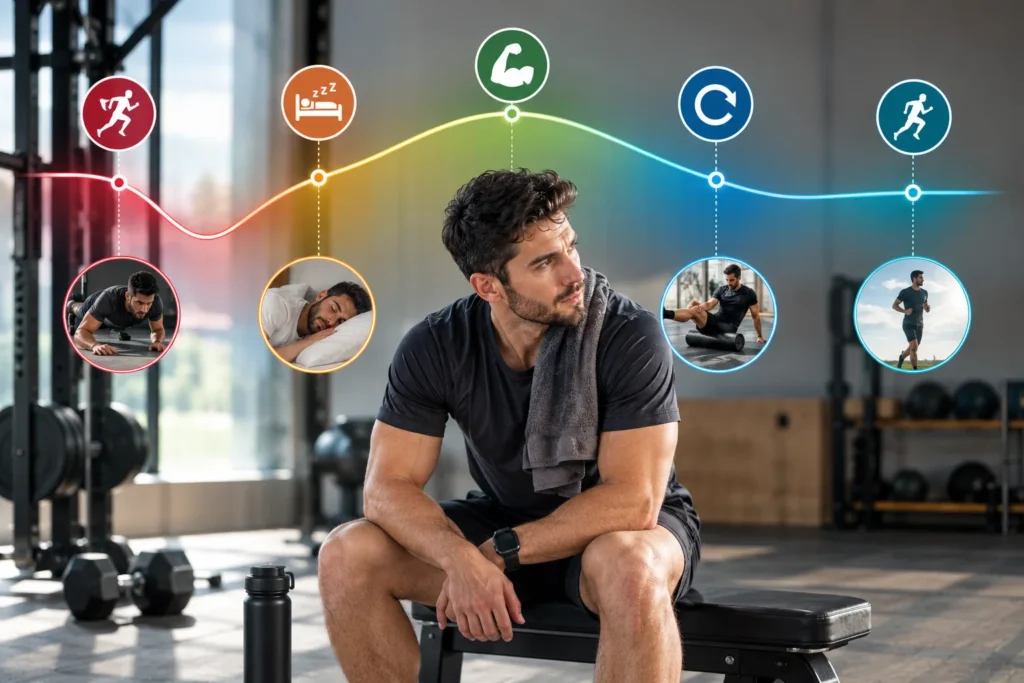
The mind-muscle connection refers to consciously focusing on a specific muscle while performing an exercise. It is commonly used in bodybuilding to improve awareness of muscle contractions and control during resistance training. But does thinking about a muscle actually help it grow? Research suggests that internal focus can increase activity in a target muscle under certain conditions, and may support muscle hypertrophy in some exercises.
However, it is not a substitute for progressive overload, appropriate training volume, and good technique. At 5dfitness, understanding how attention influences exercise can help athletes make more informed training decisions.
What Is the Mind-Muscle Connection and How Does It Work?
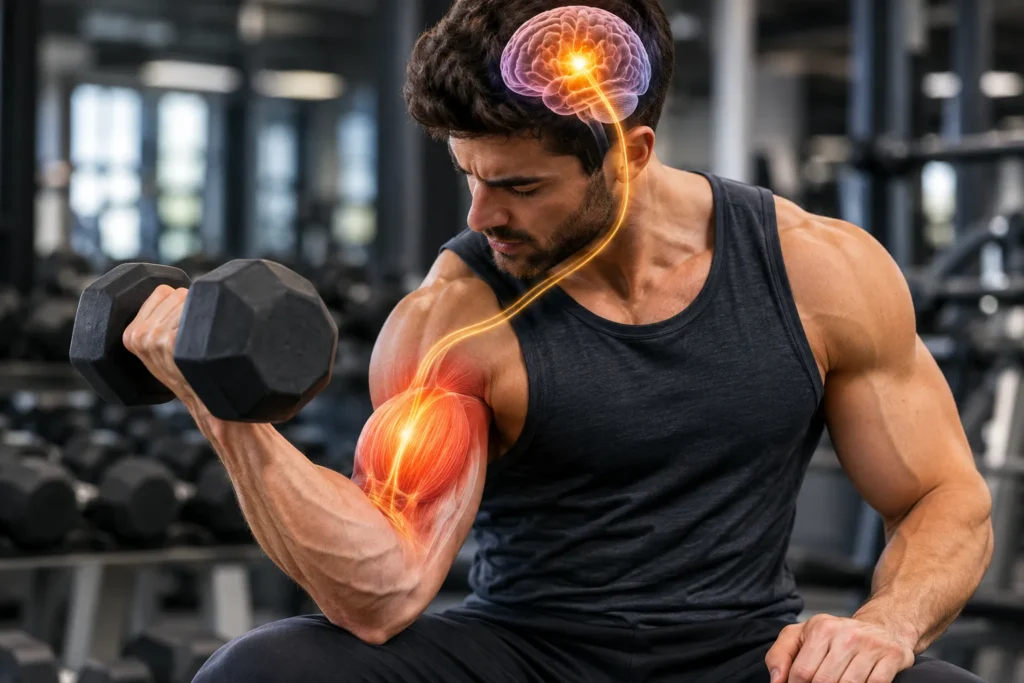
The mind-muscle connection is a form of internal attentional focus: directing your attention toward the muscle you intend to train. Instead of concentrating only on moving a weight, you consciously notice how the target muscle contracts and controls the movement. This involves communication between the nervous system and skeletal muscles, but it does not mean that you can independently switch on a muscle simply by thinking about it. The technique is best understood as a way to influence movement awareness and muscle recruitment during specific exercises.
What Happens Between the Brain and Muscles During Exercise?
Every voluntary repetition begins with signals from the central nervous system. The brain and spinal cord coordinate motor commands that activate motor units, which consist of a motor neuron and the muscle fibers it controls. The number and activity of recruited motor units depend on factors such as resistance, movement speed, fatigue, and the demands of the exercise.
When you focus on a target muscle, you may change how you coordinate the movement and distribute muscular effort. For example, during a biceps curl, concentrating on elbow flexion and the contraction of the biceps can increase awareness of that muscle. This does not mean that attention replaces the mechanical demands of training. The muscle still needs sufficient tension and an appropriate training stimulus to adapt.
What Is the Difference Between Internal and External Focus?
Internal focus means directing attention toward your body or the muscles involved in a movement. An example is thinking about contracting your chest during a chest press. External focus directs attention toward the outcome or effect of the movement, such as pushing the bar away from your body.
Both strategies can be useful, depending on the training goal. Internal focus may help bodybuilders emphasize a target muscle during selected exercises, while external focus can support movement execution and performance in many athletic tasks. Neither approach is universally superior. The most useful strategy depends on the exercise, the athlete’s experience, and whether the priority is muscle development, strength, or skill performance.
Does the Mind-Muscle Connection Improve Muscle Growth and Training Performance?
The mind-muscle connection may influence muscle activation and, in certain circumstances, muscle growth. However, these outcomes should not be confused. Increased electrical activity measured by electromyography (EMG) does not automatically prove that a muscle will grow more over time. Research has found benefits from internal focus in some resistance-training settings, but results vary according to the muscle group, exercise, training intensity, and participant experience. Understanding these differences helps athletes use the technique where it is most useful without assuming that every repetition requires intense concentration.
Can Focusing on a Target Muscle Increase Muscle Activation?
Research by Calatayud and colleagues examined 18 resistance-trained men performing bench presses under different attentional conditions. Participants were instructed to focus on either the pectoralis major or triceps brachii. The researchers reported that “focusing on using the respective muscles increased muscle activity” at loads between 20% and 60% of one-repetition maximum, but not at 80%.
This finding suggests that internal focus can influence target-muscle activity, particularly at moderate loads. However, the study measured acute EMG activity during exercise, not long-term muscle growth. It therefore supports the use of attentional focus as a training cue, rather than proving that it always produces greater hypertrophy.
Does Mind-Muscle Connection Improve Muscle Hypertrophy?
A randomized study by Schoenfeld and colleagues compared internal and external attentional focus during eight weeks of resistance training in 30 untrained men. The internal-focus group concentrated on contracting the target muscle, while the external-focus group focused on the outcome of each lift.
The researchers reported greater elbow-flexor muscle-thickness increases in the internal-focus group: 12.4% compared with 6.9%. The difference was not observed in the quadriceps. The authors concluded that “the findings lend support to the use of a mind–muscle connection to enhance muscle hypertrophy.”
These results are promising but should be interpreted carefully. The study was relatively small, involved untrained participants, and produced different results across muscle groups. More research is needed to establish how consistently internal focus improves growth in experienced lifters.
How Can You Improve the Mind-Muscle Connection During Workouts?
Developing a better mind-muscle connection requires practice, suitable exercise selection, and attention to movement quality. It is often easier to learn with controlled isolation exercises than with technically demanding compound movements. Beginners can start by reducing the weight slightly and concentrating on the target muscle throughout a repetition. However, the goal is not to make every repetition unnecessarily slow or to sacrifice performance. Internal focus should complement appropriate resistance, range of motion, and progressive training rather than replace them.

How Can You Use Controlled Repetitions to Improve Muscle Awareness?
Controlled repetitions give you more opportunity to notice how a muscle works during each phase of an exercise. For example, during a cable biceps curl, avoid swinging your torso or using momentum to move the weight. Instead, focus on controlled elbow flexion and a steady return to the starting position.
You can also pay attention to the muscle during the lengthening phase, when it controls the resistance while extending. This helps develop awareness of the complete movement rather than focusing only on the point of maximum contraction.
A slower repetition is not automatically better. Excessively slow movement can reduce the amount of weight you can use or change the training stimulus. Choose a controlled tempo that allows consistent technique and meaningful muscular effort.
Can Lighter Weights Help You Develop a Better Mind-Muscle Connection?
Lighter or moderate loads can make it easier to practise internal focus because you may have more capacity to concentrate on movement quality. Exercises such as cable flyes, lateral raises, leg extensions, and biceps curls can be useful practice options.
For example, during a lateral raise, focus on lifting your arms through a controlled range without using momentum or shrugging excessively. Notice how the deltoids contribute to the movement while keeping the load manageable.
However, lighter weights are not essential for developing this skill, and they should not become a permanent limitation. Muscle growth can be achieved across a range of loads when sets provide sufficient effort and training volume. The key is selecting resistance that allows you to maintain sound technique and achieve the intended training stimulus.
Which Exercises Help Develop a Better Mind-Muscle Connection?
Exercises that allow relatively simple movement patterns can make it easier to practise focusing on a target muscle. Isolation exercises are often useful because they reduce the number of major joints and muscle groups involved. However, internal focus can also be applied to compound exercises when it does not interfere with technique or performance. The following examples provide practical ways to develop muscle awareness across different training sessions.
Which Isolation Exercises Are Useful for Practicing Muscle Focus?
Isolation exercises are useful starting points because they generally emphasize a specific muscle group. Examples include:
- Biceps curls: Focus on controlled elbow flexion and the work performed by the biceps.
- Triceps pushdowns: Concentrate on extending the elbows without unnecessary shoulder movement.
- Lateral raises: Notice the deltoids working while avoiding excessive momentum.
- Leg extensions: Focus on controlled knee extension and quadriceps contraction.
- Cable flyes: Pay attention to the chest muscles as the arms move through the exercise.
Start with a manageable load and perform repetitions with consistent technique. The objective is not to chase a particular sensation or force an exaggerated contraction. Instead, use attention to improve control and understand how the target muscle contributes to the movement.
What Common Mistakes Should You Avoid When Practicing Mind-Muscle Connection?
Although internal focus can be useful, excessive concentration on individual muscles may distract from the overall movement. It can also encourage lifters to reduce resistance unnecessarily or change their technique to create a stronger sensation. The mind-muscle connection should be treated as one training tool, not a universal rule. Good programming still depends on appropriate exercise selection, training intensity, progressive overload, sufficient recovery, and consistent execution. Knowing when to use internal or external focus helps prevent this technique from becoming a distraction.
Can Excessive Internal Focus Reduce Exercise Performance?
Yes, it can in some situations. Concentrating too intensely on individual muscles may interfere with coordination, movement efficiency, or the ability to produce force during demanding exercises. This is particularly relevant to heavy compound lifts, where the body must coordinate several muscle groups at the same time.
For example, during a heavy squat, focusing exclusively on the quadriceps may distract you from maintaining balance, coordinating hip and knee movement, and completing the lift with consistent technique. An external cue, such as driving the floor away, may be more useful for some lifters.
Use internal focus when muscle awareness is the priority, particularly during selected isolation exercises. For strength and athletic performance, external cues may be more appropriate. The best approach is flexible rather than fixed.
What Should You Prioritize Alongside Mind-Muscle Connection?
| Training factor | Why it matters |
|---|---|
| Progressive overload | Provides a gradually increasing training challenge |
| Training volume | Helps determine the amount of work performed |
| Exercise technique | Supports consistent and controlled movement |
| Appropriate resistance | Matches the load to the exercise and training goal |
| Recovery | Allows adaptation between training sessions |
| Mind-muscle connection | Can improve awareness of target-muscle activity |
A Simple Mind-Muscle Connection Practice
- Choose a familiar isolation exercise, such as a biceps curl or lateral raise.
- Select a manageable weight that allows controlled repetitions.
- Focus on the target muscle while maintaining correct joint movement.
- Avoid swinging, rushing, or changing your range of motion to create a sensation.
- Repeat the approach across several sessions and gradually return to your normal training loads.
Conclusion
The mind-muscle connection can be a useful tool for improving awareness and, under certain conditions, increasing activity in a target muscle. Research also suggests that internal focus may support hypertrophy in selected exercises and muscle groups. However, it is not a guaranteed shortcut to muscle growth, and excessive concentration can sometimes interfere with performance.
For better results, combine appropriate attentional focus with sound exercise technique, progressive overload, sufficient training volume, and recovery. 5dfitness promotes practical, evidence-based training principles that help athletes and fitness enthusiasts make informed decisions.
Frequently Asked Questions
It is the practice of consciously focusing on a target muscle while performing an exercise.
It may improve hypertrophy in some situations, but it does not replace progressive overload, sufficient training volume, or recovery.
Research suggests it can increase target-muscle activity during certain exercises and at particular training loads.
It can help beginners develop movement awareness, but learning correct technique and building a consistent training routine should come first.
Moderate or lighter loads can make practice easier, but muscle growth is possible with a range of resistance levels when training effort is appropriate.
Neither is always better. Internal focus may be useful for target-muscle awareness, while external focus can support movement performance and coordination.