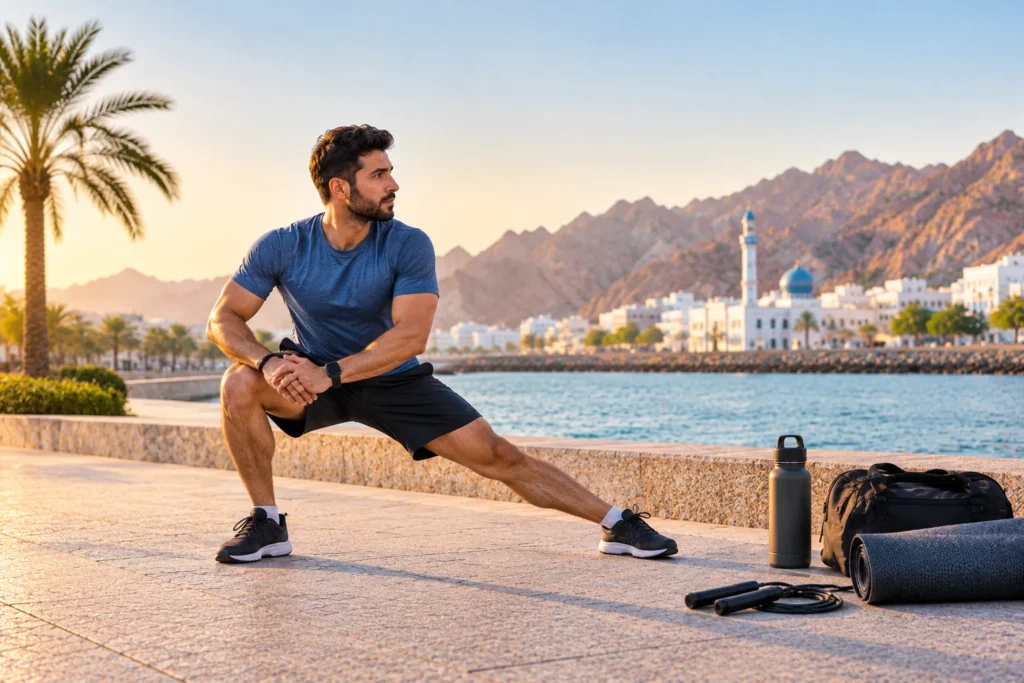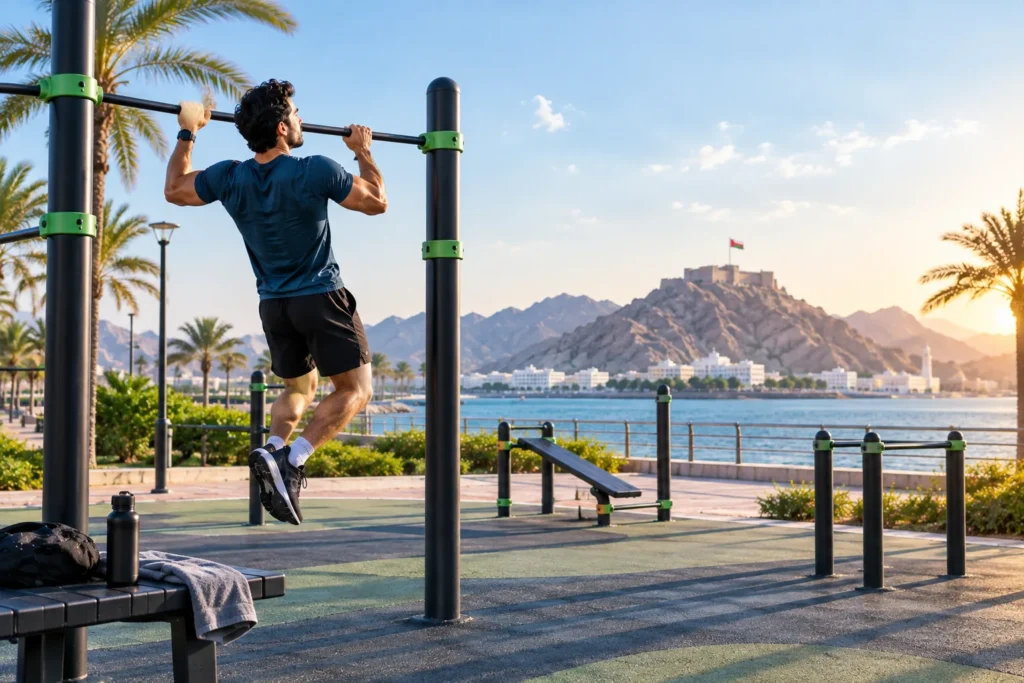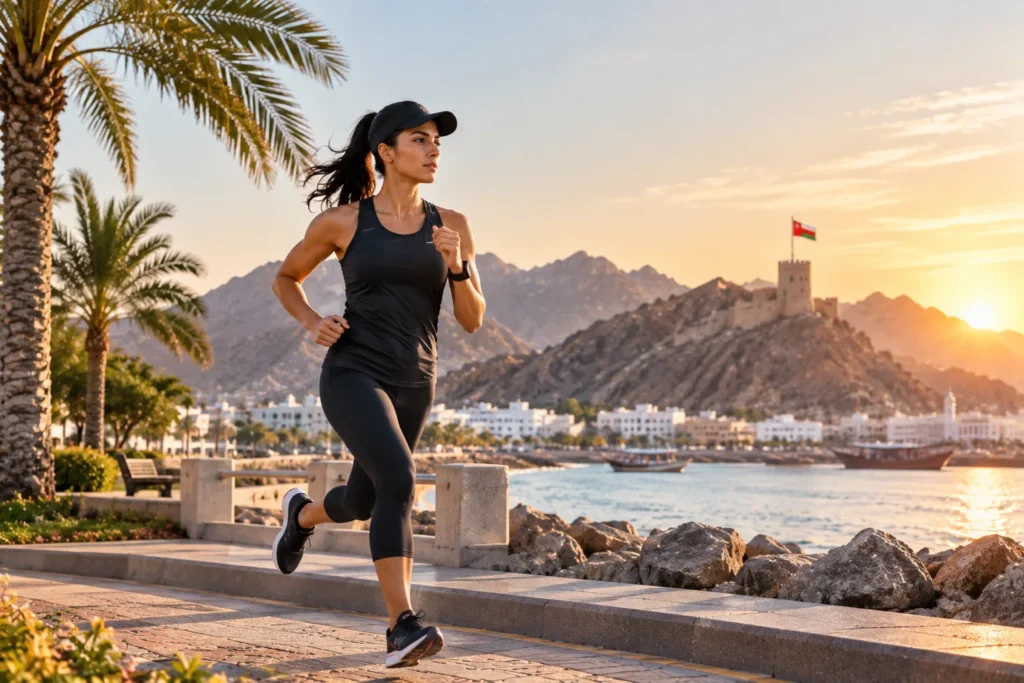
There’s a moment — usually somewhere around 5:45 in the morning — when Muscat reveals itself. The Gulf of Oman catches the first gold of sunrise, the air carries a faint trace of salt, and the Hajar Mountains glow in the distance. It’s the kind of scene that makes you want to move.
And that’s what most people miss about Muscat as a fitness destination: it isn’t just a city where you can train outdoors — it’s a city where you want to. Where the landscape becomes part of your training and an outside workout stops feeling like obligation and starts feeling like a privilege.
Whether you’re a long-time resident finally stepping out of the air-conditioned gym, or a newcomer building healthy habits in Oman, this guide covers everything — the best outdoor workout spots in Muscat, science-backed training methods, heat safety, beach workouts in Oman, and the genuine results you can expect when nature becomes your gym.
Listen
Why Is Muscat One of the Most Underrated Outdoor Workout Cities in the Region?
Muscat rarely makes international fitness headlines, but it probably should. Between a sweeping corniche, open sandy beaches, wadi trails, and a winter climate that rivals the Mediterranean for dawn training, this city offers a natural outdoor fitness environment that few regional capitals can match. You don’t need expensive equipment or a gym membership — you just need to know when to show up and where to go.
What Makes Muscat’s Climate Work in Your Favour for Outside Workouts?
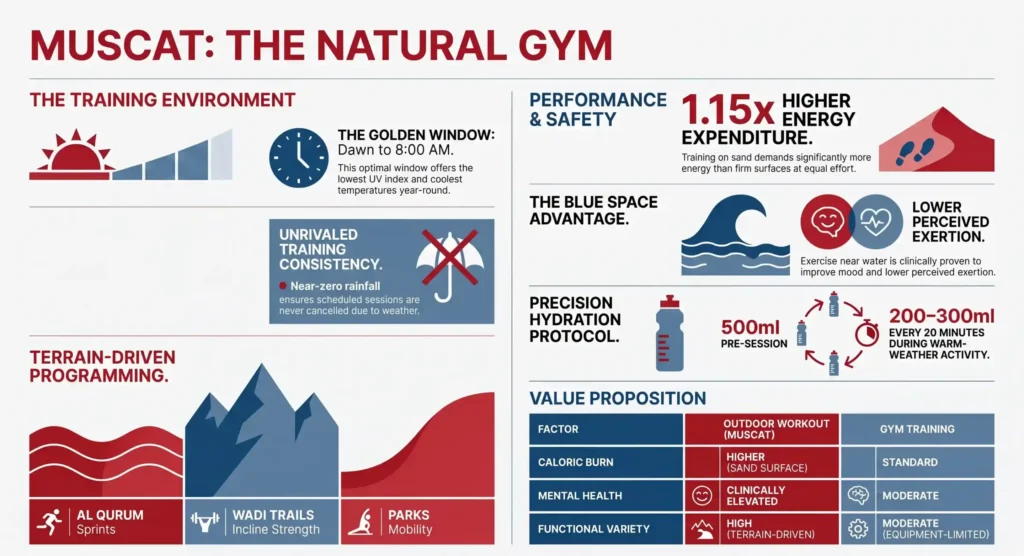
Muscat’s climate is a training asset once you understand its rhythms. From October through April, early mornings arrive with temperatures between 18°C and 26°C before 8:00 AM — a genuinely comfortable window for any intensity of outdoor exercise. The air is clear, paths are uncrowded, and the sensory experience of training at sunrise over the Gulf is something no indoor gym can replicate.
Summer demands more strategy, but Oman’s heat carries a real physiological opportunity that most people overlook. Heat acclimatisation — structured training in warm conditions with proper safety protocols — improves cardiovascular endurance, expands plasma blood volume, and increases sweat rate efficiency over time. Athletes who train in warm climates frequently demonstrate superior endurance in cooler conditions as a result. More importantly, Muscat’s climate offers consistency. There is almost no rainfall to disrupt plans, no cancelled sessions, no muddy parks, no excuses. When you schedule an outdoor workout in Muscat, it happens. That reliability matters more than people realise — because sustainable fitness is built on consistent showing up, not heroic effort that comes and goes. The city’s training environment rewards commitment in a way few places genuinely do.
Which Outdoor Locations in Muscat Are Best for Working Out?
Muscat’s geography creates a surprising variety of training environments across the city, each offering a different physical stimulus:
- Al Qurum Beach and Corniche — Wide, flat, and accessible. Ideal for running, sprint intervals, and open-air bodyweight circuits with the Gulf as your backdrop.
- Qurum Natural Park — Shaded walkways and open grass away from direct sun. Excellent for mat work, yoga flows, or small group training sessions.
- Muscat Wadi Trails and Hills — For trail runners and serious athletes. Incline variety here builds cardiovascular capacity and lower-body strength that no treadmill setting can replicate.
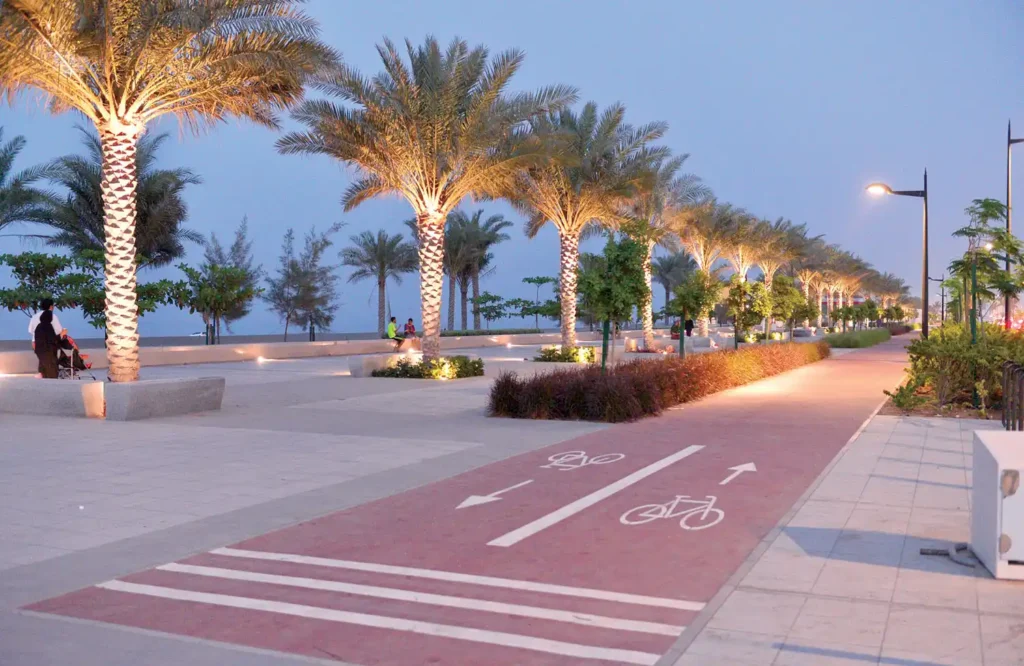
- Shatti Al Qurum Waterfront — Smooth paved paths ideal for early morning tempo runs and interval-based circuits.
- Riyam Park — Community-friendly and regularly used by Muscat’s local fitness groups, making it particularly welcoming for those returning to regular exercise.


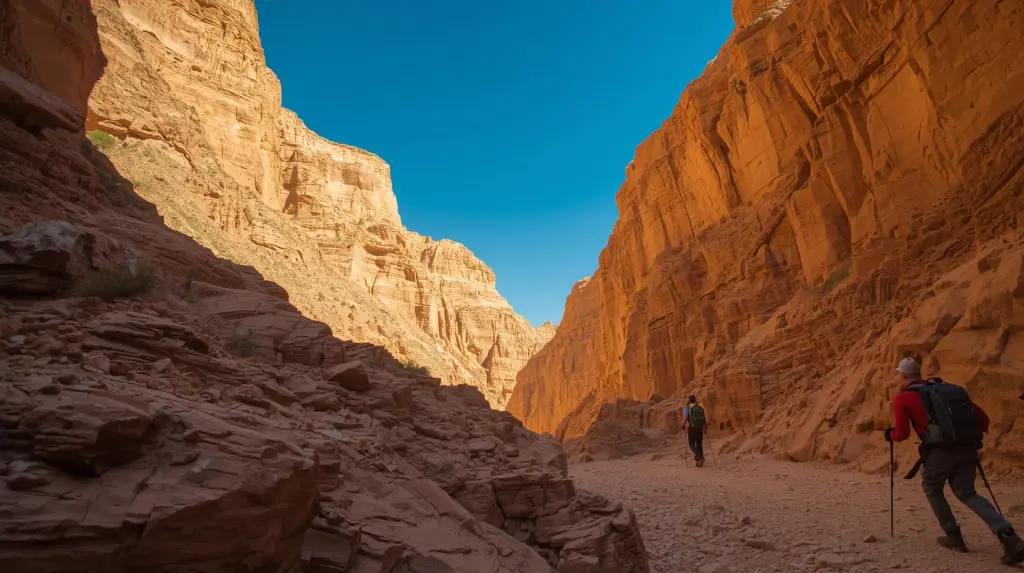
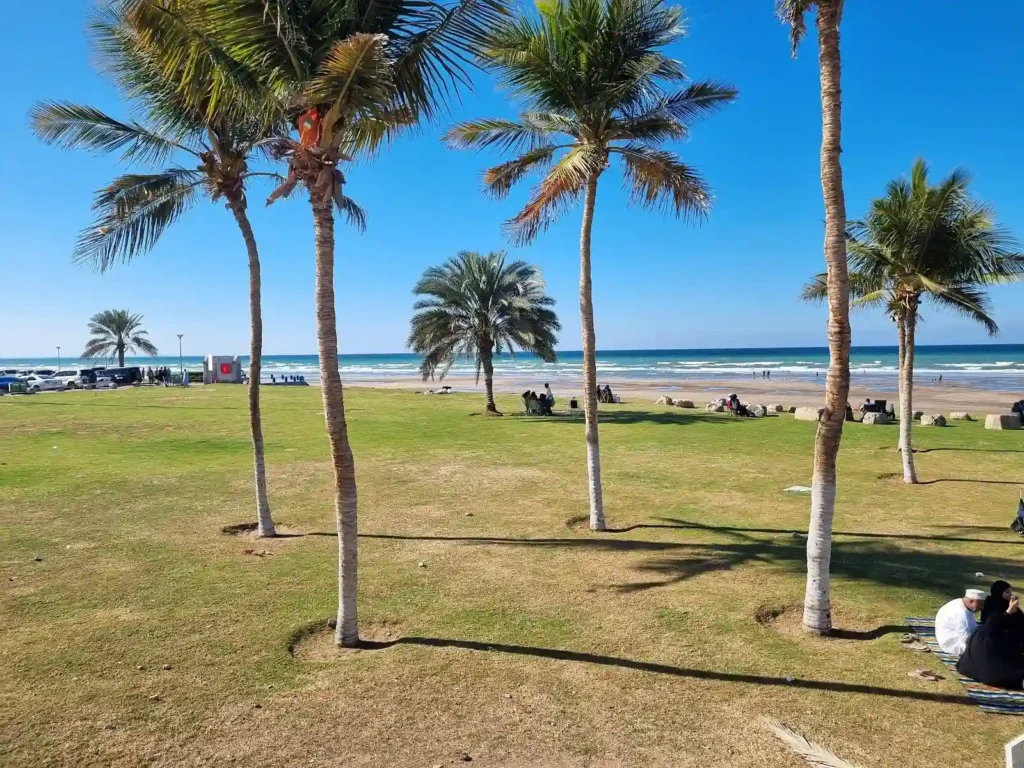
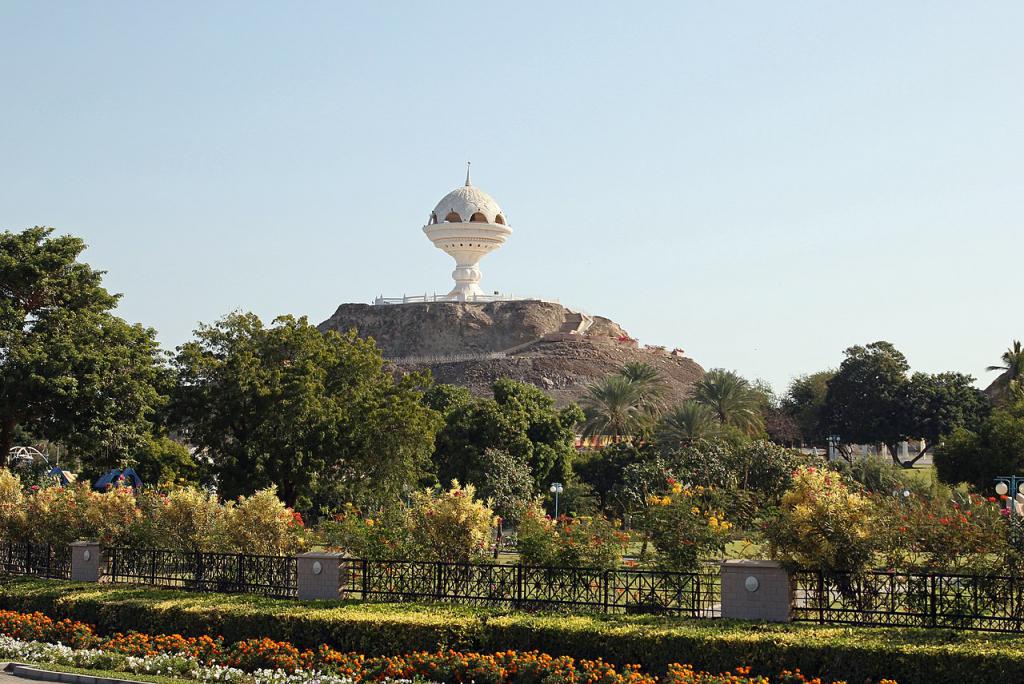
Rotating between these locations isn’t just variety for variety’s sake — from a progressive overload perspective, different terrains recruit different stabilising muscles and create different movement demands. It’s smart programming, built into the city itself.
What Does an Effective Outside Workout Routine Actually Look Like?
Most people make the mistake of approaching outdoor training like a gym session that’s been relocated to a park — same rigid structure, same thinking, different postcode. That misses the opportunity entirely. Outside workouts reward a more responsive, environment-aware mindset: one that uses available terrain intelligently and develops functional movement capacity that controlled gym environments rarely challenge.
How Should You Structure a Full-Body Outdoor Workout Session?
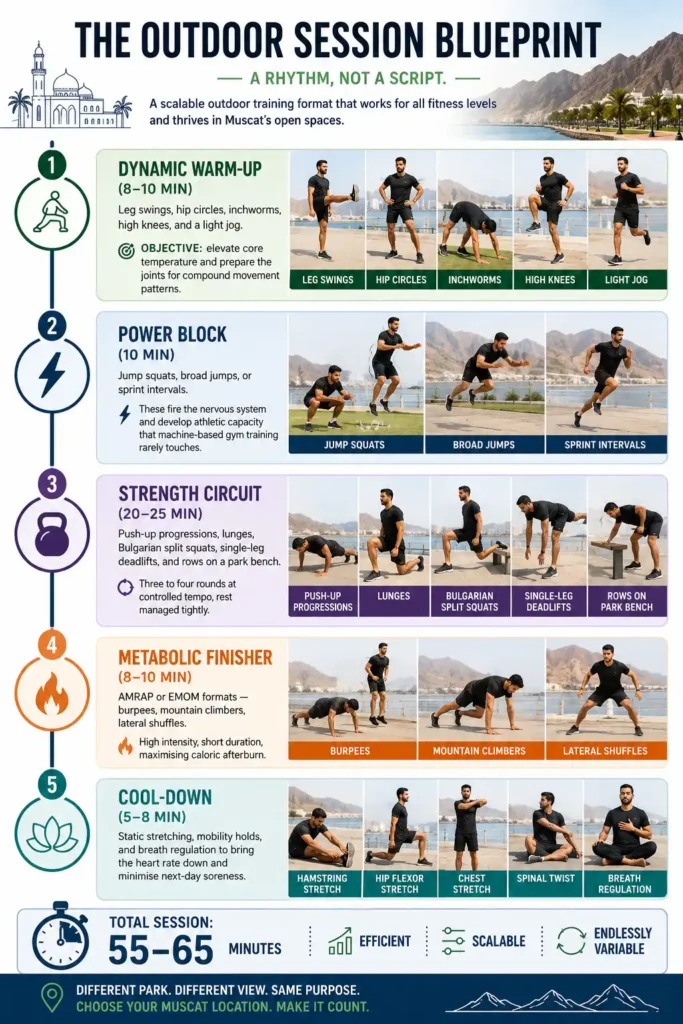
A well-designed outdoor session follows a rhythm rather than a rigid script. Here’s a format that scales across all fitness levels and works beautifully in Muscat’s open spaces:
- Dynamic Warm-Up (8–10 min): Leg swings, hip circles, inchworms, high knees, and a light jog. Objective: elevate core temperature and prepare the joints for compound movement patterns.
- Power Block (10 min): Jump squats, broad jumps, or sprint intervals. These fire the nervous system and develop athletic capacity that machine-based gym training rarely touches.
- Strength Circuit (20–25 min): Push-up progressions, lunges, Bulgarian split squats, single-leg deadlifts, and rows on a park bench. Three to four rounds at controlled tempo, rest managed tightly.
- Metabolic Finisher (8–10 min): AMRAP or EMOM formats — burpees, mountain climbers, lateral shuffles. High intensity, short duration, maximising caloric afterburn.
- Cool-Down (5–8 min): Static stretching, mobility holds, and breath regulation to bring the heart rate down and minimise next-day soreness.
Total session: 55–65 minutes. Efficient, scalable, and endlessly variable depending on which Muscat location you choose that morning.
Can You Really Get Results from an Outside Workout Without Any Equipment?
Yes — with the right programming. Bodyweight movements (push-ups, squats, lunges, planks, glute bridges, and their many progressions) require only ground and gravity, and they build a genuinely impressive physique when structured progressively and consistently. That said, a few portable additions meaningfully expand training range without adding cost or bulk. Resistance bands introduce progressive loading to upper body pulling patterns and hip hinge work. A jump rope delivers exceptional cardiovascular conditioning in minimal space. Suspension straps anchor to any park bar and unlock rowing variations and unilateral leg exercises. A slam ball adds explosive power training that bodyweight movements alone cannot replicate.
The guiding principle is minimal equipment, maximum variety. The outdoor environment already provides what a gym cannot: constantly changing terrain, spatial freedom, and sensory stimulation that sustains intrinsic motivation from session to session. Work with the environment rather than trying to recreate the gym inside it — and the results will reflect that choice.
Is a Beach Workout in Oman Everything It’s Made Out to Be?
Sand training has near-mythological status in fitness culture, and for once the reputation is justified. A beach workout in Oman isn’t just a visually compelling experience — it is physiologically distinct from training on any other surface, and the differences work consistently in your favour across multiple performance and wellbeing dimensions.
What Are the Real Physical and Mental Benefits of Training on Sand?
Sand creates what biomechanists call a destabilised surface — a medium that shifts underfoot with every step and demands constant micro-corrections from stabilising muscles throughout the lower body and core. Research has shown that sand running demands approximately 1.15 times more energy than running at the same pace on firm ground, translating directly to greater caloric expenditure at equal perceived effort. Over a typical 40-minute outdoor session, that advantage is meaningful and cumulative.
For resistance and plyometric training, sand’s instability recruits deeper muscle fibres — particularly in the glutes, hamstrings, calves, and ankle stabilisers — that flat rigid surfaces rarely engage. Barefoot training on sand also develops foot mechanics and proprioceptive awareness in ways that years of shod, flat-surface gym training often suppresses. Then there’s the psychological dimension, which exercise science is increasingly recognising as equal in importance to the physical. Studies on exercise in blue spaces — environments adjacent to water — consistently find that participants rate sessions as more enjoyable, report lower perceived exertion, and often achieve objectively higher performance compared to indoor training environments. In Oman, where world-class coastline sits within 20 minutes of most of Muscat, a beach workout isn’t a luxury — it’s a genuinely superior training environment available to anyone willing to use it.
Where Are the Best Beaches in Oman for a Structured Workout Session?
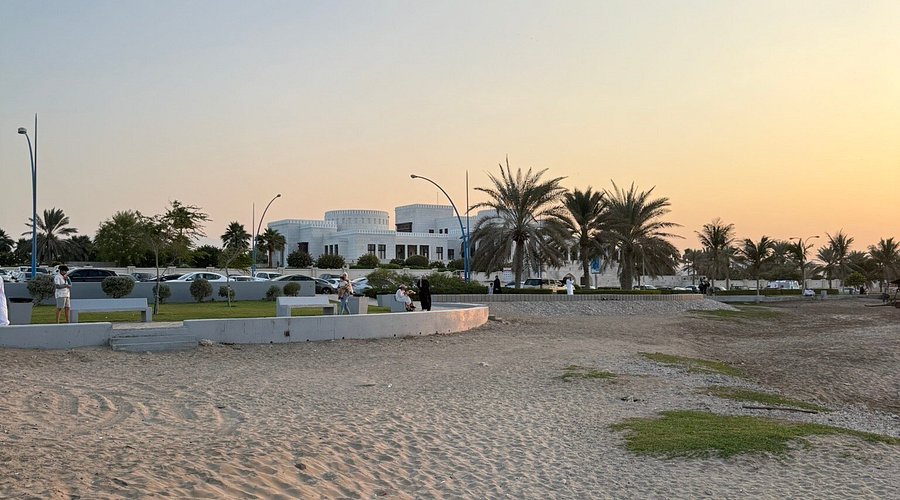
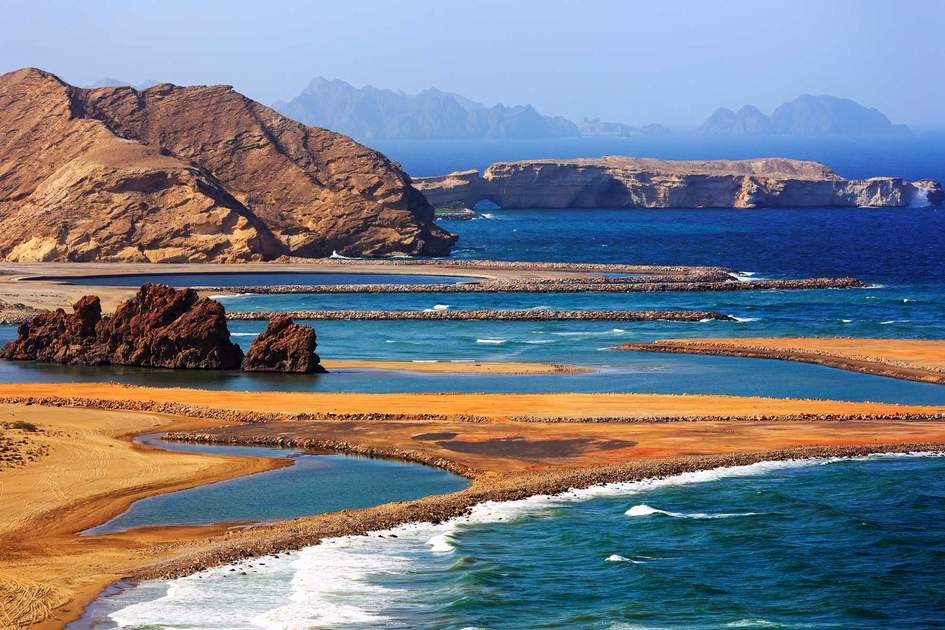
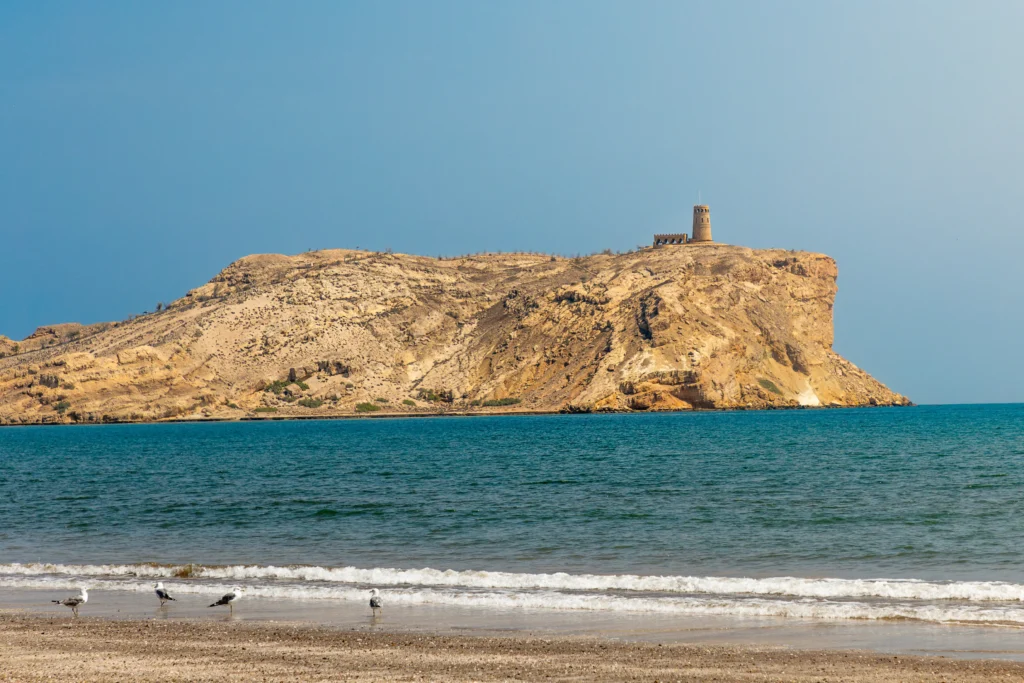
Oman’s coastline is extraordinary, and several beaches offer genuinely ideal conditions for training:
- Al Qurum Beach, Muscat — Wide flat sand, central location, and safe open-water access for swimming intervals.
- Azaiba Beach — Open, less crowded, with long uninterrupted stretches perfect for sprint work and circuits.
- Seeb Corniche Beach — Consistently used by Muscat’s fitness community; welcoming atmosphere for all experience levels.
- Yiti Beach (South Muscat) — Quieter and more rugged, excellent for trail-to-sand combination sessions.
- Sawadi Beach (Al Batinah Coast) — Worth the drive for isolation and the meditative quality of training at sunrise with the water entirely to yourself.
How Do You Train Safely During an Outside Workout in Oman’s Heat?
Heat stops more Muscat residents from training outdoors than any other factor. That’s understandable — Oman’s climate demands real respect. But heat is a manageable variable, not a permanent barrier to outdoor fitness. Understanding a handful of evidence-based principles turns it from a deterrent into a controlled, even advantageous, training condition.
“Time spent in natural environments — particularly near water — measurably lowers cortisol levels, blood pressure, and inflammatory markers. The body and brain recognise nature as a restorative state in ways that indoor environments simply cannot replicate.”
Florence Williams
What Are the Best Times to Train Outdoors in Muscat, and How Should You Hydrate?
Timing is the single most important safety decision for outdoor training in Oman. The optimal training windows are:
- Dawn to 8:00 AM — The gold standard year-round. Coolest temperatures, lowest UV index, and the motivational reward of training at sunrise over the Gulf of Oman.
- After 5:30 PM (October–April) — Comfortable evenings that support longer, more intensive sessions.
- After 6:30 PM (May–September) — Temperatures remain elevated but humidity often drops in many areas; short, high-intensity sessions perform well here.
Avoid training between 10:00 AM and 4:00 PM in summer months. This isn’t overcaution — it’s basic exercise physiology applied to Oman’s conditions.
On hydration: drink 500ml of water in the 60–90 minutes before any morning session. Carry water to every outdoor workout and aim for 200–300ml every 20 minutes during activity in warm conditions. For sessions exceeding 60 minutes, an electrolyte supplement replaces sodium and potassium that plain water cannot restore. Pre-session nutrition should be light and fast-digesting: a banana, two or three dates, or a small bowl of oats 30–45 minutes before training. Post-session, protein plus carbohydrate within 30 minutes supports muscle repair and glycogen recovery. In Muscat’s climate, your hydration strategy isn’t a footnote to your training plan — it is the foundation everything else is built on.
Outdoor Workout vs. Gym Training — Which Gets You Better Results in Muscat?
The gym-versus-outdoors debate has been running in fitness circles for decades. The real answer is always context-dependent — but for Muscat residents with access to natural beaches, open parks, and a climate that rewards early morning activity, the outdoor environment wins across multiple dimensions for most common fitness goals.
| Factor | Outdoor Workout (Muscat) | Gym Training |
|---|---|---|
| Cost | Low to zero | Monthly membership required |
| Functional movement variety | High — terrain-driven | Moderate — equipment-limited |
| Mental health benefit | Clinically elevated | Moderate |
| Natural sunlight (Vitamin D) | Yes | Minimal |
| Equipment range | Limited without coaching | Full range |
| Weather sensitivity | Moderate (timing strategy required) | None |
| Community feel | Natural group dynamic | Membership-based |
| Progressive overload | Strong with programming | Strong |
| Motivational environment | High — natural stimulation | Variable |
| Caloric expenditure (beach) | Higher (sand surface) | Standard |
What Does the Research Say About Outdoor vs. Indoor Exercise for Mind and Body?
A landmark meta-analysis published in Environmental Science & Technology found that outdoor exercise produced significantly greater improvements in mood, self-esteem, and psychological wellbeing compared to indoor exercise at identical physiological intensities. Participants consistently reported feeling more energised and less mentally fatigued after outdoor sessions — and these effects held across age groups, fitness levels, and exercise types, making them broadly applicable rather than anecdotal.
“Our meta-analysis found consistent, significant improvements in mood and self-esteem from exercise in natural outdoor environments — above and beyond what the same exercise intensity produced indoors. The environment is not a backdrop to the intervention. It is part of the intervention.”
Dr. Jo Barton, Senior Lecturer
What this means practically for Muscat residents is significant. An outdoor workout doesn’t just train the body — it actively restores the mental state while doing so. In a high-pressure professional environment like Muscat’s, that dual return on a single morning investment is worth organising your entire training week around. For the most common fitness goals — fat loss, cardiovascular health, functional strength, stress management, sustainable habit formation — outdoor training in Oman competes with or outperforms the best gym programmes on the metrics that determine long-term results: enjoyment, variety, psychological reward, and consistent attendance.
How Does Expert Coaching Transform Your Outdoor Workout in Muscat?
There is a gap between knowing that outdoor training works and actually experiencing what it can do for your body, your confidence, and your relationship with movement. Most people who try training outdoors alone gradually revert to comfortable habits — same route, same pace, same ceiling. Closing that gap is almost always the work of someone who understands both the science of progressive performance and the specific demands of training in this environment.
What Does a Professional Outdoor Training Session in Muscat Actually Look Like?
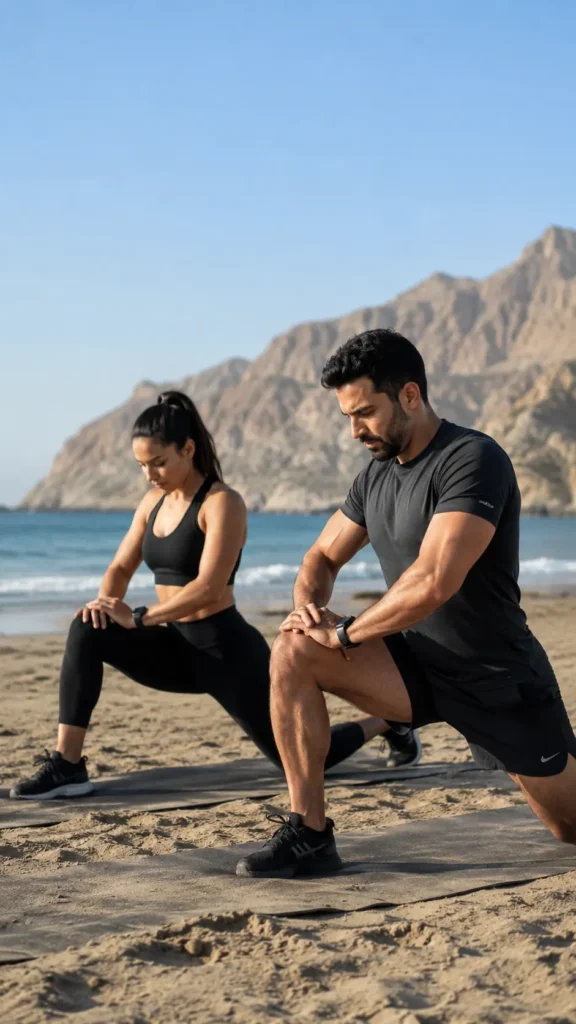
When you work with a professional outdoor coach in Muscat — as the team at 5D Fitness designs it — every session is built specifically around your goals, current fitness level, and the environment available that day. There are no generic templates recycled from one client to the next.
Before you arrive, your coach reviews your previous performance data, notes recovery patterns and any reported discomfort, and adjusts the programme accordingly. At the beach or park, the warm-up is movement-specific — designed to prime exactly what the main session will demand rather than a default five-minute jog. The work itself might blend sprint intervals on sand with resistance band supersets, plyometric power sequences, and mobility-based recovery movements — all timed and tracked against measurable progress benchmarks. Heart rate response, rest periods, and movement technique are coached in real time, not analysed after the fact.
Post-session, recovery is addressed directly: targeted stretching protocols, breath regulation, and nutritional guidance tied to your specific longer-term goals. This is outdoor fitness practised at its highest professional level — intentional, progressive, and fully calibrated to the extraordinary natural training environment that Muscat provides. It’s the difference between a workout and a programme. And that difference, compounded across weeks and months, is where real transformation happens.
Ready to Train in One of the World’s Best Natural Gyms?
Muscat is waiting. The corniche, the beaches, the wadi trails — they’re all there before the sun comes up, ready for the kind of workout that changes not just your body, but your entire relationship with fitness.
5D Fitness offers professional outdoor training sessions designed around your goals, your current fitness level, and the best that Muscat’s outdoor environment has to offer. Whether you’re starting from scratch or ready to push further than you have before — this is where it begins.
Book Your First Outdoor Session Today and experience the difference between working out and truly training.
FAQ
The optimal time for an outdoor workout in Muscat is between dawn and 8:00 AM — the coolest window, lowest UV exposure, and the most motivating light of the day. From October to April, after 5:30 PM is equally comfortable. During summer months (May–September), early morning is the non-negotiable choice for safety and performance.
Yes, with the right precautions. Train before 8:00 AM or after 6:30 PM, hydrate aggressively (500ml before the session and 200–300ml every 20 minutes during), wear lightweight UV-protective clothing, and never train between 10:00 AM and 4:00 PM in peak summer. Many experienced athletes in Oman use summer heat strategically for acclimatisation training.
Technically, none. Bodyweight movements deliver a complete training stimulus for most fitness goals. That said, resistance bands, a jump rope, and suspension straps meaningfully expand variety without adding bulk or cost. Start with bodyweight, add tools as your programming develops.
Yes. Muscat has an active outdoor fitness community with regular group sessions at Al Qurum, Riyam Park, and beach locations most mornings. Professional outdoor coaching services — including those offered by 5D Fitness — provide structured, goal-specific sessions in these spaces with qualified coaches.
For most fitness goals, yes. Sand training demands more energy expenditure than firm-surface exercise, recruits stabilising muscles gym floors don’t engage, and produces measurably better psychological outcomes. The primary limitation is progressive overload without structured programming — which a coach solves entirely.
Choose lightweight, moisture-wicking fabrics with UPF sun protection. Breathable shorts, a fitted technical tee, and a cap for sun coverage are the standard setup. Barefoot training on sand offers additional neuromuscular benefits if your feet are conditioned to it. In cooler months, a light long-sleeve layer for dawn sessions is sufficient.