
Supercompensation in training is a sports science concept that explains how the body may improve its performance capacity after exercise, provided sufficient recovery follows the training stimulus. For athletes, bodybuilders, and fitness enthusiasts, understanding this process can help balance training intensity, recovery, and long-term progress. However, supercompensation does not follow an identical timeline for everyone. At 5dfitness, understanding the science behind training adaptation can help athletes make more informed decisions about workout scheduling and performance development.
1. What Is Supercompensation in Training and Why Does It Matter?
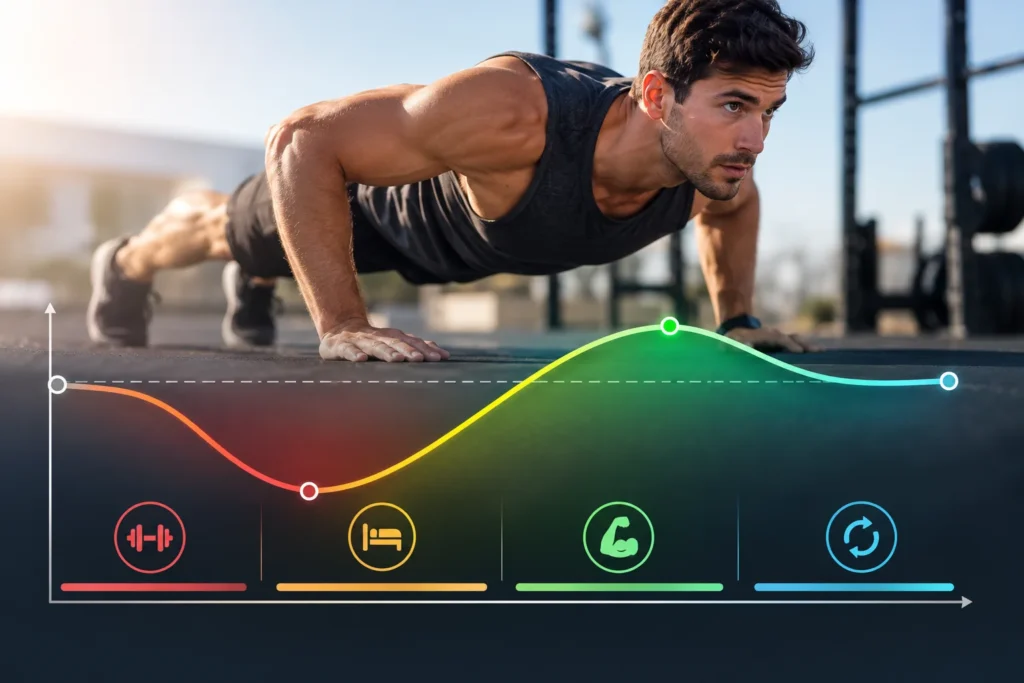
Supercompensation describes a theoretical process in which exercise temporarily reduces performance capacity through fatigue, recovery restores the body’s condition, and adaptation may subsequently raise certain capacities above their previous baseline. The concept helps explain why training stress alone is not enough to guarantee progress. The body also needs time and resources to respond to that stress. Although the model is useful for understanding training adaptation, it simplifies complex biological processes that vary across individuals, tissues, and types of exercise.
How Does Supercompensation Support Athletic Performance?
During exercise, the body uses energy, experiences neuromuscular fatigue, and responds to physical stress. During recovery, it restores energy stores, repairs tissues, and activates processes associated with adaptation. With appropriate training and recovery repeated over time, these changes can contribute to improvements in strength, endurance, and other performance qualities.
A review published in Physiological Reviews explains that “training adaptation is initiated by a homeostatic disruption induced by exercise.” Read the scientific review.
The practical lesson is that a challenging workout creates a stimulus, but the benefits depend on how the body responds afterward. More training is not automatically better if accumulated fatigue prevents high-quality performance in subsequent sessions.
2. What Are the Main Phases of the Supercompensation Cycle?
The supercompensation curve commonly illustrates four stages: the training stimulus, temporary fatigue, recovery, and a potential period of improved performance capacity. This model helps athletes understand why performance can decline immediately after a demanding session before improving later. However, these stages should not be interpreted as precise biological checkpoints. Different systems—including muscle tissue, energy availability, and the nervous system—recover at different rates. The curve is therefore best used as a planning concept rather than a guaranteed prediction of when an athlete will reach peak readiness.
What Happens During Fatigue, Recovery, and Supercompensation?
| Phase | What may happen | Training implication |
|---|---|---|
| Training stimulus | Exercise challenges the body | Apply an appropriate workload |
| Fatigue | Performance may temporarily decline | Avoid judging progress from one session |
| Recovery | Energy restoration and repair occur | Prioritize sleep, nutrition, and rest |
| Supercompensation | Certain capacities may exceed baseline | Progress if readiness and performance support it |
For example, a demanding strength workout may temporarily reduce the number of repetitions an athlete can perform at a given load. After sufficient recovery, performance may return to baseline or improve. If another demanding session is introduced before adequate recovery, fatigue may accumulate. Conversely, if training stimuli become too infrequent, the athlete may miss opportunities to build consistent adaptations. The actual response depends on training history, workload, nutrition, sleep, and the specific performance quality being developed.
3. How Long Does Supercompensation Take After Exercise?
There is no universal number of hours that guarantees supercompensation. Recovery depends on exercise intensity, training volume, movement type, the athlete’s experience, nutritional intake, sleep quality, and other sources of stress. A light workout may require less recovery than an unfamiliar, high-volume session that produces substantial fatigue. Different physiological systems also recover on different schedules. Consequently, rules such as “train every muscle again after exactly 48 hours” should be treated as general scheduling conventions, not precise scientific laws. Athletes should use their training plan alongside performance and recovery observations.
How Can You Assess Readiness for Your Next Workout?
Monitor several indicators rather than relying on muscle soreness alone. Consider whether you can perform the planned movements with appropriate technique, whether your warm-up feels normal, and whether your usual training loads produce expected results. Persistent fatigue, declining performance across multiple sessions, disrupted sleep, or unusual difficulty completing normal workouts may indicate that your workload or recovery needs reassessment.
A review in Current Opinion in Physiology states that “Recovery after exercise is an essential element of the training–adaptation cycle.” Read the review on exercise recovery.
These observations do not diagnose a medical or training condition, but tracking them over time can support better decisions. If performance continues to deteriorate, reduce training stress and seek qualified guidance when needed.

4. How Can You Apply Supercompensation to Different Types of Training?
The practical application of supercompensation depends on the goal of the session. Strength training, endurance exercise, sprinting, and team sports place different demands on the body. An athlete should therefore avoid applying a single recovery schedule to every workout. Training frequency should reflect the interaction between workload, performance goals, and recovery capacity. Periodized plans can help organize harder and easier sessions, while planned reductions in training volume may be useful before important competitions. The aim is to create a repeatable balance between productive training stress and sufficient recovery.
How Should You Adjust Training Load and Recovery?
Use the following process to apply the principle to a training plan:
- Define the objective: Decide whether the session targets strength, endurance, speed, or technical skill.
- Record the workload: Track sets, repetitions, resistance, duration, distance, or intensity as appropriate.
- Schedule recovery: Allow enough time between demanding sessions that stress the same performance systems.
- Monitor your response: Compare performance, perceived effort, sleep, and fatigue with your usual pattern.
- Adjust progressively: Increase workload only when your performance and recovery indicate that the change is manageable.
For example, a runner preparing for a race may reduce training volume before competition while retaining some race-specific intensity. A resistance-trained athlete may distribute demanding sessions across the week to manage fatigue. These approaches are not proof that every athlete will experience a predictable supercompensation peak; they are practical ways to manage training stress and readiness.
5. What Mistakes Can Disrupt Supercompensation and Training Progress?
The most common mistake is treating supercompensation as a fixed timetable rather than a simplified model. Training too frequently without adequate recovery can contribute to accumulated fatigue, while insufficient training stimulus may limit progress. Other mistakes include neglecting sleep, eating inadequately for the training workload, increasing volume too quickly, and interpreting soreness as a reliable measure of readiness. Athletes should also distinguish normal short-term fatigue from persistent performance decline. Effective programming combines planned workloads with ongoing observation and adjustment instead of relying on a single recovery formula.
How Can You Avoid Common Supercompensation Mistakes?
Avoid scheduling every workout around an assumed peak that must occur at a specific hour. Instead, establish a consistent training plan, maintain adequate energy and nutrient intake, and protect sleep. Track performance trends across several sessions and adjust the program when fatigue persists. Research reviews also emphasize that training adaptation is complex and that existing models cannot fully predict individual responses. Explore the evolution of sports training adaptation theory.
If you experience prolonged performance deterioration or unusual symptoms, consider professional assessment rather than attempting to solve the problem simply by training harder or resting for a predetermined number of days.
How Can You Use Supercompensation in Your Weekly Plan?
- Set a clear training goal for each session.
- Alternate demanding sessions with suitable recovery or lower-intensity work.
- Record training loads and perceived effort.
- Review performance and fatigue regularly.
- Adjust the next session based on your overall trend, not one isolated symptom.
Conclusion
Supercompensation in training offers a useful framework for understanding the relationship between exercise stress, recovery, and performance improvement. Its central lesson is that training quality and recovery must work together. Because adaptation varies across athletes and training demands, use the model as a guide—not a rigid schedule. Build a consistent plan, monitor performance, and adjust workloads as needed. Explore more evidence-informed training and recovery guidance at 5dfitness to support your long-term fitness goals.
Frequently Asked Questions
It is a model describing how certain performance capacities may improve beyond baseline after exercise and adequate recovery.
There is no universal timeline. It depends on the workload, athlete, and physiological system involved.
Appropriate resistance training and recovery support muscle adaptation, but muscle growth depends on multiple factors, not this model alone.
No. Recovery restores the body after exercise; supercompensation refers to a possible improvement beyond the previous baseline.