Suspension training is a form of resistance exercise that uses adjustable straps and body weight to challenge strength, balance, and muscular control. For athletes, bodybuilders, and fitness enthusiasts, it offers a flexible way to train multiple muscle groups without relying on a large collection of weights.
At 5dfitness, the goal is to help readers understand how training methods work and how to apply them effectively. Although suspension training can support full-body conditioning, its benefits depend on exercise selection, technique, and training goals. This guide explains how it works, its main benefits, beginner-friendly exercises, and essential safety considerations.
1. What Is Suspension Training and How Does It Work?
Suspension training uses straps attached to a secure anchor point, with handles or foot cradles supporting different movements. Unlike conventional machines, the system allows you to use body weight as resistance while adjusting exercise difficulty through body position and leverage. Many exercises require you to control your body while the straps move, creating additional demands on coordination and stability. This makes suspension training adaptable for different fitness levels, although the amount of resistance is not as precisely measurable as it is with weights.
How Does a Suspension Training System Work?
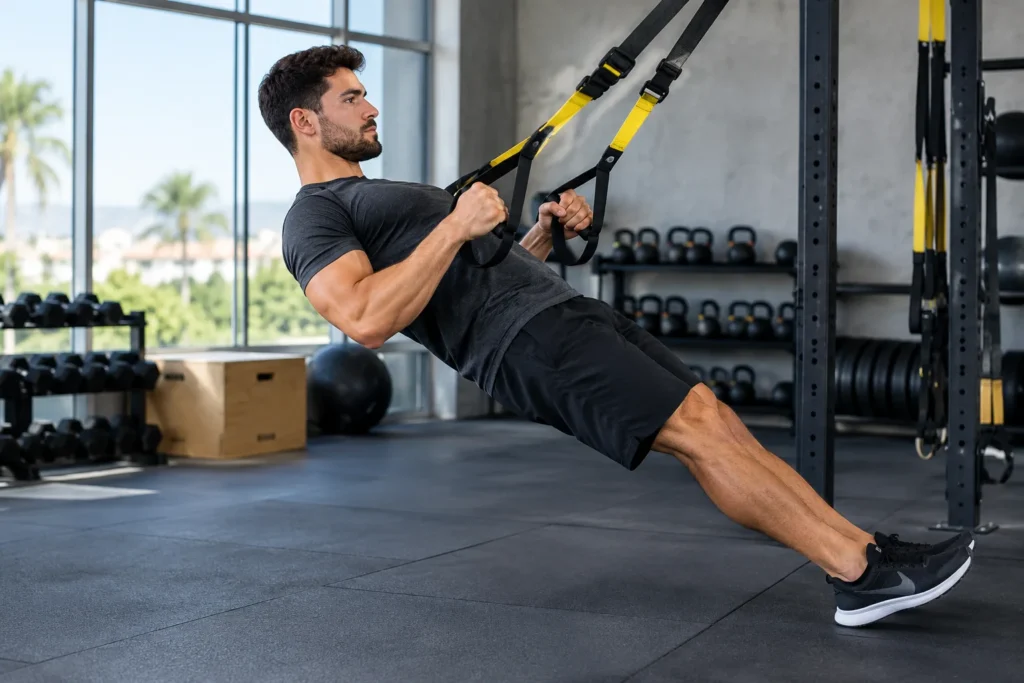
During a suspension exercise, part of your body is supported by the straps while your feet or hands remain in contact with the floor. Changing your body angle changes how much of your body weight you must move. For example, leaning farther backward during a suspension row generally increases the challenge, while standing more upright makes the exercise easier.
The straps can be used for pulling, pressing, squatting, lunging, and core exercises. Because the body must remain controlled throughout each movement, some exercises challenge stabilizing muscles as well as the primary muscles producing the movement. However, instability does not automatically make an exercise more effective. Good exercise selection and controlled technique remain essential for developing strength and fitness.
2. What Are the Main Benefits of Suspension Training?
Suspension training can be a useful addition to a balanced fitness programme because it combines resistance exercise with movement control. Depending on the exercises selected, it can develop muscular endurance, challenge core stability, and provide an adaptable full-body workout. The equipment is also relatively compact, making it convenient for home workouts and travel. However, benefits depend on the programme and the individual. Suspension training should be viewed as one training option rather than a universal replacement for traditional resistance training.
How Does Suspension Training Improve Core Stability and Balance?
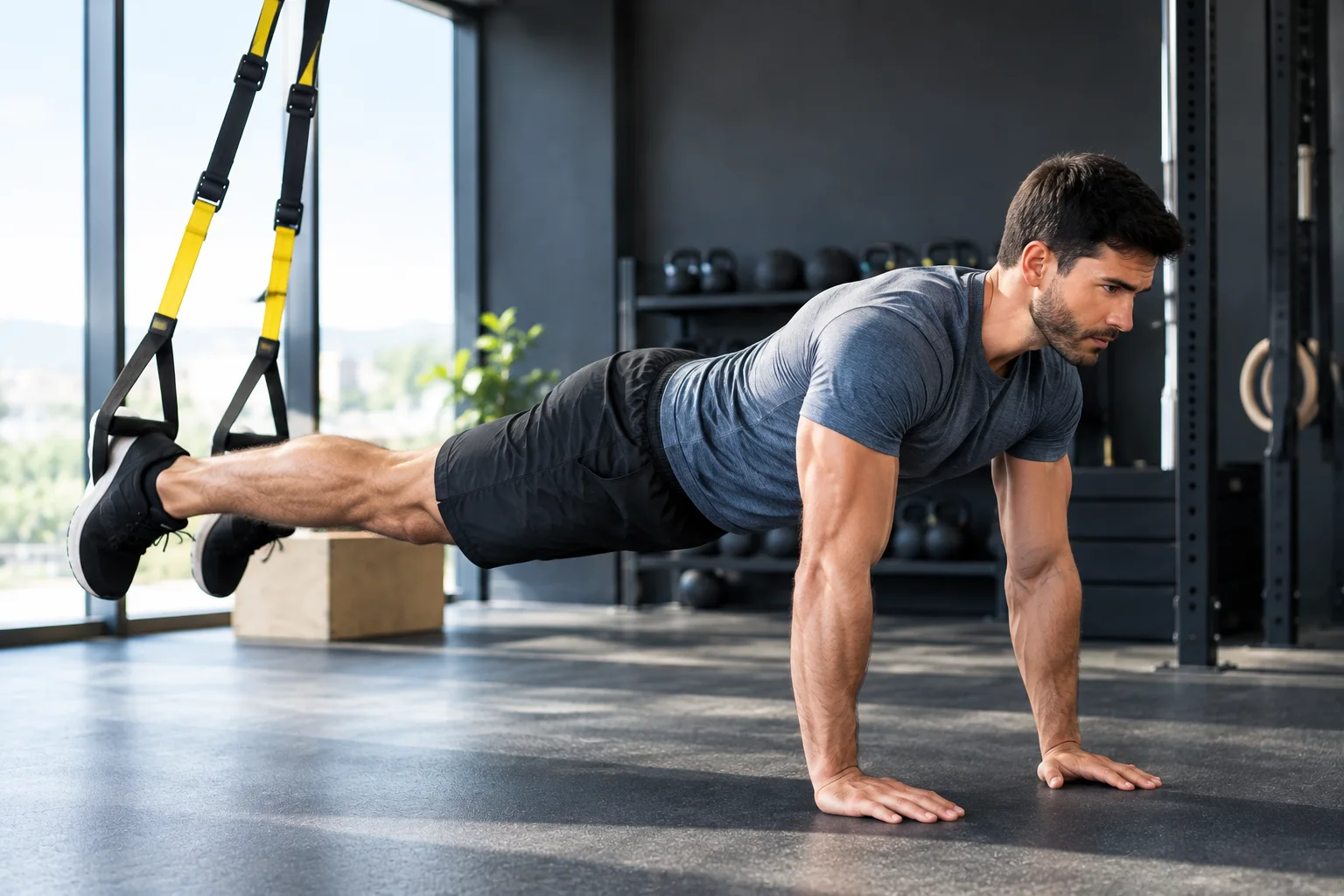
Many suspension exercises require you to maintain a controlled trunk position while your arms or legs move. During a plank variation, for example, the abdominal muscles, obliques, and other trunk muscles help resist unwanted movement. Exercises performed with reduced support can also challenge coordination and postural control.
A 2022 systematic review and meta-analysis published in the Journal of Sports Sciences found that core-training programmes improved dynamic balance across the studies included. However, the research examined core training broadly, not suspension training alone. It therefore supports the potential value of core-focused exercise without proving that suspension straps are superior to every other method.
Can Suspension Training Build Strength and Muscular Endurance?
Suspension exercises can challenge major muscle groups through movements such as rows, push-ups, squats, and lunges. Repeated controlled repetitions can improve muscular endurance, while appropriately challenging resistance can support strength development, particularly in beginners and recreational exercisers.
The main limitation is that your body weight and leverage determine much of the resistance. Advanced lifters seeking maximal strength or substantial progressive loading may need barbells, dumbbells, machines, or other external resistance. A 2021 systematic review found that unstable exercise conditions could reduce strength, power, and movement-speed performance compared with stable conditions in many tested tasks. Suspension training can therefore complement conventional strength work, but it is not automatically the best option for every performance goal.
3. Which Muscles Does Suspension Training Work?
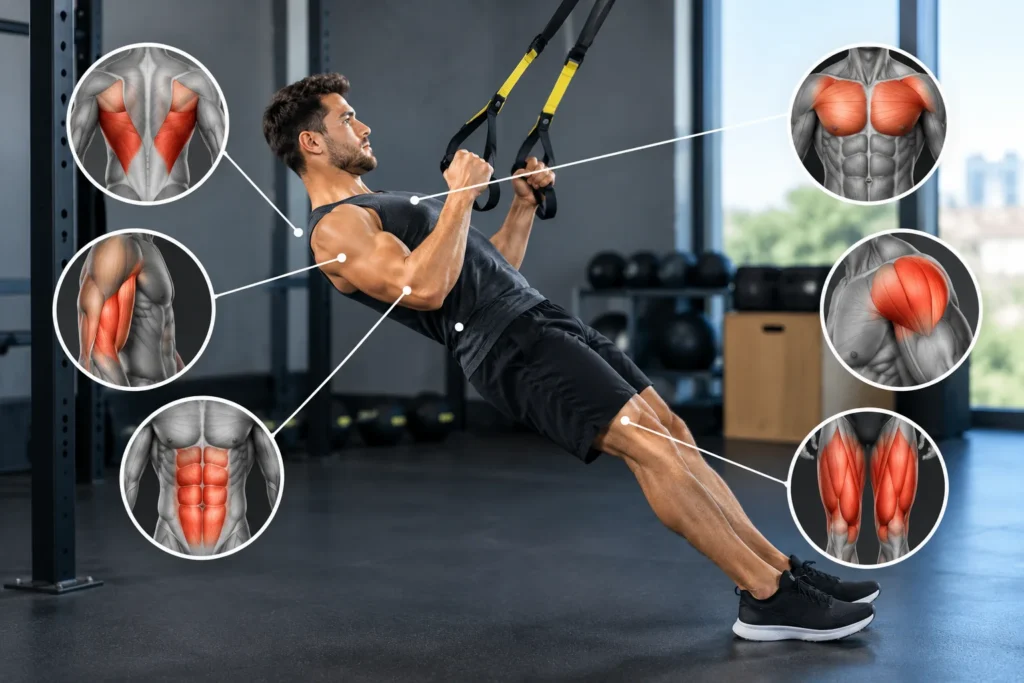
Suspension training can involve the upper body, lower body, and trunk, depending on the movement. Pulling exercises emphasize the back and arms, pressing exercises challenge the chest and shoulders, and lower-body movements train the legs and hips. Core muscles often work to stabilize the body during these exercises. The exact demands vary with body angle, movement range, support position, and exercise difficulty. A well-designed routine should cover the main movement patterns rather than repeating only the exercises that feel easiest or most familiar.
Which Upper-Body Muscles Are Trained With Suspension Straps?
Suspension rows primarily challenge the back muscles, including the latissimus dorsi and muscles around the shoulder blades, while the biceps help bend the elbows. Suspension push-ups place greater demands on the chest, triceps, and front shoulders. The shoulder and trunk muscles also contribute to keeping the movement controlled.
To develop a balanced upper-body routine, include both pulling and pushing exercises. Begin with an angle that allows you to complete repetitions without swinging, shrugging excessively, or losing trunk alignment. As control improves, increase the challenge gradually. If a movement causes sharp pain or unusual joint discomfort, stop and reassess your technique rather than attempting to push through it.
How Does Suspension Training Work the Core and Lower Body?
Suspension squats and assisted lunges train the quadriceps and gluteal muscles, while the hamstrings and other hip muscles contribute to lower-body control. Holding the straps lightly can provide assistance during a squat, making it easier for some beginners to practise balance and movement depth. More demanding variations can increase the challenge as technique improves.
Planks, knee tucks, and other trunk-focused movements challenge abdominal muscles and overall body control. The straps do not guarantee greater muscle activation in every exercise, and excessive instability can make it harder to produce force. Choose a variation that matches your ability, maintain controlled movement, and prioritize the intended muscles rather than simply selecting the most difficult-looking exercise.
4. What Are the Best Suspension Training Exercises for Beginners?
Beginners should start with movements that are easy to control and adjust. A basic programme can include a suspension row, supported squat, chest press, and a suitable plank variation. These exercises cover pulling, pushing, lower-body strength, and trunk stability without requiring advanced skills. Start with a comfortable range of motion and stop each set before technique deteriorates. The objective is to learn the movement patterns first, then gradually increase the challenge as strength and coordination improve.
How Do You Build a Simple Full-Body Suspension Workout?
The following routine is a starting point for generally healthy beginners. Adjust it to your ability and stop if you experience pain, dizziness, or unusual symptoms.
Beginner Suspension Training Workout
| Exercise | Suggested sets | Suggested repetitions |
|---|---|---|
| Suspension squat | 2–3 | 8–12 |
| Suspension row | 2–3 | 8–12 |
| Suspension chest press | 2 | 8–10 |
| Assisted reverse lunge | 2 | 6–8 per side |
| Suspension plank variation | 2 | 15–30 seconds |
Rest for around 60–120 seconds between sets, or longer if needed to maintain good technique. These are starting suggestions, not universal requirements. Use a more upright position or greater support if you cannot control the movement. Train on nonconsecutive days initially, allowing enough recovery between sessions.
Progress safely
- Inspect the straps, handles, stitching, and anchor before every session.
- Practise each movement with an easy body angle.
- Keep repetitions smooth and avoid swinging.
- Increase difficulty by changing leverage or movement range gradually.
- Record repetitions and technique quality to monitor progress.
5. Is Suspension Training Safe and How Does It Compare With Weight Training?
Suspension training can be suitable for many fitness levels when equipment is installed correctly and exercises match the user’s ability. Nevertheless, the anchor must be designed for the intended use, the straps must be in good condition, and there must be enough clear space to move safely. Beginners should prioritize technique over difficulty. People with injuries, balance limitations, or relevant medical conditions may need individualized guidance from a qualified exercise professional or healthcare provider.
Is Suspension Training Better Than Traditional Weight Training?
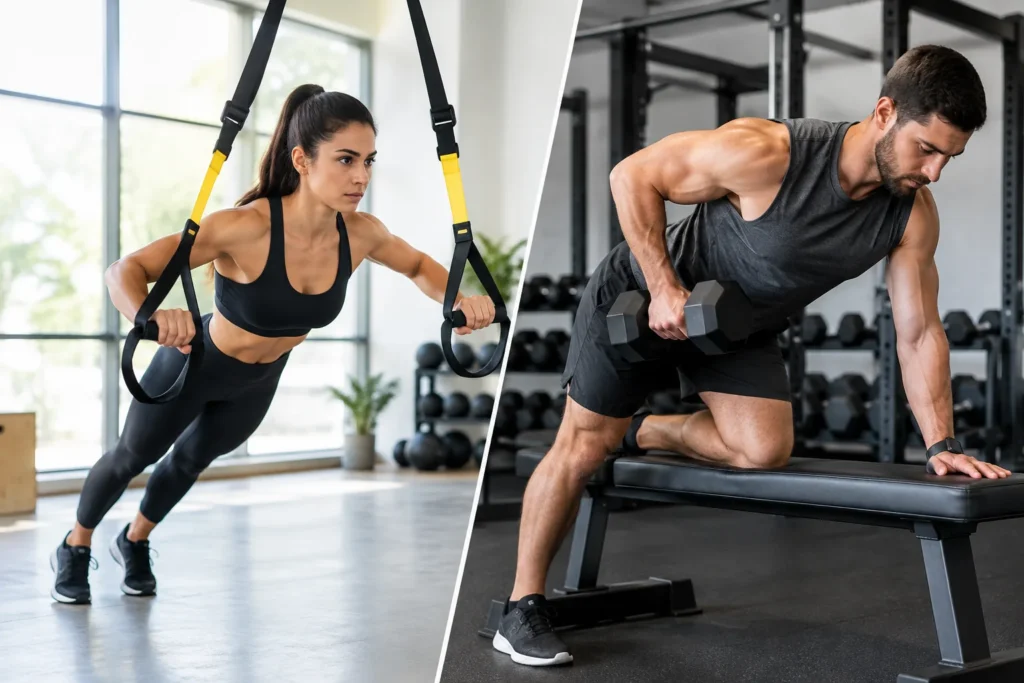
Neither method is universally better. Suspension training is convenient, adaptable, and useful for bodyweight resistance and movement control. Traditional weights allow resistance to be increased and measured more precisely, which can be especially useful for progressive overload and maximal-strength goals.
The best choice depends on the outcome you want. A beginner may use suspension straps to learn rows, squats, and controlled pressing movements, while an experienced lifter may use them as supplementary work alongside free weights. Combining methods can provide variety without sacrificing the benefits of structured resistance training.
Conclusion
Suspension training is a versatile way to challenge strength, muscular endurance, balance, and core control with compact equipment. Its main advantages are adaptability and the ability to train multiple movement patterns with body weight. However, it does not replace every benefit of traditional resistance training, particularly when precise or heavy loading is required. Start with manageable exercises, check your equipment, and progress gradually. Explore more evidence-informed training guides at 5dfitness and build a routine that fits your goals, experience, and available equipment.
FAQ
It is resistance exercise using adjustable straps anchored to a secure point, with body weight providing much of the resistance.
Yes, many movements can be adjusted for beginners. Start with easier angles and prioritize control and correct setup.
It can support muscle development, especially for beginners, when exercises provide sufficient challenge and training progresses. Heavier external resistance may be useful for advanced lifters.
It can contribute to overall physical activity and energy expenditure. Fat loss still depends on sustained energy balance, nutrition, and other lifestyle factors.
Many beginners can start with two sessions per week on nonconsecutive days, then adjust according to training experience, goals, and recovery.
It can be, provided the anchor is suitable and secure, the equipment is inspected, and the surrounding area is clear.