Tracking your training consistently is one of the simplest ways to understand whether your program is actually working. Workout progress tracking allows athletes, bodybuilders, and fitness enthusiasts to move beyond subjective feelings and evaluate changes in strength, endurance, training volume, body measurements, and performance.
For users of 5dfitness, effective tracking does not mean recording every possible metric. It means choosing relevant measurements, recording them consistently, comparing them over time, and using the results to make smarter training decisions. A well-maintained workout log can reveal gradual improvements that are difficult to notice from one session to the next and can also identify when a program needs adjustment.
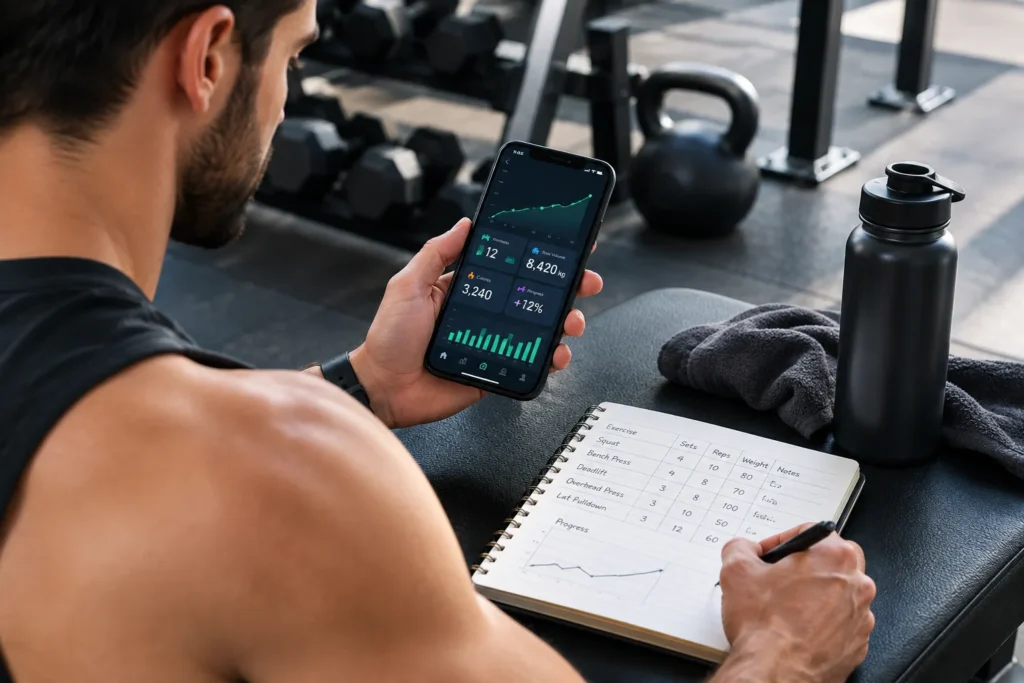
How Can You Track Your Workout Progress Effectively?
Effective workout progress tracking starts with a simple and repeatable system. Record the exercises you perform, sets, repetitions, resistance or running distance, and other metrics that directly relate to your goal. For strength training, performance improvements may appear as more weight lifted, more repetitions completed with the same load, or better control at a similar workload. For endurance training, longer distances, faster times, or improved exercise tolerance may be more meaningful. The important point is consistency: the same variables should be measured under reasonably similar conditions so that comparisons remain useful.
What Should You Record in a Workout Log?
A practical workout log should include the exercise, sets, repetitions, resistance, duration when relevant, and optionally rest periods or perceived effort. You can also record notes about technique, fatigue, sleep, or unusual circumstances when they may affect performance.
For example, a strength-training entry could look like this:
Bench press — 3 × 8 at 70 kg — 90 seconds rest
Over several weeks, this simple record can show whether you are completing more repetitions, lifting more weight, or maintaining performance while using better technique. For endurance exercise, the log might include distance, time, pace, duration, and perceived effort.
The goal is not to create complicated paperwork. A useful log should take only a few minutes and provide information that can guide future training decisions.
How Can You Track Progressive Overload?
Progressive overload means gradually increasing the training challenge over time. Tracking it requires looking beyond the amount of weight lifted in a single session.
You might progress by adding weight, increasing repetitions, completing additional sets, improving range of motion, reducing unnecessary rest, or performing the same workload with better technique. The appropriate progression depends on the training goal.
For example, if you perform 60 kg for 8 repetitions and later perform 60 kg for 10 repetitions with similar technique and effort, that represents progress even though the load has not changed.
A useful tracking system therefore compares load, repetitions, sets, and performance quality rather than treating weight alone as the definition of improvement.
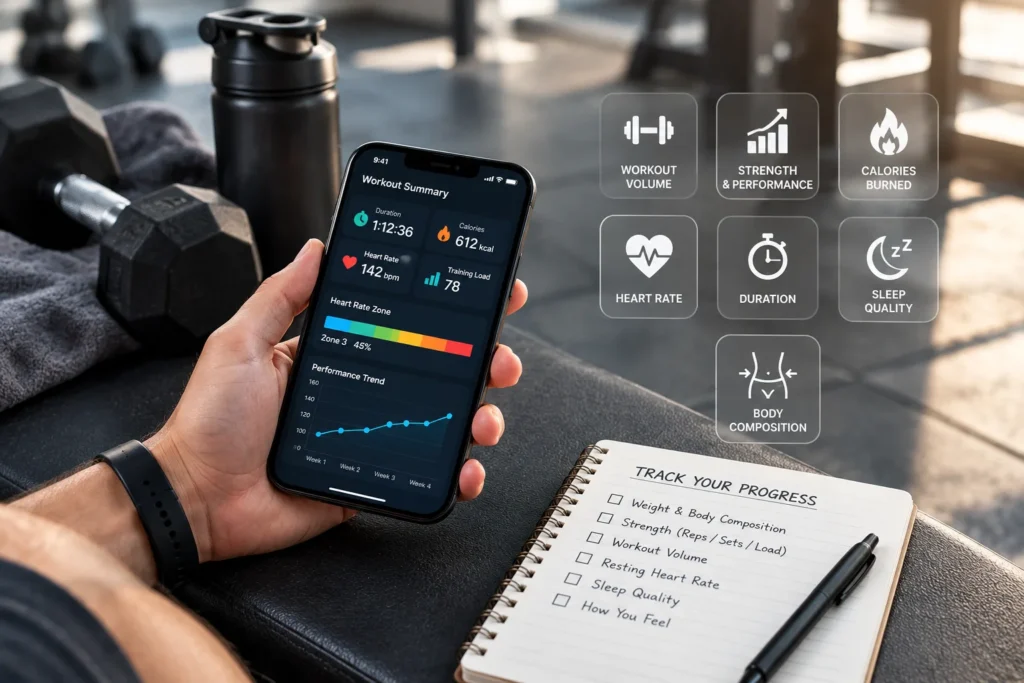
What Workout Metrics Should You Track to Measure Progress?
The best metrics depend on your objective. Someone training primarily for maximal strength should emphasize load and performance in key movements, while someone preparing for a running event may prioritize pace, distance, duration, and endurance. A bodybuilder may need to monitor training volume, repetitions, strength trends, body measurements, and progress photos. Tracking everything can create unnecessary complexity, so select metrics that directly reflect your goal. The most useful system is usually the smallest one that provides enough information to make informed training decisions.
Why Should You Track Sets, Reps, and Weight?
Sets, repetitions, and resistance provide a basic picture of resistance-training workload. Recording these variables makes it possible to compare sessions and identify trends that are otherwise difficult to remember.
Suppose you perform squats at 80 kg for 3 sets of 8 repetitions during one training phase. Several weeks later, you may be able to perform the same load for 3 sets of 10 repetitions or increase the load while maintaining your target repetitions. Both outcomes indicate a change in performance.
Tracking these variables also helps prevent accidental stagnation. If your exercises, loads, and repetitions remain unchanged for months, your training stimulus may no longer be progressing. The log gives you objective information that can support decisions about exercise selection, volume, intensity, or progression.
How Does Training Volume Help You Measure Progress?
Training volume provides another useful way to evaluate resistance-training progress. A simple calculation for volume load is:
Training Volume = Sets × Repetitions × Load
For example:
3 × 10 × 50 kg = 1,500 kg
If the same exercise later reaches:
4 × 10 × 50 kg = 2,000 kg
the recorded workload has increased. However, volume should not be interpreted in isolation. Higher volume is not automatically better if recovery, technique, or performance quality deteriorates.
Current ACSM guidance emphasizes that resistance-training variables should be matched to the individual’s goals, with load and volume adjusted accordingly. Therefore, volume tracking is most useful when combined with performance and recovery information.
Should You Track Exercise Quality and Perceived Effort?
Yes. Numbers alone do not always explain performance. Two sessions can contain the same weight and repetitions while feeling completely different.
Recording perceived effort can provide additional context. For example, completing 80 kg for 8 repetitions at a moderate effort and completing the same workload when extremely fatigued are not necessarily equivalent training experiences.
You can use a simple rating such as RPE 1–10, where higher numbers represent greater perceived effort. Notes about technique quality, unusual fatigue, pain, or recovery can also help explain unexpected changes in performance.
This additional information is particularly useful when performance temporarily declines. Instead of immediately assuming that your program has failed, you can examine whether poor sleep, accumulated fatigue, stress, or inadequate recovery may have influenced the session.
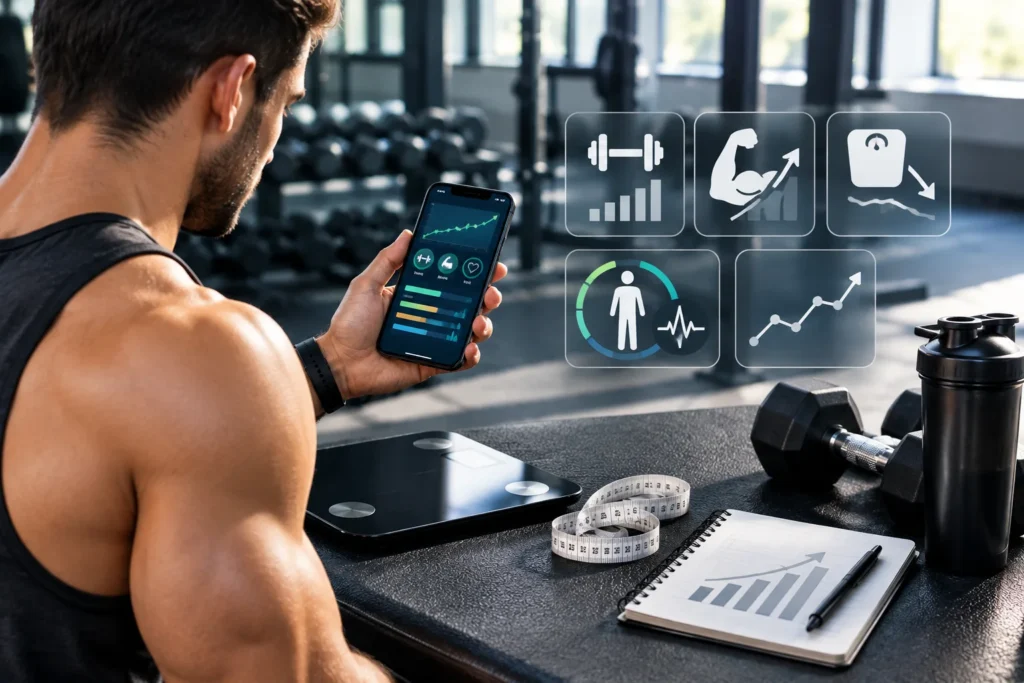
How Can You Measure Strength, Muscle, and Fitness Progress?
Workout progress is broader than simply becoming stronger. Depending on the goal, meaningful progress may include improved strength, increased endurance, better movement quality, changes in body measurements, improved exercise technique, or greater training consistency. Using several complementary indicators reduces the risk of making decisions based on a single number. For example, body weight can fluctuate because of hydration, glycogen, food intake, and other short-term factors. Combining performance data with body measurements and visual assessments can provide a more complete picture of long-term change.
How Can You Measure Strength Progress?
Strength progress can be measured by comparing performance under similar conditions. Useful indicators include the amount of weight lifted, repetitions completed at a given load, estimated one-repetition maximum, or improved performance at a predetermined intensity.
For example, if your deadlift increases from 100 kg for 5 repetitions to 110 kg for 5 repetitions with comparable technique, that is a clear performance improvement.
You do not need to test a true one-repetition maximum frequently to monitor strength. Regular training sets can provide enough information to identify trends.
For athletes and experienced lifters, more advanced performance testing may be appropriate. For general fitness users, consistent workout records are often sufficient to show whether strength is improving over time.
Can Body Measurements Show Workout Progress?
Body measurements can complement workout performance, particularly when the goal involves muscle gain or fat loss. Useful measurements may include body weight, waist circumference, hip circumference, chest circumference, or other site-specific measurements relevant to the individual.
Measurements should be collected under reasonably consistent conditions. For example, taking measurements at approximately the same time of day and using the same technique can make comparisons more meaningful.
Body weight should also be interpreted carefully. A temporary increase or decrease does not necessarily mean an equivalent change in muscle or body fat. Water retention, glycogen, food volume, and other factors can influence short-term body weight.
For this reason, combining body measurements with training performance and longer-term trends generally provides better information than relying on the scale alone.
Are Progress Photos Useful for Tracking Fitness Changes?
Progress photos can be particularly useful for observing changes that numbers may not capture. They can help show changes in muscular development, body shape, posture, or overall physique.
For meaningful comparisons, use consistent conditions. Similar lighting, camera position, distance, clothing, and poses make visual comparisons more reliable.
Progress photos should not be taken excessively or used as the only measure of success. Weekly or monthly comparisons are generally more useful than judging your appearance every day.
The purpose is to identify longer-term trends rather than react to normal daily changes in appearance. Combining photos with workout records and measurements provides a more objective assessment of physical transformation.
How Often Should You Review and Compare Your Workout Progress?
Progress should be recorded frequently but evaluated over an appropriate time frame. Individual workouts can fluctuate because of sleep, nutrition, stress, recovery, hydration, and other factors. Therefore, one unusually good or bad session should not determine whether a program is successful. Record important data during each relevant workout, then review trends periodically. Weekly reviews can identify immediate patterns, while monthly comparisons may provide a clearer picture of longer-term adaptation. The exact review schedule should depend on the training goal, but consistency is more important than choosing a perfect interval.
How Often Should You Record Your Workout Data?
For resistance training, recording each workout is usually the most practical approach. You can immediately capture exercises, sets, repetitions, load, and relevant notes while the information is fresh.
For endurance training, record the main variables after each session, such as distance, duration, pace, and perceived effort.
Recording every session creates a historical record that can later be analyzed for trends. It also reduces reliance on memory, which is particularly important when training involves multiple exercises or changing loads.
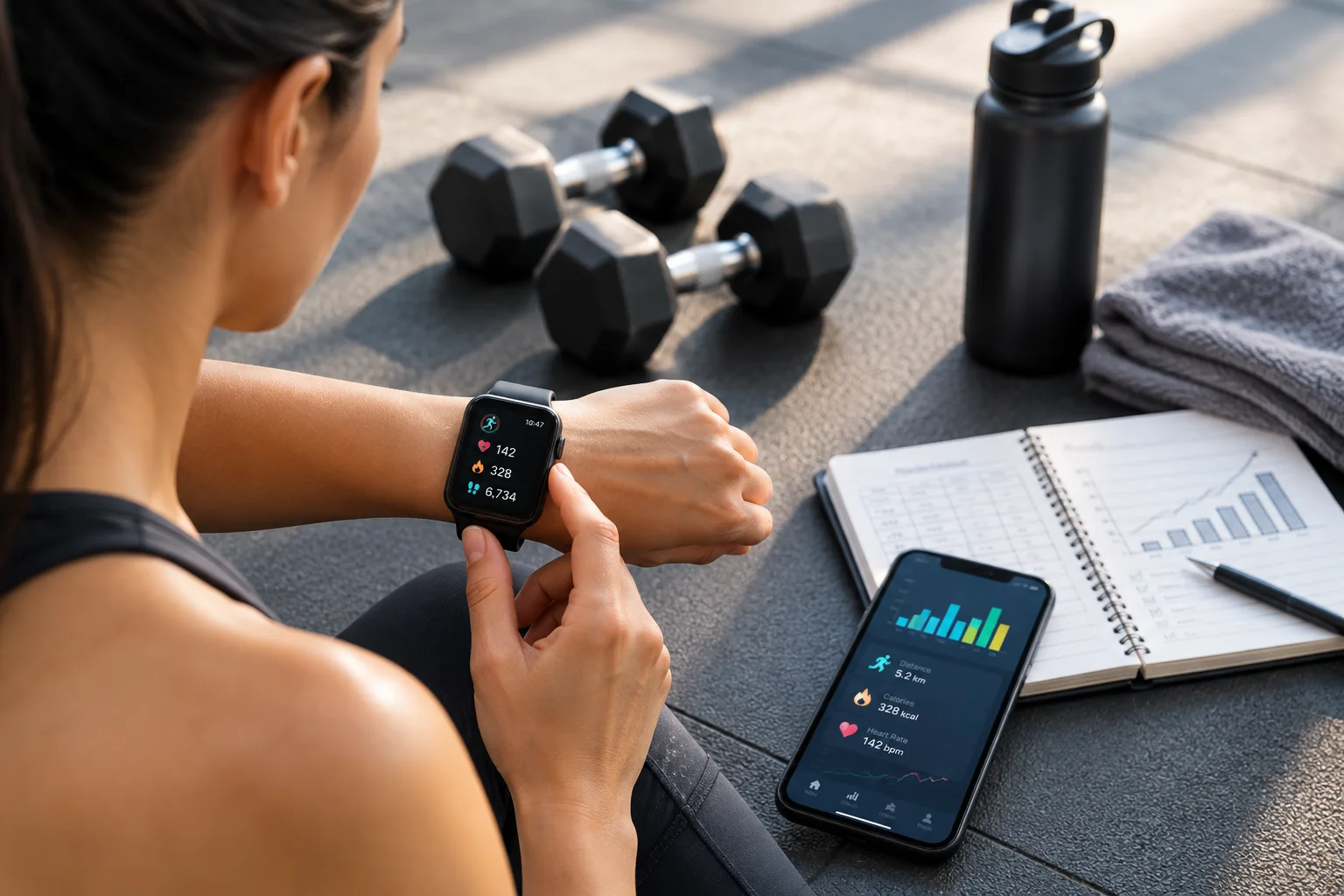
The process should remain simple. A notebook, spreadsheet, or workout-tracking application can all work if you use the system consistently.
How Can You Compare Workout Performance Over Time?
Compare similar workouts rather than isolated sessions. For example, compare the same exercise, movement pattern, distance, or training session across several weeks.
Useful comparisons include:
- More repetitions at the same load
- More load at the same repetitions
- Greater distance at a similar pace
- Faster completion time at a similar workload
- Better technique at the same resistance
- Similar performance with lower perceived effort
NSCA guidance on performance tracking emphasizes recording variables such as weight, repetitions, rest, time, and overall volume so that performance can be compared across different stages of a training program.
The objective is to identify a trend, not to win every individual workout.
When Should You Consider Your Progress Meaningful?
Progress becomes more meaningful when improvements are repeated across multiple sessions or measurement points.
For example, lifting a heavier weight once may be an isolated event. Repeatedly performing that weight with controlled technique suggests a more reliable adaptation.
The same principle applies to endurance, body measurements, and other metrics. Look for consistent changes rather than reacting to single-day fluctuations.
A useful question is:
“Is my performance or physical outcome improving under comparable conditions over time?”
If the answer is consistently yes, your training is likely moving in the intended direction.
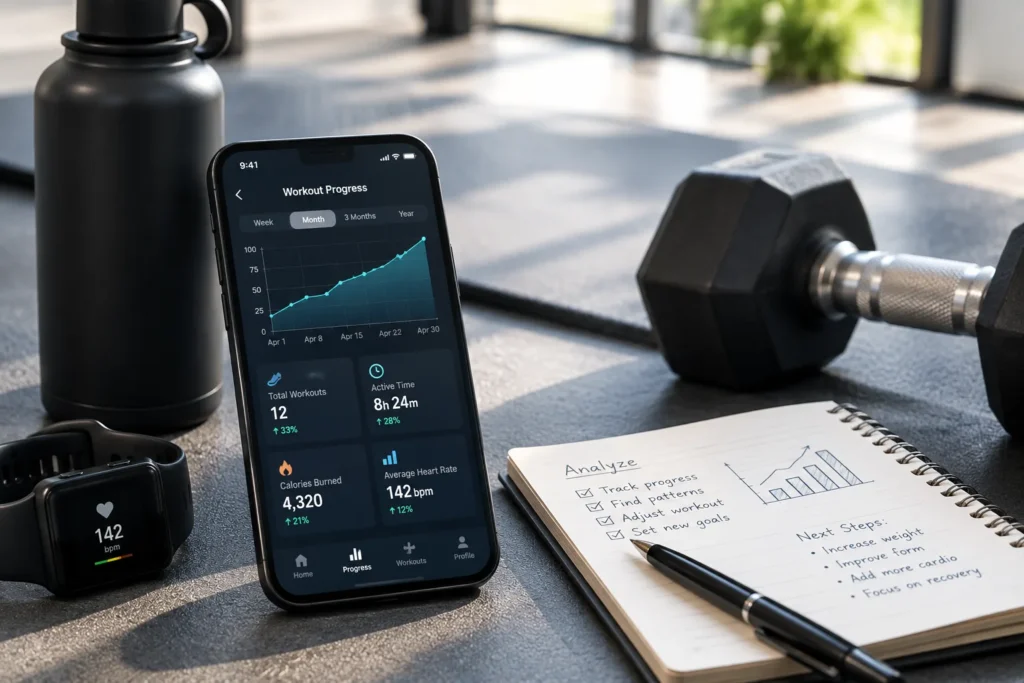
How Can You Use Your Workout Data to Improve Your Training?
Tracking only becomes valuable when the information influences your decisions. After collecting data, review whether your current training is producing the expected response. If performance is improving, you may continue with the existing approach and progress gradually. If progress has stalled, investigate potential causes before making major changes. Training volume, exercise selection, recovery, nutrition, technique, and consistency can all influence results. Data should therefore be used as a decision-making tool rather than as a source of pressure to increase numbers at every workout.
How Can You Identify When Your Training Has Stalled?
A plateau should be evaluated over multiple sessions rather than one disappointing workout. If your strength, repetitions, endurance, or other goal-specific metrics remain unchanged for an extended period, your training may require review.
First, check consistency. Are you actually completing the planned sessions? Next, review recovery, sleep, nutrition, technique, training volume, and exercise progression.
You should also determine whether your expectations are realistic. Progress is rarely perfectly linear, particularly as training experience increases.
A workout log helps distinguish a genuine plateau from normal variation. Without historical data, it is easy to assume that progress has stopped when performance may actually be improving slowly.
When Should You Change Your Workout Program?
Change your program based on a clear reason rather than simply because progress feels slow for a few days.
A program may need adjustment when performance consistently stalls, the training goal changes, recovery becomes inadequate, or the current routine no longer fits your schedule or circumstances.
ACSM’s 2026 resistance-training guidance emphasizes that training should be individualized and that a program that is too demanding to maintain can lose its effectiveness.
This means the best program is not necessarily the most complicated one. A sustainable routine that you can perform consistently and progressively is often more useful than a highly complex program that is difficult to maintain.
How Can You Turn Your Workout Data Into Better Training Decisions?
Use your data to answer three questions:
What improved?
Identify measurable changes in strength, endurance, volume, technique, or body composition.
What stopped improving?
Look for repeated plateaus rather than isolated bad sessions.
What should change next?
Adjust only the variables that are relevant to the problem.
For example, if repetitions are increasing consistently, there may be no reason to make major changes. If performance has stalled while fatigue is increasing, recovery and training load may deserve attention.
This approach turns a workout log into a feedback system:
Record → Compare → Analyze → Adjust → Repeat
That cycle makes training more deliberate and reduces the risk of making decisions based only on motivation or daily feelings.
Workout Progress Tracking: Key Metrics and Their Uses
| Metric | What It Measures | Best Used For |
|---|---|---|
| Weight lifted | Resistance performance | Strength training |
| Repetitions | Exercise capacity | Strength and hypertrophy |
| Sets | Training workload | Volume monitoring |
| Training volume | Total workload | Resistance-training progression |
| Distance | Endurance output | Running, cycling and cardio |
| Time/Pace | Performance efficiency | Endurance training |
| RPE | Perceived effort | Training intensity and fatigue |
| Body weight | Overall weight trend | Weight management |
| Body measurements | Physical changes | Fat loss or muscle gain |
| Progress photos | Visual changes | Physique transformation |
How Can You Build a Simple Workout Progress Tracking System?
You do not need advanced software to start tracking effectively. Choose a simple system that you can maintain consistently.
- Step 1: Define your main goal.
Choose strength, muscle growth, endurance, fat loss, general fitness, or another measurable objective.
- Step 2: Select three to five key metrics.
For example, a strength trainee could track weight, repetitions, sets, and RPE.
- Step 3: Record every relevant workout.
Write down your results immediately after or during the session.
- Step 4: Review trends regularly.
Compare similar workouts instead of focusing on individual sessions.
- Step 5: Adjust gradually.
If the data shows consistent progress, continue. If progress repeatedly stalls, investigate the cause and make a targeted adjustment.
The system should remain simple enough that you can use it for months, not just for a few workouts.
Conclusion
Effective workout progress tracking is not about collecting the largest possible amount of data. It is about recording the right information consistently and using it to understand whether your training is moving toward your goal. Track performance variables such as load, repetitions, sets, volume, distance, time, and effort, then combine them with body measurements or progress photos when appropriate. Reviewing trends over time can help you identify genuine progress, recognize plateaus, and make more informed adjustments.
For 5dfitness, the practical takeaway is simple: record, compare, analyze, and adjust. Your workout data should help you train with greater purpose rather than simply produce more numbers.
FAQ
The best approach is to record goal-specific metrics consistently, such as weight, repetitions, sets, distance, time, RPE, and relevant body measurements.
Record important workout data during every relevant session. Review the broader trend weekly or monthly rather than judging progress from one workout.
No. More repetitions, better technique, greater endurance, improved range of motion, increased training capacity, and lower perceived effort can also indicate progress.
Yes, if body composition or weight management is part of your goal. However, body weight should be evaluated as a longer-term trend rather than a daily measure of success.
Yes. Consistent progress photos can help identify visual changes that may not be obvious from workout performance or body weight alone.
A workout app can make recording and comparing data easier, but a notebook or spreadsheet can work equally well if you use it consistently.
First review your training consistency, recovery, nutrition, exercise technique, volume, and progression. Look for a persistent trend before making major changes to your program.