
Walking or running is one of the most common questions among people who want to improve cardiovascular fitness, manage body weight, increase daily activity, or complement strength training. Both activities are accessible, inexpensive, and supported by strong evidence, but they create different physiological demands. For readers of 5dfitness, the important question is not simply which activity burns more calories, but which option delivers the best balance of fitness benefits, recovery, sustainability, injury risk, and personal goals. This article compares walking and running through exercise intensity, energy expenditure, cardiovascular adaptations, weight management, recovery, and practical programming to help athletes, fitness enthusiasts, bodybuilders, and beginners make an evidence-informed decision.
Listen
Is walking or running more effective for improving cardiovascular fitness?
Walking and running can both improve cardiovascular health when performed consistently, but their training stimulus is different. Running generally reaches vigorous intensity more quickly, while brisk walking can provide moderate-intensity aerobic exercise with lower mechanical stress. The World Health Organization recommends that adults accumulate at least 150–300 minutes of moderate-intensity aerobic activity or 75–150 minutes of vigorous-intensity activity per week, or an equivalent combination. Therefore, the better option depends on how much intensity a person can safely tolerate and how consistently the activity can be performed.
Can walking provide enough intensity to improve cardiovascular fitness?
Yes. Walking does not automatically mean low-intensity exercise. According to the Compendium of Physical Activities, brisk walking at approximately 3.5–3.9 mph is listed at 4.8 METs, while very brisk walking at 4.0–4.4 mph reaches approximately 5.5 METs. Faster walking, hills, inclines, or Nordic walking can increase the physiological demand further.
For someone who is sedentary, overweight, returning to exercise, or managing a lower fitness level, brisk walking can be an effective starting point. Increasing pace, duration, incline, or frequency can progressively raise the training stimulus without immediately introducing the mechanical demands associated with running.
Walking can also be accumulated throughout the day. This makes it particularly useful for people who struggle to dedicate a long uninterrupted workout session to cardiovascular exercise.
Does running improve aerobic fitness faster than walking?
Running generally provides a greater cardiovascular stimulus per minute because it requires substantially more energy and usually produces a higher heart rate and oxygen demand. The Compendium lists general jogging at 7.5 METs, while running at 6–6.3 mph is listed at 9.3 METs.
This means a person with adequate conditioning can obtain vigorous aerobic training in a shorter period. Running can therefore be highly efficient for improving endurance, particularly when time is limited.
However, greater intensity is not automatically better. A training method is effective only when the individual can recover from it and repeat it consistently. Someone who runs aggressively twice a week but experiences persistent soreness may ultimately accumulate less useful activity than someone who briskly walks five or six days a week.
Which activity is better for long-term cardiovascular health?
Neither activity has an absolute advantage for every person. The most important variables are total activity, intensity, consistency, recovery, and individual health status.
WHO emphasizes that “some physical activity is better than none”, while recommending progressive increases toward established weekly activity targets.
For beginners, walking may provide the most sustainable entry point. For trained individuals, running can efficiently deliver vigorous cardiovascular work. A combination can often be even more practical: easy walking for frequent activity and selected running sessions for higher-intensity conditioning.
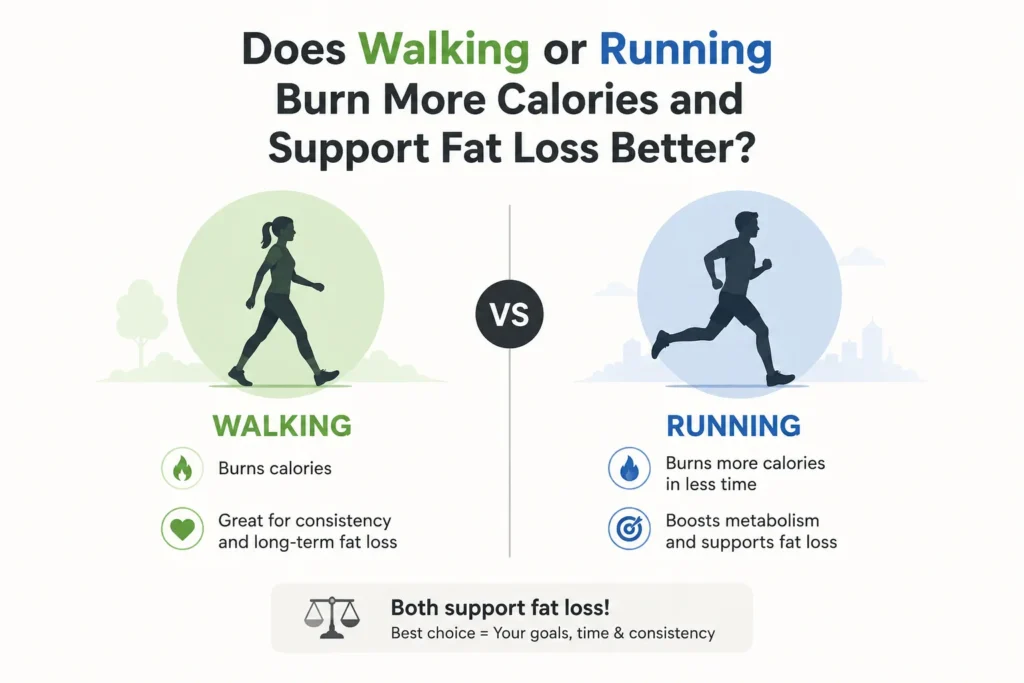
Does walking or running burn more calories and support fat loss better?
Running normally burns more energy per unit of time than ordinary walking because the exercise intensity is higher. However, calorie expenditure should not be treated as the sole measure of fat-loss effectiveness. Body composition changes primarily depend on long-term energy balance, nutrition, resistance training, sleep, recovery, and adherence. A theoretically superior exercise that someone cannot perform consistently may be less useful than a moderate activity that becomes a sustainable daily habit.
Does running burn more calories than walking?
In most comparable situations, running burns more calories per minute. The Compendium of Physical Activities demonstrates the difference: brisk walking at 3.5–3.9 mph is approximately 4.8 METs, whereas running around 6–6.3 mph is approximately 9.3 METs.
The actual number of calories burned varies with body mass, pace, terrain, incline, duration, running economy, and individual physiology. Consequently, online calorie calculators should be considered estimates rather than precise measurements.
Running is particularly useful when a person wants to obtain a substantial cardiovascular workload within a limited amount of time. Nevertheless, calorie expenditure during exercise represents only one part of the overall energy equation.
Can walking be better for fat loss despite burning fewer calories?
It can be, especially when adherence and recovery are considered. Walking creates relatively low fatigue compared with hard running, which allows many people to perform it frequently without significantly interfering with strength workouts or daily responsibilities.
For someone following a bodybuilding or resistance-training program, this distinction can be important. Excessive high-intensity cardio may compete with recovery capacity, whereas moderate walking can increase daily energy expenditure while placing less stress on the musculoskeletal system.
Walking can also be easier to integrate into everyday life: commuting on foot, taking longer routes, walking during breaks, or completing an evening walk can increase total daily movement without requiring every session to feel like a formal workout.
“Any amount of physical activity is better than none.”
WHO Guidelines on Physical Activity and Sedentary Behaviour
Is walking or running better for maintaining a calorie deficit?
The better option is the one that helps create a sustainable energy deficit without undermining nutrition, training quality, recovery, or adherence.
For example, a person may prefer running because it is time-efficient, while another may prefer walking because it produces less fatigue and can be performed almost every day. Both can contribute to weight management.
A practical approach is to use walking as a high-frequency movement strategy and running strategically when appropriate. This allows people to increase energy expenditure while controlling training stress rather than attempting to maximize calorie burn during every session.

Which is safer for joints, muscles, and injury prevention?
The difference in mechanical loading is one of the most important considerations when comparing walking and running. Running involves repeated impact and higher forces, while walking generally places less mechanical stress on the lower limbs. This does not mean running is inherently harmful or walking is completely risk-free. Injury risk depends on training volume, progression rate, biomechanics, footwear, surfaces, previous injuries, strength, recovery, and individual tolerance.
Does walking place less stress on the joints than running?
Generally, yes. Walking is a lower-impact movement pattern and usually creates less repetitive mechanical loading than running. This makes it an attractive option for beginners, older adults, people returning after periods of inactivity, and individuals whose bodies do not currently tolerate high-impact exercise well.
However, walking can still become demanding when duration, incline, speed, or total weekly volume increases significantly. A long uphill walk can create considerable muscular fatigue, particularly in the calves, quadriceps, glutes, and feet.
The correct principle is therefore not that walking is “safe” and running is “unsafe,” but that training stress should match current capacity and increase progressively.
Can runners reduce their injury risk through progressive training?
Yes. Gradual progression is one of the most important principles in running. Increasing distance, speed, hills, and frequency simultaneously can create a rapid rise in training load.
A sensible progression usually changes one major variable at a time. A beginner might start with walking and short jogging intervals before gradually extending the running portions. This approach gives connective tissues, muscles, and the cardiovascular system time to adapt.
Strength training can also complement running by developing muscular capacity and movement control. Adequate sleep, nutrition, rest days, appropriate footwear, and attention to persistent pain are additional components of sensible training management.
Is walking a better recovery activity for athletes and bodybuilders?
Often, yes. Low- to moderate-intensity walking can increase daily movement without creating the same training demand as hard running. This makes it useful on recovery days or after demanding resistance sessions.
For bodybuilders and strength athletes, walking can also support general cardiovascular conditioning without necessarily taking as much recovery capacity away from lifting. The exact response varies by individual, but the lower intensity makes walking easier to place around heavy training.
A recovery walk should feel genuinely easy enough to support the broader training program. If the walk becomes a demanding hill session every day, it is no longer functioning as a low-stress recovery activity.

Should athletes choose walking or running based on their specific fitness goal?
The best choice depends heavily on the desired adaptation. There is no universally superior cardio exercise because different goals require different combinations of intensity, volume, specificity, and recovery. A marathon runner needs running-specific conditioning; a beginner seeking basic health may benefit enormously from walking; a bodybuilder may prioritize low-fatigue cardio; and someone preparing for a high-intensity sport may need a mixture of aerobic and anaerobic work.
Which is better for beginners who want to get fit?
Walking is usually the more accessible starting point. It allows beginners to establish exercise consistency before introducing higher-impact work.
A practical progression could involve regular brisk walks, gradually increasing duration or pace, followed by walk-jog intervals if the individual feels ready. The goal is not to prove fitness during the first week but to build the capacity to train repeatedly.
WHO specifically recommends that inactive people start with manageable amounts and gradually increase duration, frequency, and intensity.
This principle is particularly important because consistency over months is more meaningful than an extremely demanding workout performed once or twice.
“Some physical activity is better than none, and more is better.”
WHO Physical Activity Guidance
Which is better for bodybuilders and strength athletes?
For many strength-focused athletes, walking is a highly practical form of supplementary cardiovascular activity. It can increase overall activity while generally producing less fatigue than repeated hard running.
That does not mean bodybuilders should never run. Short running sessions can be useful when cardiovascular fitness, athleticism, or personal preference makes them desirable. However, if the primary objective is muscle growth or maximal strength, cardio should be programmed so that it does not unnecessarily compromise resistance-training performance or recovery.
Walking can therefore serve as a flexible baseline, with more intense cardio added according to individual goals.
Which is better for endurance athletes?
Running is usually the more specific choice for runners because physiological and mechanical adaptations are strongly influenced by the movement being trained. Someone preparing for a 5K, 10K, half marathon, or marathon needs progressive running exposure.
Walking can still have a role as recovery work, cross-training, or a low-intensity supplement. Run-walk strategies can also be useful for beginners and some long-distance athletes.
For endurance development, the question should therefore be less about “walking versus running” and more about how different intensities can be organized within a complete training week.
Which option is better when time is limited?
Running generally has the advantage when the goal is to obtain a higher-intensity aerobic stimulus in less time. Its higher MET values mean that more energy is typically expended per minute compared with ordinary walking.
However, time efficiency must be balanced against recovery. A short hard run can require more preparation and recovery than a brisk walk.
If someone has only 20 minutes available, running may provide a stronger cardiovascular stimulus. If someone can incorporate several 10–20-minute walks throughout the day, the cumulative activity may be substantial. The optimal strategy is therefore determined by both available time and the person’s ability to recover.
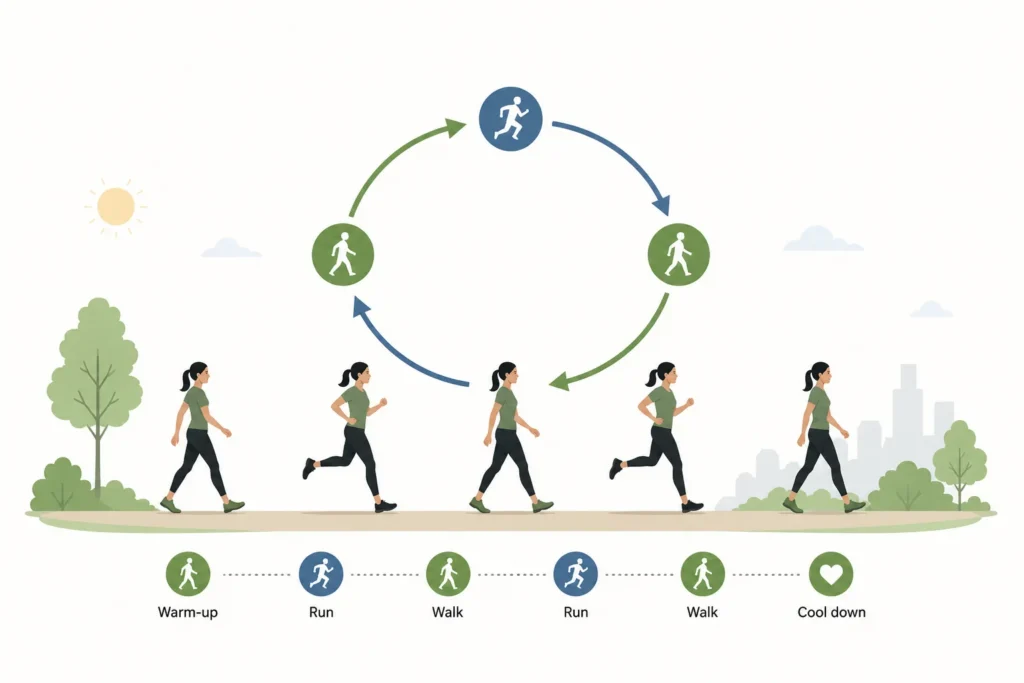
How can you combine walking and running for better overall fitness?
Combining both activities can provide a balanced approach by allowing higher-intensity running sessions alongside lower-intensity walking. This strategy is particularly useful for people who want cardiovascular benefits while managing fatigue and maintaining resistance training. Rather than treating walking and running as competing choices, they can be viewed as different tools within the same training system.
How to Combine Walking and Running Step-by-Step?
- Step 1: Start with brisk walking
Begin with 20–30 minutes of brisk walking, 3–5 days per week. Keep the pace challenging enough to raise your breathing rate while still allowing you to speak in short sentences.
- Step 2: Add short running intervals
After establishing a consistent walking routine, introduce 1–2 minutes of easy running followed by 2–3 minutes of walking. Repeat this cycle for approximately 20–30 minutes.
- Step 3: Increase running gradually
As your fitness improves, gradually extend the running intervals. For example, progress from 1–2 minutes of running to 3–5 minutes while maintaining comfortable walking intervals between them.
- Step 4: Keep most sessions manageable
Avoid making every workout intense. Use walking for lower-intensity activity and reserve faster running or longer sessions for selected workouts. This helps control fatigue and supports consistent training.
- Step 5: Schedule recovery
Allow sufficient recovery between demanding running sessions. If your legs remain unusually sore or your performance declines, reduce running volume or intensity temporarily.
- Step 6: Adjust the routine to your goal
For general fitness, prioritize consistency. For fat loss, combine regular activity with appropriate nutrition. For bodybuilding, use walking as a low-fatigue cardio option and keep running compatible with your resistance-training recovery. For endurance sports, progressively increase running-specific training.
- Step 7: Progress according to your response
Do not increase running frequency, distance, and intensity simultaneously. Progress one variable at a time and monitor fatigue, soreness, performance, and overall recovery.
A simple progression is therefore: walk consistently → introduce run-walk intervals → increase running gradually → manage intensity → prioritize recovery → adapt the plan to your goal.
Can a weekly plan include both walking and running?
Yes. A mixed program can be adjusted according to fitness level and objectives.
A beginner could prioritize several brisk walking sessions and introduce one or two short run-walk workouts. An intermediate exerciser could combine multiple walks with two or three running sessions. A well-conditioned athlete may use walking for low-intensity movement and running for specific endurance or conditioning workouts.
The key is to distribute stress intelligently. Hard sessions should not simply accumulate without recovery. The WHO recommendation of 150–300 minutes of moderate activity or 75–150 minutes of vigorous activity provides a useful general framework, but individual training plans should be adapted to goals and capacity.
Can walking replace running completely?
For general health and physical activity, walking can be sufficient for many people, especially when performed briskly and consistently. It can contribute meaningfully toward weekly aerobic activity targets.
However, walking cannot completely replicate the sport-specific adaptations of running. If someone wants to become a faster or more efficient runner, running itself needs to be included.
The distinction is therefore between general health and specific performance. For general health, walking may be enough. For running performance, walking is complementary rather than a full substitute.
What is a practical weekly combination for fitness and fat loss?
A general example for a healthy adult could be:
| Goal | Practical approach | Main advantage |
|---|---|---|
| General health | Frequent brisk walking + strength training | Sustainable activity |
| Fat management | Regular walking + 1–3 running sessions | Higher energy expenditure with manageable fatigue |
| Beginner fitness | Brisk walking + gradual run-walk intervals | Progressive adaptation |
| Bodybuilding | Frequent walking + limited moderate/hard cardio | Supports activity with lower fatigue |
| Endurance | Structured running + easy walking | Performance-specific conditioning |
| Limited time | Short running sessions + daily walking | Efficient cardiovascular stimulus |
The exact volume should be adjusted according to fitness level, training history, recovery, and medical considerations. The table is a framework rather than a prescription.
Summary: Is walking or running ultimately better for fitness?
There is no universal winner. Running is generally more time-efficient and produces a higher cardiovascular and energy expenditure stimulus per minute, while walking is typically easier to recover from, easier to perform frequently, and more accessible to a broader range of people.
For beginners, walking is often the most practical starting point. For experienced athletes, running can provide a stronger stimulus when performance and time efficiency are priorities. For bodybuilders and people whose main goal is muscle development, walking can be particularly useful as supplementary cardiovascular activity because it can increase daily movement without necessarily adding as much fatigue as hard running.
The most effective choice is ultimately the activity that matches the individual’s goal, fitness level, physical tolerance, schedule, and ability to remain consistent. As the WHO summarizes, “Any amount of physical activity is better than none.”
For evidence-based fitness guidance and practical training insights, follow 5dfitness and turn your preferred form of cardio into a sustainable part of your training strategy.
FAQ
Not automatically. Running generally burns more calories per minute, but walking may be easier to perform frequently and recover from. Long-term consistency and overall energy balance matter more than choosing the activity with the highest calorie burn per session.
Yes. Brisk walking can reach moderate-intensity exercise levels and can improve cardiovascular fitness, particularly in less-trained individuals. Increasing speed, duration, incline, or frequency can make walking progressively more challenging.
WHO recommends at least 150–300 minutes of moderate-intensity aerobic activity or 75–150 minutes of vigorous-intensity activity per week, or an equivalent combination.
Running is not inherently bad for the knees. Injury risk depends on multiple factors, including training load, progression, biomechanics, previous injury, strength, recovery, and individual tolerance. Gradual progression is more appropriate than assuming that running itself is harmful.
Yes. Daily walking can contribute to increased energy expenditure and can support a calorie deficit when combined with appropriate nutrition. It can be especially useful because many people can maintain frequent walking without excessive fatigue.
It depends on your goal and recovery. Easy walking is often easier to integrate after lifting. Hard running may be more demanding and could interfere with recovery if performed too frequently or too close to demanding lower-body sessions.
Neither should be considered a primary muscle-building exercise. Resistance training and adequate nutrition are more important for hypertrophy. Running can develop some muscular endurance, while walking can provide general activity with relatively low recovery demands.